
What Is the Bulking Calorie Calculator?
Bulking is the phase of training where you intentionally eat more calories than you burn to support muscle growth. This calculator estimates how many calories you should eat each day to build muscle, and breaks those calories down into protein, carbohydrate and fat targets. It works for any region — it is based on universal nutrition and energy-balance science, not a country-specific diet plan.
How to Use It
Enter your gender, weight (kg), height (cm) and age. Pick your activity level — be honest, as overestimating is the most common mistake. Then choose your surplus: a lean bulk (+250) minimises fat gain, a moderate bulk (+350) is a balanced default, and an aggressive bulk (+500) maximises weight gain. The calculator returns your daily calorie goal plus a macro split.
The Formula Explained
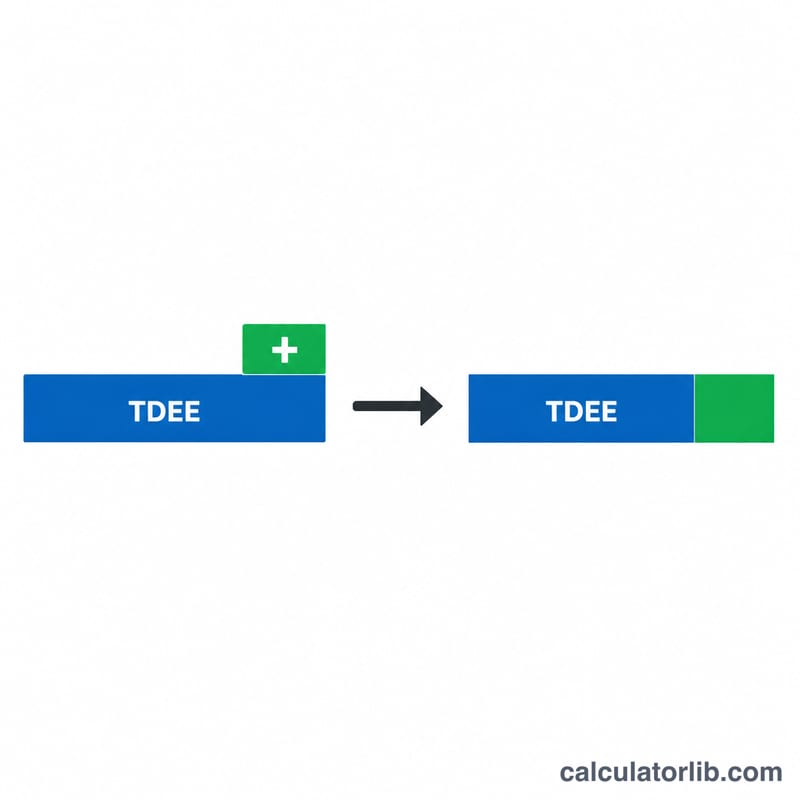
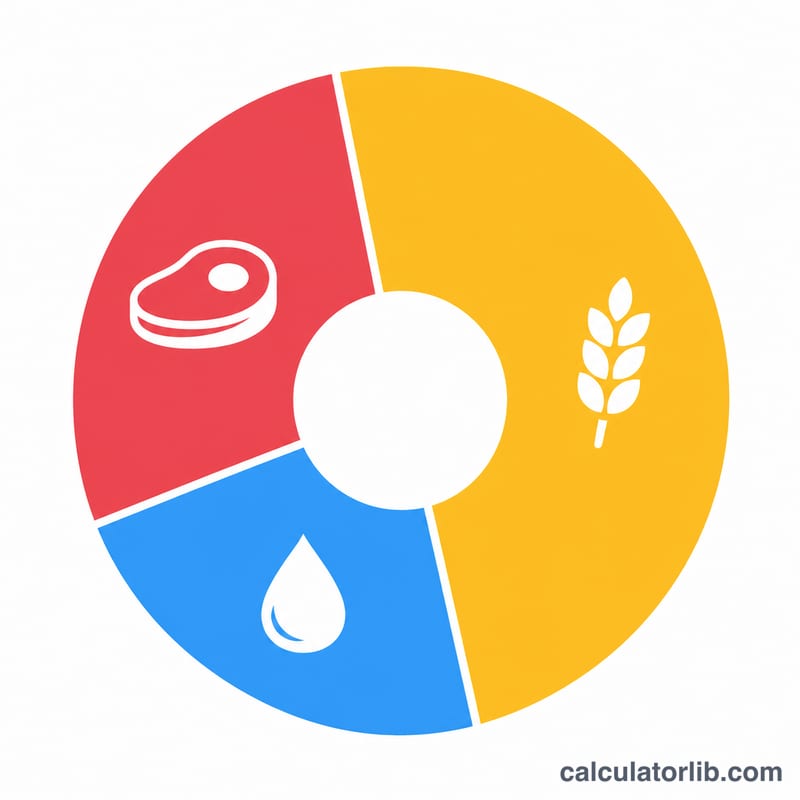
First we estimate your BMR (Basal Metabolic Rate) with the Mifflin-St Jeor equation: for men, BMR = 10×weight + 6.25×height − 5×age + 5; for women the last term is −161. Multiplying BMR by an activity factor gives your TDEE (maintenance calories). Adding your chosen surplus gives bulking calories. Macros default to 30% protein, 45% carbs and 25% fat, converted to grams using 4 kcal/g for protein and carbs and 9 kcal/g for fat.
Worked Example
A 25-year-old man, 75 kg, 178 cm, moderately active (×1.55), moderate bulk (+350): BMR = 10×75 + 6.25×178 − 5×25 + 5 = 750 + 1112.5 − 125 + 5 = 1742.5 kcal. TDEE = 1742.5 × 1.55 ≈ 2701 kcal. Calories = 2701 + 350 ≈ 3051 kcal. Protein = 0.30×3051/4 ≈ 229 g, carbs ≈ 343 g, fat ≈ 85 g.
Interpreting Your Bulking Targets
A bulking target is simply your maintenance TDEE plus a deliberate calorie surplus. The surplus supplies the extra energy and substrate your body needs to build new muscle tissue, but it cannot all be partitioned into muscle — some inevitably becomes body fat. The size of the surplus controls how the gained weight is split between lean mass and fat.
Because roughly 7,700 kcal of stored energy corresponds to about 1 kg of body weight, a sustained daily surplus translates into a predictable rate of weight gain:
- 250 kcal/day → about 0.23 kg per week (a lean, slow gain favouring muscle over fat).
- 350 kcal/day → about 0.32 kg per week (a moderate middle-ground bulk).
- 500 kcal/day → about 0.45 kg per week (a faster bulk with more fat accrual).
Trained lifters can only synthesise a limited amount of new muscle per week, so larger surpluses do not produce proportionally more muscle — the extra energy is stored as fat. Smaller surpluses keep fat gain low at the cost of slower progress. Beginners and those returning to training tend to partition a higher fraction of the surplus into muscle than advanced lifters.
The macro grams matter as much as the total. Protein at 1.6–2.2 g per kg of body weight supplies the amino acids that drive muscle protein synthesis and maximises the muscle-building response to resistance training; intakes above this range provide little additional benefit for muscle gain. Carbohydrates refill muscle glycogen and fuel hard training sessions, while dietary fat supports hormone production and absorption of fat-soluble vitamins. A common starting split for bulking is roughly 25–30% protein, 45–55% carbohydrate, and 20–30% fat of total calories.
This is general educational information, not personalised nutrition or medical advice. Individual responses vary with genetics, training history, sleep, and health status.
Key Terms Explained
- BMR (Basal Metabolic Rate)
- The number of calories your body burns at complete rest to keep vital functions running — breathing, circulation, cell maintenance. It is the largest single component of daily energy use.
- TDEE (Total Daily Energy Expenditure)
- Your full daily calorie burn: BMR multiplied by an activity factor that accounts for movement, exercise, and the energy cost of digesting food. TDEE is your maintenance calorie level.
- Calorie surplus
- Eating more calories than your TDEE. The surplus provides the extra energy required to build new tissue; in bulking it is typically set at 250–500 kcal per day.
- Lean / moderate / aggressive bulk
- Descriptions of surplus size. A lean bulk uses a small surplus (~250 kcal) to minimise fat gain; a moderate bulk (~350 kcal) balances speed and leanness; an aggressive bulk (~500 kcal or more) prioritises faster weight gain and accepts more fat.
- Macronutrient
- One of the three energy-providing nutrients: protein (4 kcal/g), carbohydrate (4 kcal/g), and fat (9 kcal/g). The balance of these “macros” shapes body composition outcomes alongside total calories.
- Mifflin-St Jeor equation
- A widely used, validated formula for estimating BMR: \(10 \times \text{weight(kg)} + 6.25 \times \text{height(cm)} - 5 \times \text{age} + 5\) for males (use −161 instead of +5 for females). This calculator uses it as the basis for your TDEE.
FAQ
How fast should I gain weight? Aim for roughly 0.25–0.5% of body weight per week. Faster gains usually mean more fat.
Why so much protein? Protein drives muscle repair and growth; 1.6–2.2 g per kg of body weight is a common evidence-based range.
Should I recalculate as I gain weight? Yes — recalculate every 4–6 weeks since a heavier body needs more calories.