
What This Calculator Does
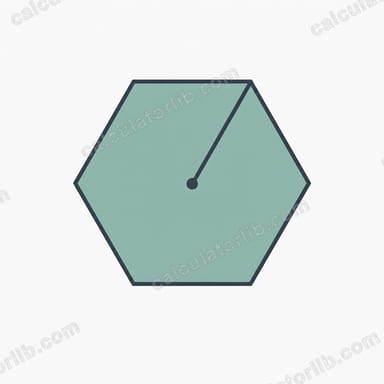
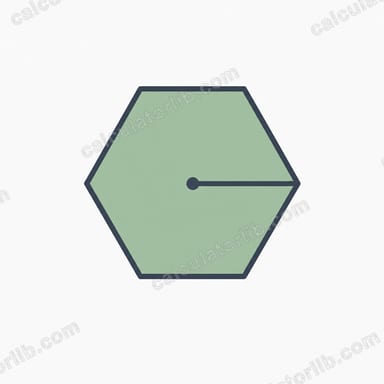
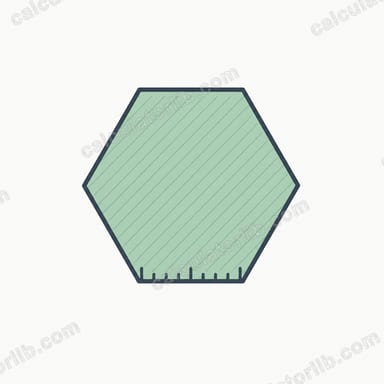
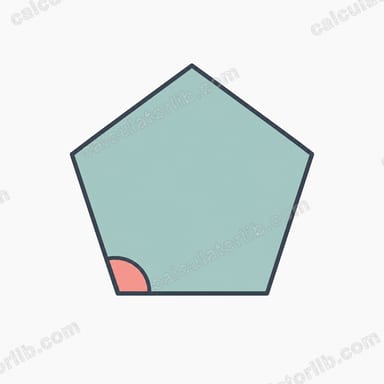
A regular polygon is a closed shape with all sides equal in length and all angles equal in measure. This calculator finds the measure of each interior angle of a regular polygon when you know the number of sides (n). It also reports each exterior angle and the total sum of the interior angles. This is a universal geometry tool that works for any polygon with three or more sides.
How to Use It
Enter the number of sides of your polygon — for example 3 for a triangle, 4 for a square, 5 for a pentagon, or 8 for an octagon. The number must be a whole number of at least 3. The calculator instantly returns the interior angle, the exterior angle, and the sum of all interior angles.
The Formula Explained
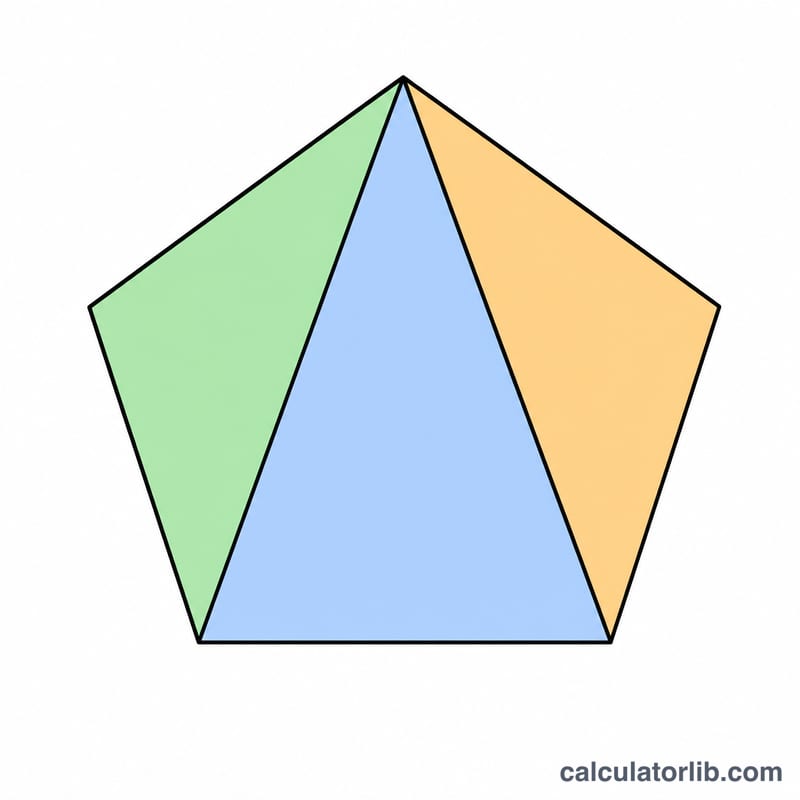
The sum of the interior angles of any polygon with n sides is \((n - 2) \times 180^{\circ}\), because the polygon can be split into (n − 2) triangles, each contributing 180°. Since a regular polygon has equal angles, each interior angle is that sum divided by n:
$$\text{Interior Angle} = \frac{\left(\text{Sides (n)} - 2\right) \times 180^{\circ}}{\text{Sides (n)}}$$
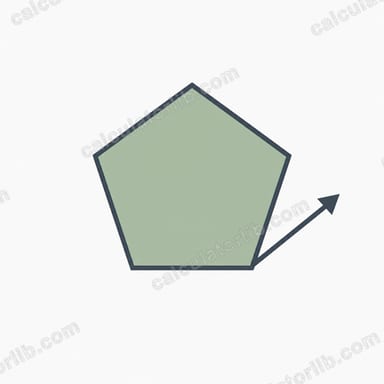
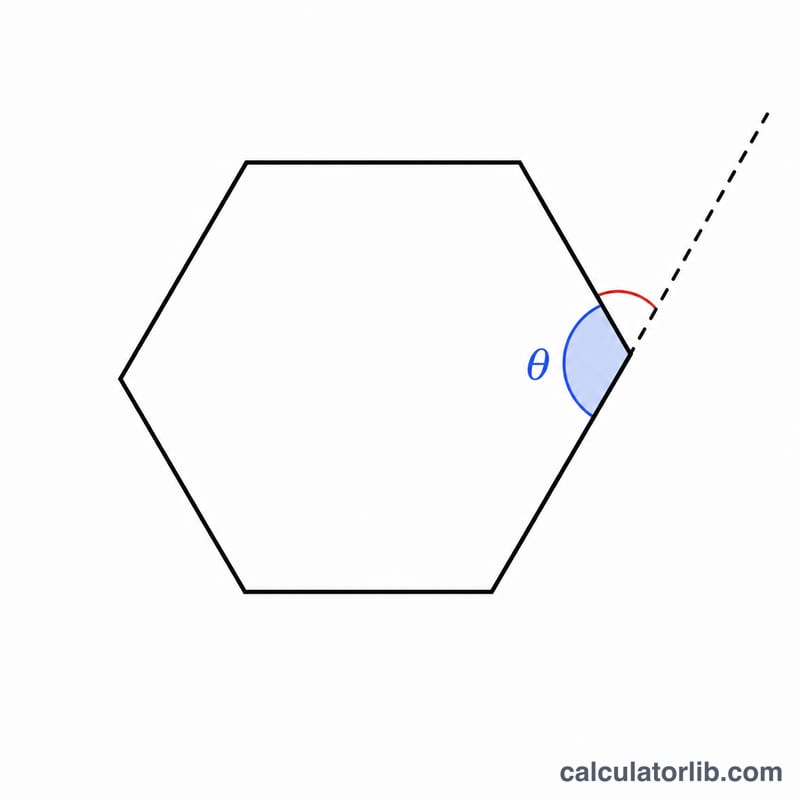
The exterior angle is simpler: the exterior angles of any convex polygon always add up to 360°, so each one is \(360 / n\). Note that the interior and exterior angle at any vertex add up to 180°.
Worked Example
Consider a regular hexagon, where \(n = 6\). The sum of interior angles is \((6 - 2) \times 180 = 720^{\circ}\). Each interior angle is $$720 / 6 = 120^{\circ}.$$ Each exterior angle is \(360 / 6 = 60^{\circ}\), and indeed \(120^{\circ} + 60^{\circ} = 180^{\circ}\).
FAQ
Why must n be at least 3? A polygon needs at least three sides to enclose an area; with two or fewer sides there is no closed shape.
Does this work for irregular polygons? The sum of interior angles formula \((n - 2) \times 180\) applies to any simple polygon, but the "each angle" result is only correct for regular (equal-angle) polygons.
What is the interior angle of a square? With \(n = 4\), it is $$\frac{(4 - 2) \times 180}{4} = \frac{360}{4} = 90^{\circ}.$$