
What Is the Exterior Angle of a Polygon?
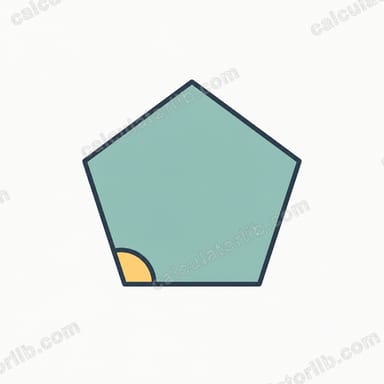
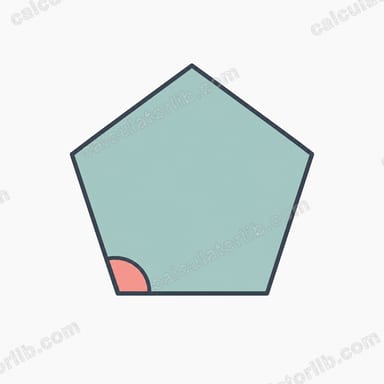
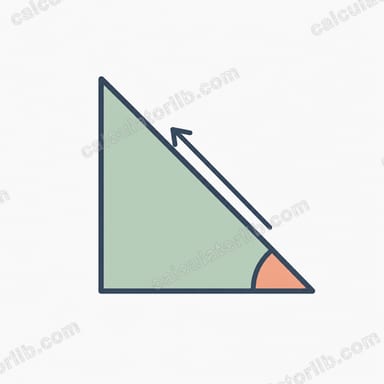
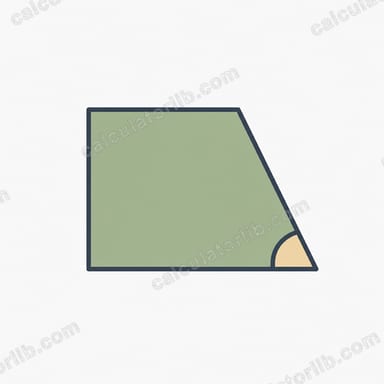
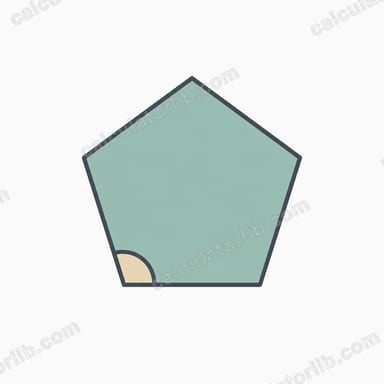
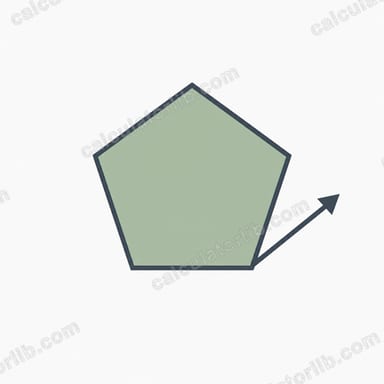
The exterior angle of a polygon is the angle formed between one side of the polygon and the extension of an adjacent side. For any convex polygon, the exterior angles always add up to a full turn of 360°. In a regular polygon (all sides and angles equal), each exterior angle is simply 360° divided by the number of sides, making it a quick calculation once you know n.

How to Use This Calculator
Enter the number of sides n (must be 3 or more) and the calculator instantly returns each exterior angle, each interior angle, the sum of all interior angles, and the constant sum of exterior angles. This works for triangles, squares, pentagons, hexagons, and any larger regular polygon.
The Formulas Explained
Each exterior angle equals \(\frac{360^{\circ}}{n}\), because the exterior angles of any convex polygon always sum to 360°. The matching interior angle is the supplement of the exterior angle, given by \(\frac{(n-2)\times 180^{\circ}}{n}\). The total sum of interior angles is \((n-2)\times 180^{\circ}\), since any n-sided polygon can be split into (n − 2) triangles.
$$\text{Exterior Angle} = \frac{360^{\circ}}{\text{Number of Sides}}$$
Worked Example
For a regular hexagon (n = 6): each exterior angle =
$$\frac{360}{6} = 60^{\circ}$$Each interior angle =
$$\frac{(6-2)\times 180}{6} = \frac{720}{6} = 120^{\circ}$$The interior angles sum to
$$(6-2)\times 180 = 720^{\circ}$$while the exterior angles always sum to 360°.
FAQ
Do the exterior angles always add to 360°? Yes — for any convex polygon, regardless of the number of sides, the exterior angles sum to exactly 360°.
Does this work for irregular polygons? The per-angle results assume a regular polygon. The sum of interior angles \((n-2)\times 180^{\circ}\) holds for any simple convex polygon, regular or not.
What is the smallest polygon? A triangle with n = 3, giving an exterior angle of 120° and an interior angle of 60° when regular (equilateral).