
What is a Course Handicap?
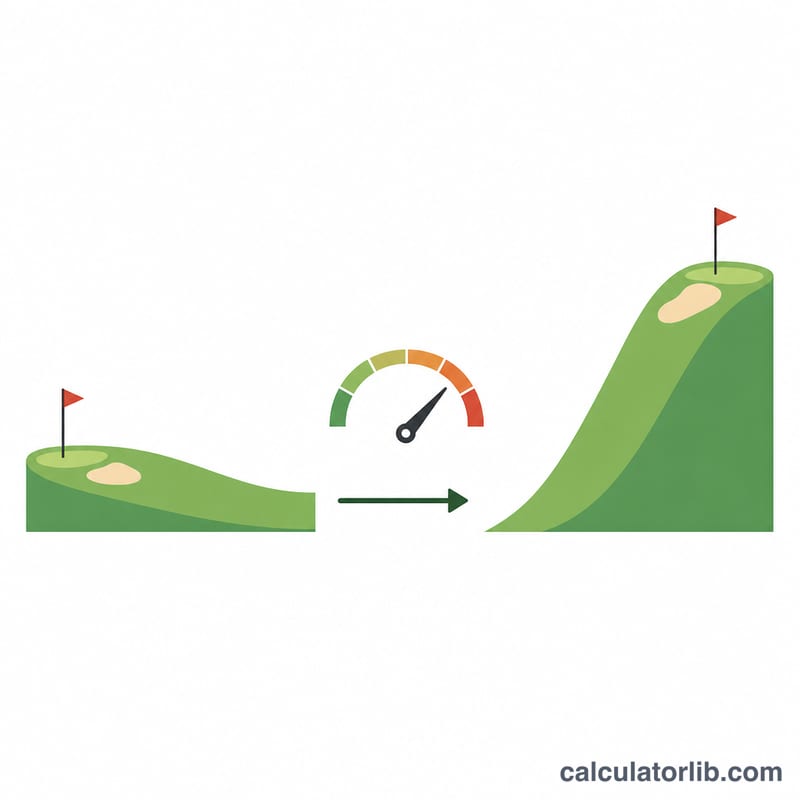
Your Handicap Index is a portable measure of your potential ability, but it must be converted to a Course Handicap before you tee off — because every set of tees plays differently. The Course Handicap tells you how many strokes you receive (or give) on a particular course and tee set, allowing fair competition between players of all skill levels.
How to use this calculator
Enter four values from your scorecard or your golf association app: your Handicap Index, the Slope Rating of the tees you are playing (between 55 and 155, where 113 is the standard difficulty), the Course Rating, and the Par for those tees. The calculator returns your exact Course Handicap and the value rounded to the nearest whole stroke, which is what you actually use during play.
The formula explained
The current World Handicap System uses:
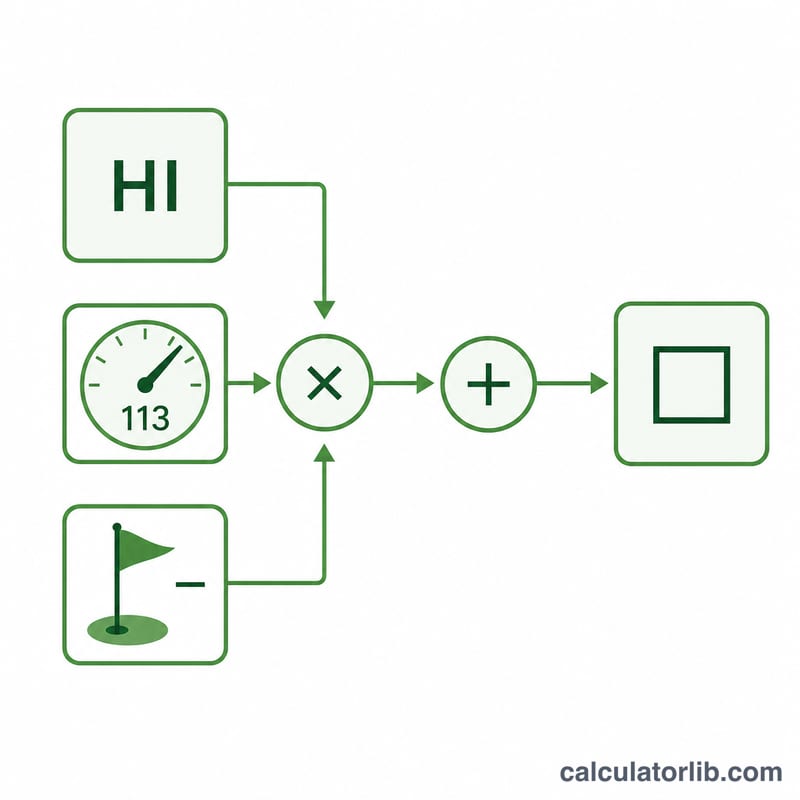
$$\text{Course Handicap} = \text{Handicap Index} \times \frac{\text{Slope Rating}}{113} + \left(\text{Course Rating} - \text{Par}\right)$$
The slope ratio scales your index to the relative difficulty for a bogey golfer, while the (Course Rating − Par) term accounts for how hard the course plays for a scratch golfer compared to par. The result is rounded to the nearest whole number.
Worked example
Suppose your Handicap Index is 10.4, the Slope Rating is 125, the Course Rating is 71.2 and Par is 72. Then: $$10.4 \times \left(125 \div 113\right) = 11.504$$ plus \((71.2 - 72) = -0.8\), giving \(10.704\), which rounds to a Course Handicap of 11.
FAQ
Why divide by 113? 113 is the slope rating of a course of standard playing difficulty, so the ratio neutralises tee difficulty.
Should I round up or down? The result is rounded to the nearest whole number (0.5 rounds up).
Is this the same worldwide? This is the standard World Handicap System formula adopted in most countries, including the US, UK and Australia.