
What this calculator does
This tool adds or subtracts two fractions and returns the answer as a fully simplified fraction, the raw (unsimplified) fraction, and an equivalent decimal. It works with any whole-number numerators and denominators, including negative values, so you can quickly check homework, recipes, measurements, or any calculation involving fractions.
How to use it
Enter the first fraction's numerator and denominator, choose whether to add or subtract, then enter the second fraction's numerator and denominator. Press calculate to see the result. The simplified fraction is shown in the large box, while the table reveals the step before simplification and the decimal equivalent.
The formula explained
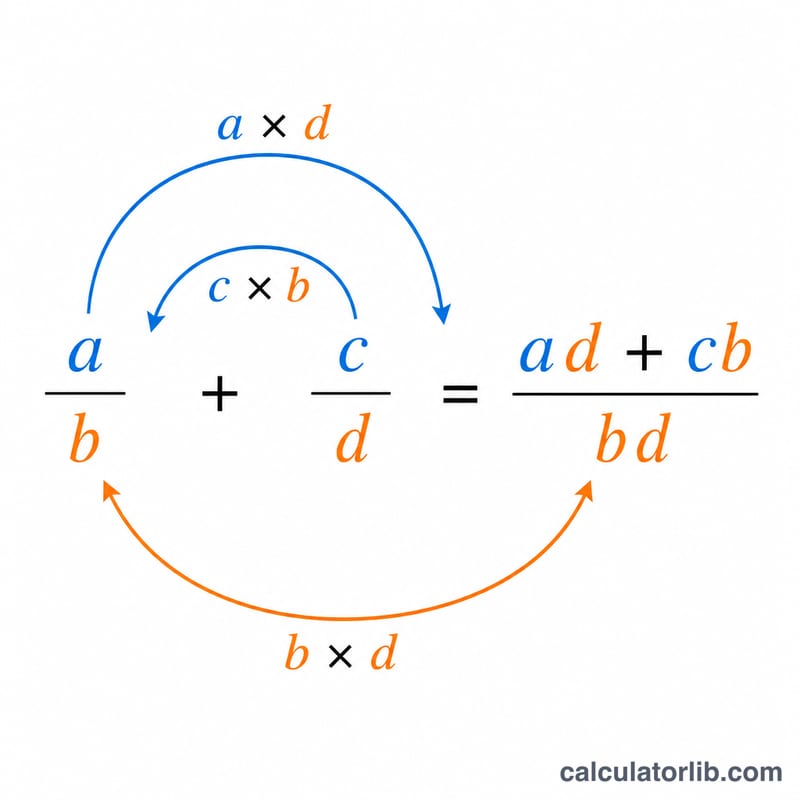
To combine two fractions you need a common denominator. The simplest shared denominator is the product of the two denominators, \(b\cdot d\). Each numerator is scaled by the opposite denominator: a becomes \(a\cdot d\) and c becomes \(c\cdot b\). You then add or subtract those scaled numerators over the common denominator:
$$\frac{a}{b} \pm \frac{c}{d} = \frac{a\cdot d \pm c\cdot b}{b\cdot d}$$
Finally, the result is reduced by dividing both the numerator and denominator by their greatest common divisor (GCD), giving the answer in lowest terms.
Worked example
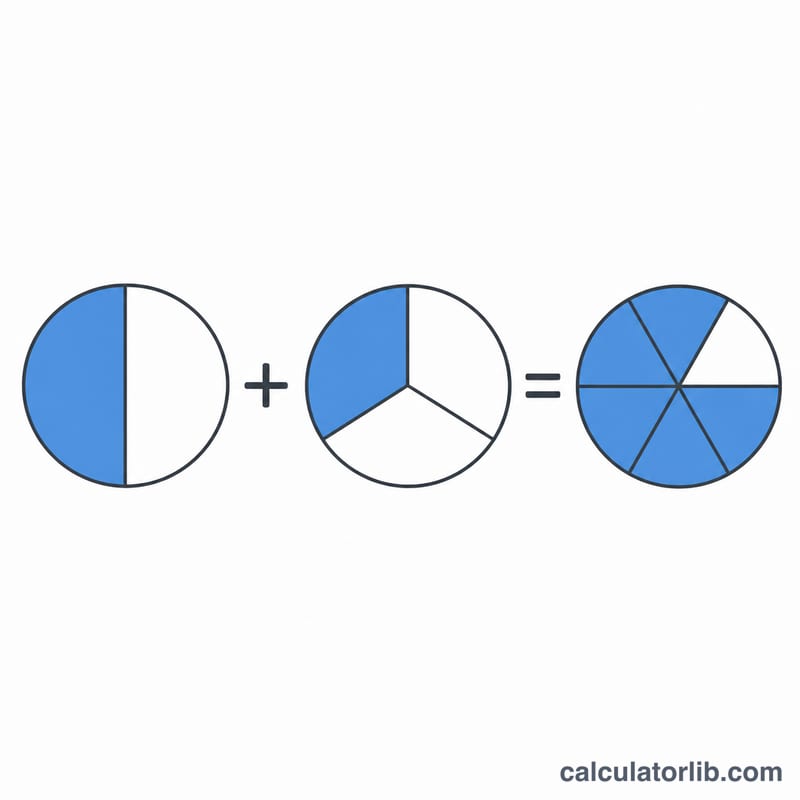
Compute 1/2 + 1/3. Using the formula: numerator = \(1\cdot 3 + 1\cdot 2 = 5\), denominator = \(2\cdot 3 = 6\). So the unsimplified result is \(\frac{5}{6}\). The GCD of 5 and 6 is 1, so it is already in lowest terms: $$\frac{5}{6} \approx 0.8333$$.
Key Terms
- Numerator
- The top number of a fraction; it counts how many equal parts you have. In \(\frac{3}{4}\) the numerator is 3.
- Denominator
- The bottom number of a fraction; it states how many equal parts make one whole. In \(\frac{3}{4}\) the denominator is 4 and cannot be zero.
- Common denominator
- A shared denominator used so two fractions can be added or subtracted. Any common multiple of the denominators works; the smallest one is the least common denominator (LCD).
- Greatest common divisor (GCD)
- The largest whole number that divides both the numerator and denominator with no remainder. Dividing both by their GCD reduces a fraction. Also called the greatest common factor (GCF).
- Simplified / lowest terms
- A fraction whose numerator and denominator share no common factor other than 1 (their GCD is 1), such as \(\frac{11}{15}\).
- Improper fraction
- A fraction whose numerator is greater than or equal to its denominator, for example \(\frac{7}{4}\). It has an absolute value of 1 or more and can be rewritten as the mixed number \(1\tfrac{3}{4}\).
Common Fraction Equivalents
Decimal equivalents for everyday fractions. A bar (e.g. \(0.\overline{3}\)) marks a repeating decimal; other values are rounded to three places.
| Fraction | Decimal |
|---|---|
| 1/8 | 0.125 |
| 1/6 | 0.1667 |
| 1/5 | 0.2 |
| 1/4 | 0.25 |
| 1/3 | 0.3333 |
| 3/8 | 0.375 |
| 2/5 | 0.4 |
| 1/2 | 0.5 |
| 3/5 | 0.6 |
| 5/8 | 0.625 |
| 2/3 | 0.6667 |
| 3/4 | 0.75 |
| 4/5 | 0.8 |
| 7/8 | 0.875 |
To confirm any equivalence, divide the numerator by the denominator — for instance \(3\div 4 = 0.75\).
FAQ
Can I subtract a larger fraction from a smaller one? Yes. If the result is negative, the calculator keeps the denominator positive and puts the minus sign on the numerator, e.g. \(\frac{1}{4} - \frac{1}{2} = -\frac{1}{4}\).
What if my answer is a whole number? The result is still shown as a fraction with denominator 1, for example \(\frac{2}{3} + \frac{1}{3} = \frac{1}{1} = 1\).
Does it always simplify? Yes, the result is automatically reduced using the GCD so you always get the fraction in lowest terms.