
What is the LC Resonant Frequency Calculator?
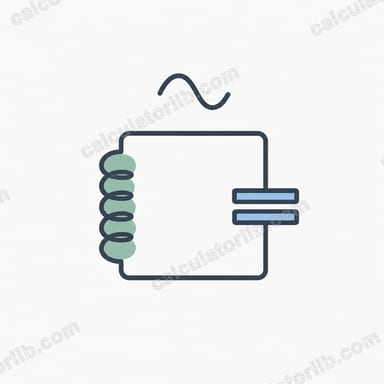
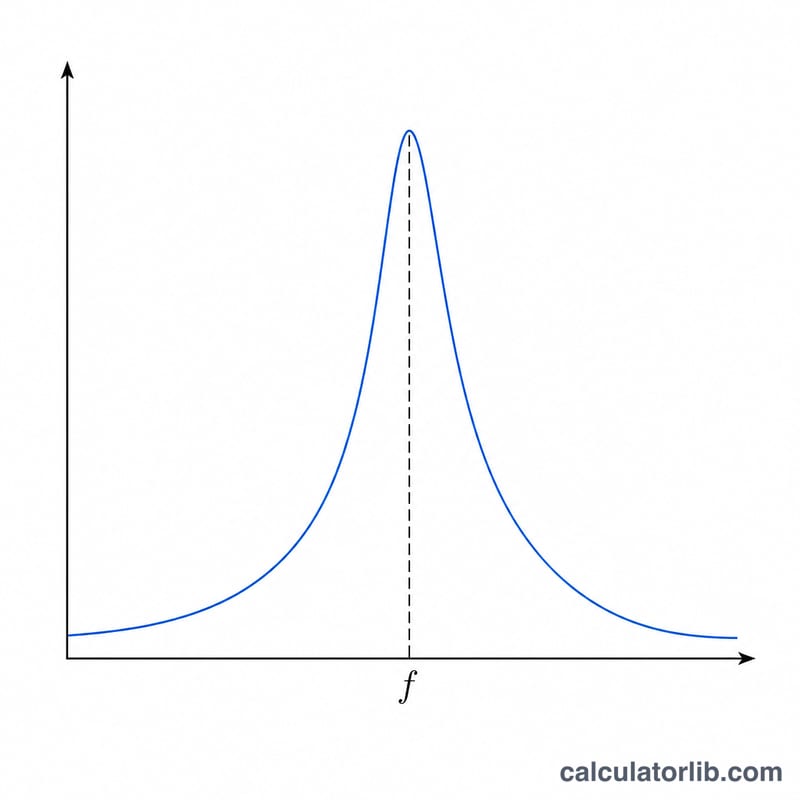
An LC circuit (also called a tank or resonant circuit) is built from an inductor (L) and a capacitor (C). Energy sloshes back and forth between the magnetic field of the inductor and the electric field of the capacitor, producing oscillation at a single natural frequency known as the resonant frequency. This calculator finds that frequency from the inductance and capacitance values you enter, and supports common engineering unit prefixes.
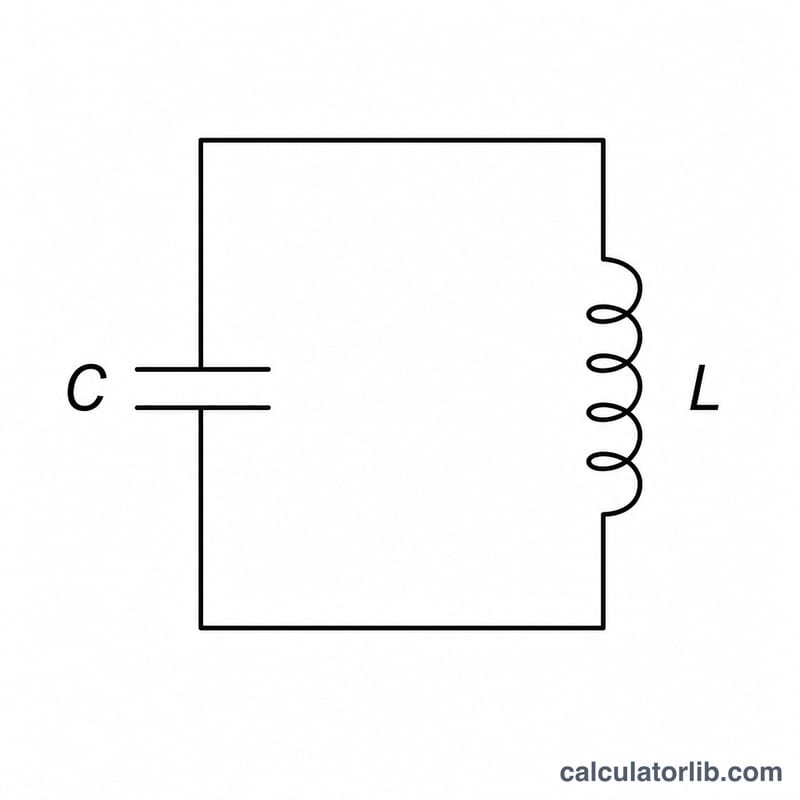
How to use it
Enter the inductance and pick its unit (H, mH, µH, or nH). Enter the capacitance and pick its unit (F, µF, nF, or pF). The calculator converts both to base SI units, computes the frequency, and shows it in Hz, kHz, MHz, plus the angular frequency \(\omega\) in rad/s.
The formula explained
The resonant frequency is given by:
$$ f = \frac{1}{2\pi\sqrt{L \cdot C}} $$Here L is in henries (H) and C is in farads (F). Larger L or C lowers the frequency; smaller values raise it. The angular frequency is \(\omega = 2\pi f = \frac{1}{\sqrt{L \cdot C}}\).
Worked example
Suppose \(L = 100\ \mu\text{H} = 0.0001\ \text{H}\) and \(C = 100\ \text{pF} = 1\times10^{-10}\ \text{F}\). Then \(LC = 1\times10^{-14}\), and \(\sqrt{LC} = 1\times10^{-7}\). So $$ f = \frac{1}{2\pi \times 1\times10^{-7}} \approx 1{,}591{,}549\ \text{Hz} \approx 1.59\ \text{MHz} $$ — a typical AM-radio-band frequency.
FAQ
Does series or parallel matter? The resonant frequency formula is identical for ideal series and parallel LC circuits; they differ in impedance behavior, not in the resonant frequency.
What units should I use? Any — just select the matching prefix. The tool converts everything to henries and farads internally.
Is resistance considered? No. Pure LC resonance ignores resistance. Real circuits with significant R have a slightly shifted damped frequency, but for high-Q circuits this formula is an excellent approximation.