
What is the Centrifuge RCF Calculator?
This tool converts a centrifuge's rotation speed (RPM, revolutions per minute) into Relative Centrifugal Force (RCF), also called g-force. RCF is the standardized way protocols specify spin conditions because it accounts for the rotor radius — two centrifuges set to the same RPM can apply very different forces if their rotors differ in size. Reporting RCF instead of RPM makes laboratory results reproducible across instruments.
How to use it
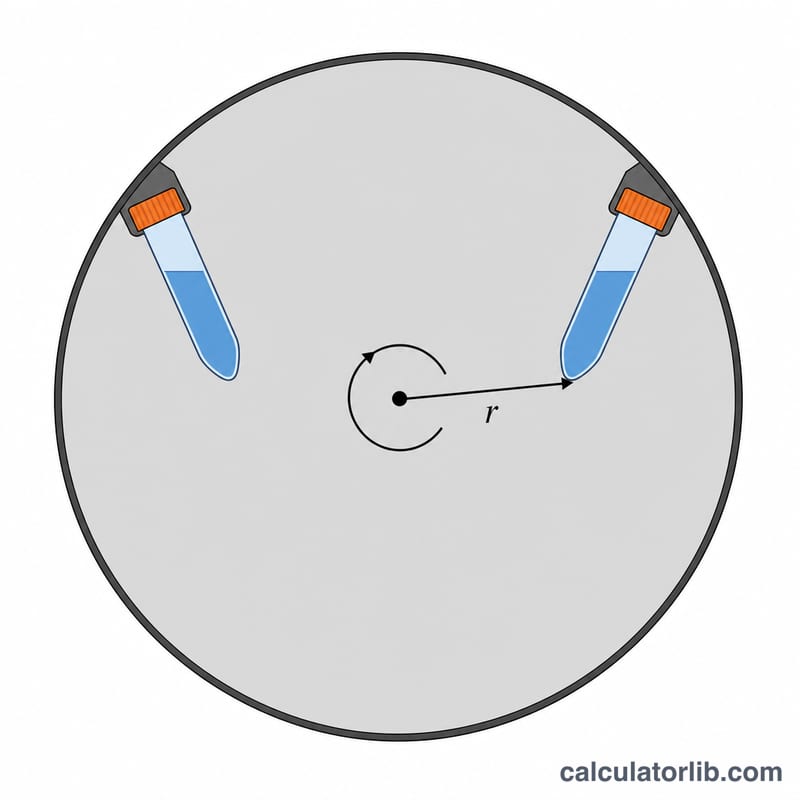
Enter the rotation speed in RPM and the rotor radius in millimetres (measured from the center of the rotor axis to the bottom of the tube or sample). The calculator converts the radius to centimetres internally and returns the RCF in multiples of Earth's gravity (× g).
The formula explained
The relationship is $$\text{RCF} = 1.118 \times 10^{-5} \times r \times \text{RPM}^{2}$$, where \(r\) is the rotational radius in centimetres. The constant \(1.118 \times 10^{-5}\) bundles together the conversion factors from angular velocity and gravitational acceleration. Because RPM is squared, doubling the speed quadruples the force, while RCF only scales linearly with radius.
Worked example
A microcentrifuge spinning at 10,000 RPM with a rotor radius of 80 mm (8 cm): $$\text{RCF} = 1.118 \times 10^{-5} \times 8 \times 10{,}000^{2} = 1.118 \times 10^{-5} \times 8 \times 100{,}000{,}000 = 8{,}944 \times g$$ So the sample experiences roughly 8,944 times the force of gravity.
FAQ
Should I measure radius from the center or the tube tip? Use the maximum radius — from the axis to the outermost point of the sample (tube bottom) — for the peak force experienced.
Why convert mm to cm? The classic constant \(1.118 \times 10^{-5}\) is defined for radius in centimetres, so this calculator divides your millimetre input by 10.
Can I go from RCF back to RPM? Yes — rearrange to \(\text{RPM} = \sqrt{\text{RCF} / (1.118 \times 10^{-5} \times r)}\).