
What Is the Circular Motion Calculator?
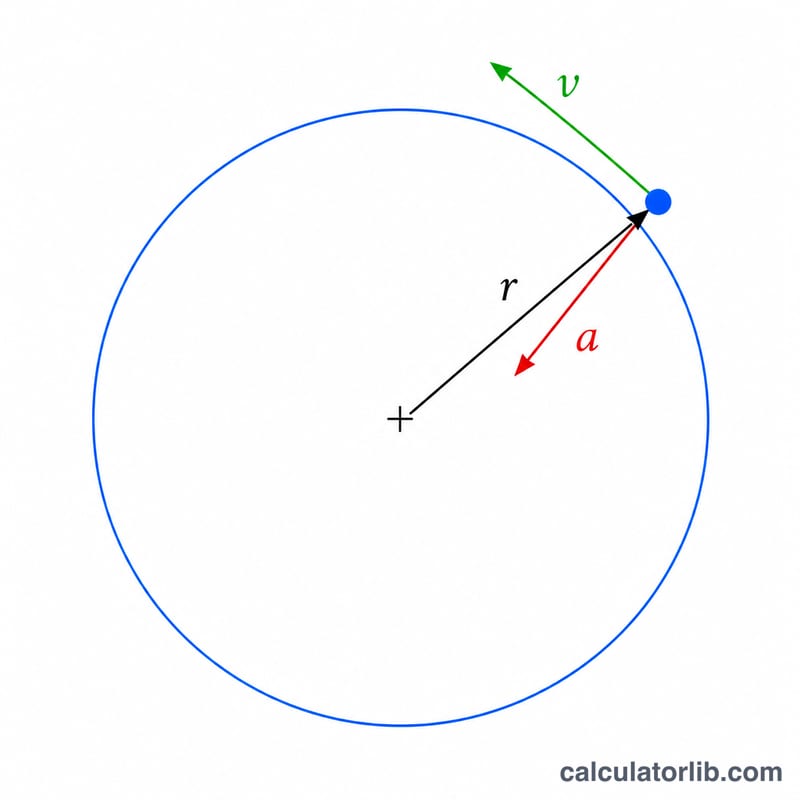
This calculator analyzes uniform circular motion — an object traveling at constant speed along a circular path. Given the radius of the path and the period (the time for one complete revolution), it computes the tangential speed, the centripetal acceleration, and the angular velocity. These quantities describe how fast the object moves, how strongly it is pulled toward the center, and how quickly it sweeps out angle.
How to Use It
Enter the radius r in meters and the period T in seconds. The calculator returns the tangential speed in m/s, the centripetal acceleration in m/s², and the angular velocity in rad/s. Use consistent SI units so the outputs are physically meaningful.
The Formulas Explained
The object covers a circumference of \(2\pi r\) in one period \(T\), so its speed is $$v = \frac{2\pi r}{T}$$ Because the velocity direction constantly changes, there is an acceleration pointed toward the center: $$a_c = \frac{v^2}{r}$$ The angular velocity is $$\omega = \frac{2\pi}{T}$$ and note that \(v = \omega r\) and \(a_c = \omega^2 r\) are equivalent forms.
Worked Example
Suppose a stone on a string moves in a circle of radius \(r = 2\ \text{m}\), completing one revolution every \(T = 4\ \text{s}\). The speed is $$v = \frac{2\pi(2)}{4} = \pi \approx 3.1416\ \text{m/s}$$ The centripetal acceleration is $$a_c = \frac{v^2}{r} = \frac{\pi^2}{2} \approx 4.9348\ \text{m/s}^2$$ The angular velocity is $$\omega = \frac{2\pi}{4} \approx 1.5708\ \text{rad/s}$$
FAQ
Is the speed constant in uniform circular motion? Yes — the magnitude of velocity is constant, but its direction changes continuously, which is why there is centripetal acceleration.
What provides centripetal acceleration? A net inward force such as tension, gravity, friction, or a normal force. The acceleration always points toward the center.
Can I use frequency instead of period? Yes — period \(T\) equals \(1/f\). Enter \(T = 1/f\) in seconds to use frequency in hertz.