
What is the Uniform Motion Speed Calculator?
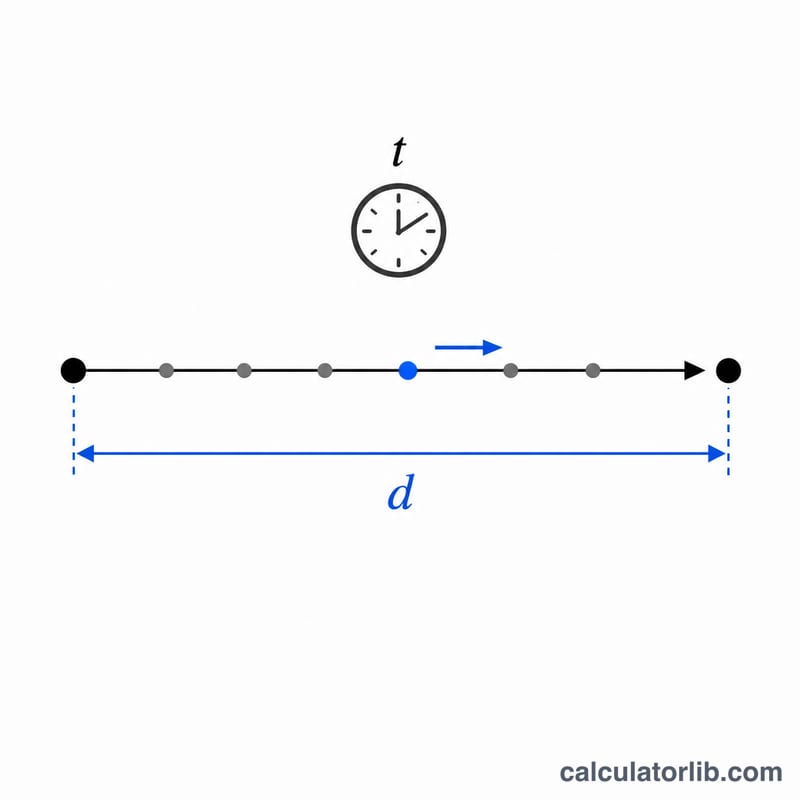
This tool computes the speed (velocity) of an object in uniform motion — motion at a constant velocity in a straight line. Given how far the object travels and how long the journey takes, it returns the speed in three equivalent units at once: meters per second (m/s), meters per minute (m/min), and kilometers per hour (km/h). It is pure kinematics and applies everywhere, with no region-specific rules.
How to use it
Enter the travel time split across three boxes — hours, minutes and seconds — and the three are summed into a single total time. Then type the distance and pick its unit, either kilometers (km) or meters (m). Press calculate and the speed appears in all three representations. The total time must be greater than zero, otherwise the speed is undefined (you cannot divide by zero time).
The formula explained
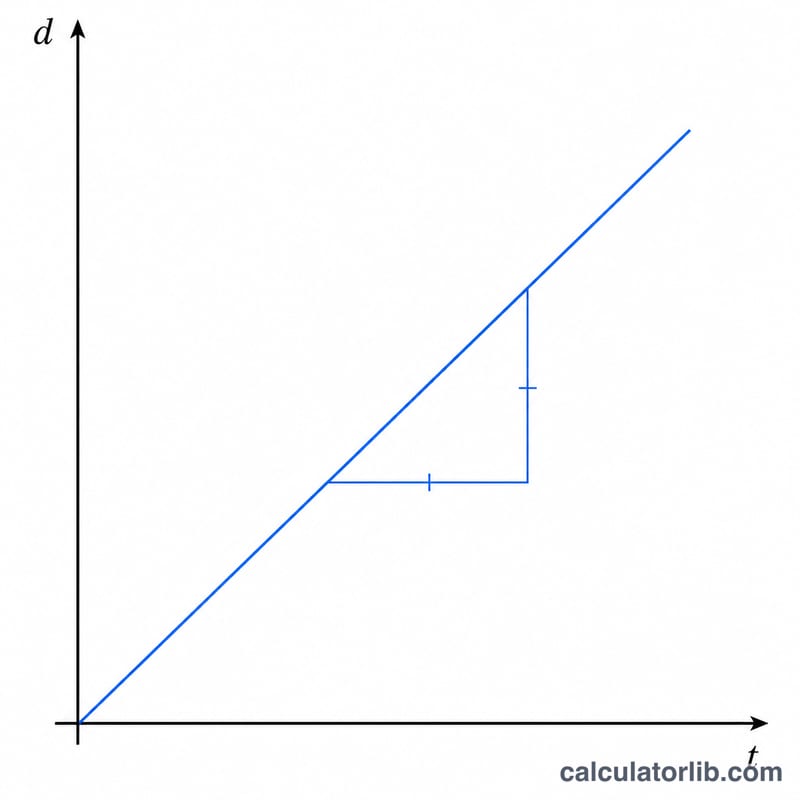
The core rule of uniform motion is speed = distance / time, written \(v = d / t\). To keep things consistent the calculator first normalizes everything to SI units: total time in seconds (\(t = \text{hours}\times 3600 + \text{minutes}\times 60 + \text{seconds}\)) and distance in meters (distance \(\times 1000\) for km, \(\times 1\) for m). The base speed is then $$v = \frac{d_m}{t_s}$$ in m/s. Multiplying by 60 gives m/min, and multiplying by 3.6 gives km/h.
Worked example
Suppose a car travels 100 km in exactly 1 hour. Total time = \(1\times 3600 = 3600\) s, distance = \(100\times 1000 = 100000\) m. Speed per second = \(100000 / 3600 = 27.7778\) m/s. Per minute = \(27.7778 \times 60 = 1666.67\) m/min. Per hour = \(27.7778 \times 3.6 = 100\) km/h. The 100 km/h result matches the intuitive "100 km in one hour" — a good sanity check.
FAQ
Why three different units? The same physical speed can be read in m/s (common in physics), m/min, or km/h (common for vehicles). Showing all three saves you manual conversions.
What if I only know seconds? Leave hours and minutes at 0 and enter the seconds — the boxes simply add up.
Does this work for acceleration? No. This calculator assumes constant velocity (uniform motion). If speed changes over time, it returns only the average speed, not instantaneous velocity.