
What this calculator does
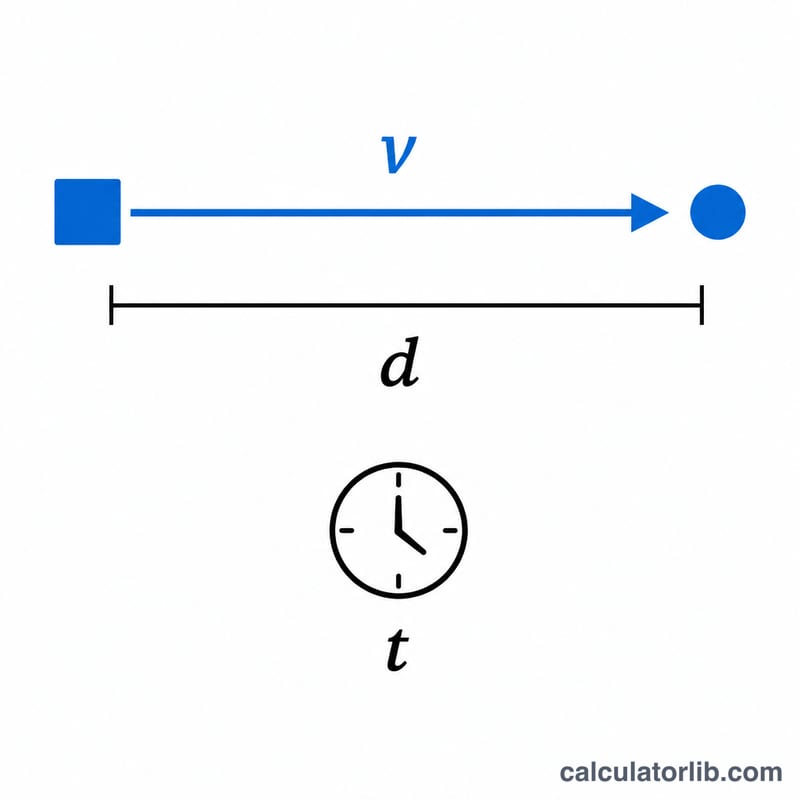
This tool computes how far an object travels when it moves at a constant (uniform) velocity. With no acceleration, distance is simply speed multiplied by elapsed time: \(d = v \times t\). It is a universal physics relationship and applies anywhere — there is no country-specific rule involved.
The default speed of 80 in m/min reflects a common convention in Japanese real-estate listings, where human walking speed is taken as 80 m/min; you can change both the value and the unit freely.
How to use it
Enter the speed and pick its unit (km/h, m/min, or m/s). Then enter the elapsed time split across hours, minutes, and seconds — the three fields are summed, so values like 90 minutes are fine. The result shows the distance in both meters and kilometers, plus the speed converted to SI units (m/s) and the total time in seconds.
The formula explained
The calculator first normalizes everything to SI base units. Speed is multiplied by a unit factor: km/h uses \(1000/3600 \approx 0.27778\), m/min uses \(1/60 \approx 0.01667\), and m/s uses \(1\). Time is converted to seconds with \(\text{hours} \times 3600 + \text{minutes} \times 60 + \text{seconds}\). The distance in meters is then \(\text{speed}_{SI} \times \text{time}_{seconds}\), and kilometers is that value divided by 1000.
$$d = (v \cdot k) \cdot t$$ $$\text{where}\quad \left\{ \begin{aligned} v &= \text{Speed} \\ k &= \text{Unit factor} \\ t &= 3600\,\text{Hours} + 60\,\text{Minutes} + \text{Seconds} \end{aligned} \right.$$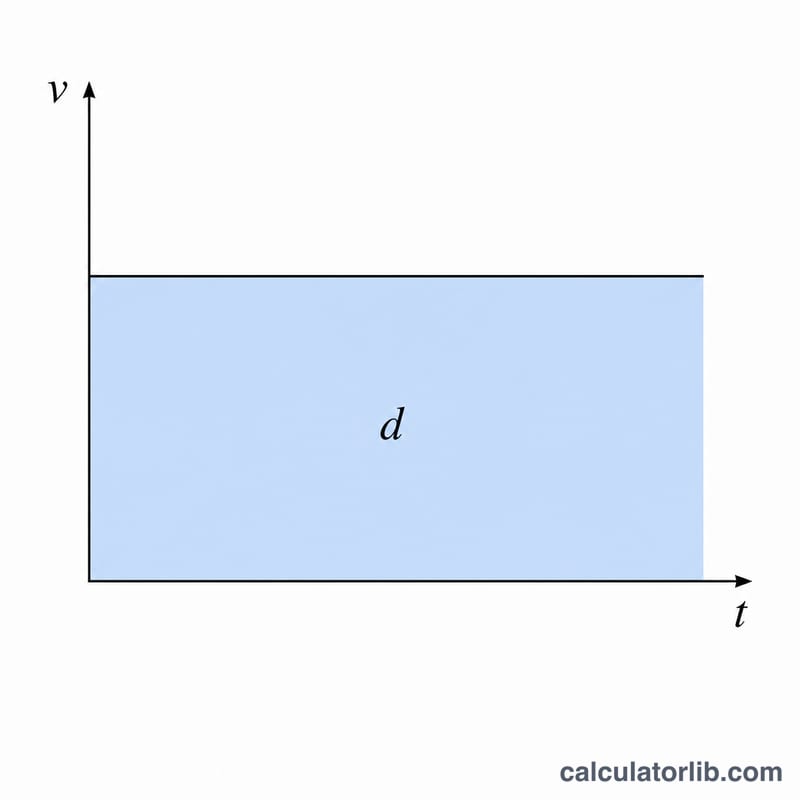
Worked example
Walking at 80 m/min for 1 hour: $$\text{speed}_{SI} = 80 \times (1/60) = 1.3333 \text{ m/s}$$ $$t = 3600 \text{ s}$$ $$d = 1.3333 \times 3600 = 4800 \text{ m} = 4.8 \text{ km}$$ Equivalently, \(80 \text{ m/min} \times 60 \text{ min} = 4800 \text{ m}\).
FAQ
Does this account for acceleration? No. It assumes uniform (constant) velocity. For accelerating motion you need \(d = v_0 t + \tfrac{1}{2} a t^2\).
What if time or speed is zero? The distance is zero. There is no division involved in the core formula, so there is no divide-by-zero risk.
Can I mix time units? Yes — enter any combination of hours, minutes, and seconds; they are added together before the calculation.