
What Is Vaccine Efficacy?
Vaccine efficacy (VE) measures how well a vaccine reduces the risk of disease in people who are vaccinated compared with those who are not, under controlled trial conditions. It is reported as a percentage: a VE of 90% means vaccinated people had 90% fewer cases than they would have had if unvaccinated. This calculator works from raw case counts and group sizes, so it is a universal epidemiology tool — it is not tied to any single country, vaccine, or disease.
How to Use This Calculator
Enter four numbers: the number of disease cases in the vaccinated group, the total number of vaccinated participants, the number of cases in the unvaccinated (or placebo) group, and the total unvaccinated participants. The calculator converts cases into attack rates for each group and returns the vaccine efficacy plus both attack rates so you can see the underlying risk.
The Formula Explained
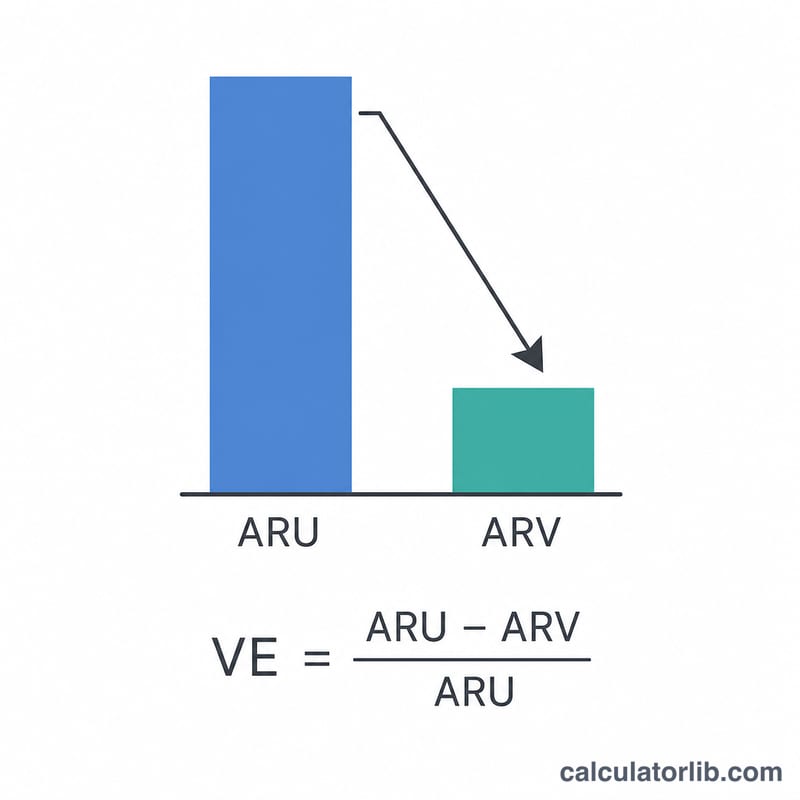
First compute each attack rate: \(\text{ARV} = \frac{\text{vaccinated cases}}{\text{vaccinated total}}\), and \(\text{ARU} = \frac{\text{unvaccinated cases}}{\text{unvaccinated total}}\). Then:
$$\text{VE} = \left(1 - \frac{\text{ARV}}{\text{ARU}}\right) \times 100$$The ratio \(\text{ARV}/\text{ARU}\) is the relative risk; subtracting it from 1 gives the proportional reduction in risk attributable to vaccination.
Worked Example
Suppose a trial has 30 cases among 1,000 vaccinated people and 150 cases among 1,000 unvaccinated people. \(\text{ARV} = 30/1000 = 0.03\) (3%) and \(\text{ARU} = 150/1000 = 0.15\) (15%).
$$\text{VE} = \left(1 - \frac{0.03}{0.15}\right) \times 100 = (1 - 0.2) \times 100 = 80\%$$The vaccine reduced disease risk by 80%.
FAQ
What does a negative VE mean? If the attack rate is higher in the vaccinated group, VE becomes negative, suggesting no protection (often due to chance, small samples, or confounding).
Is VE the same as effectiveness? Efficacy refers to performance in controlled trials; effectiveness refers to real-world use. The arithmetic is identical, but the data sources differ.
Why must group sizes be entered? Because risk is a rate, not a count — comparing raw case numbers from unequal group sizes would be misleading.