
What this calculator does
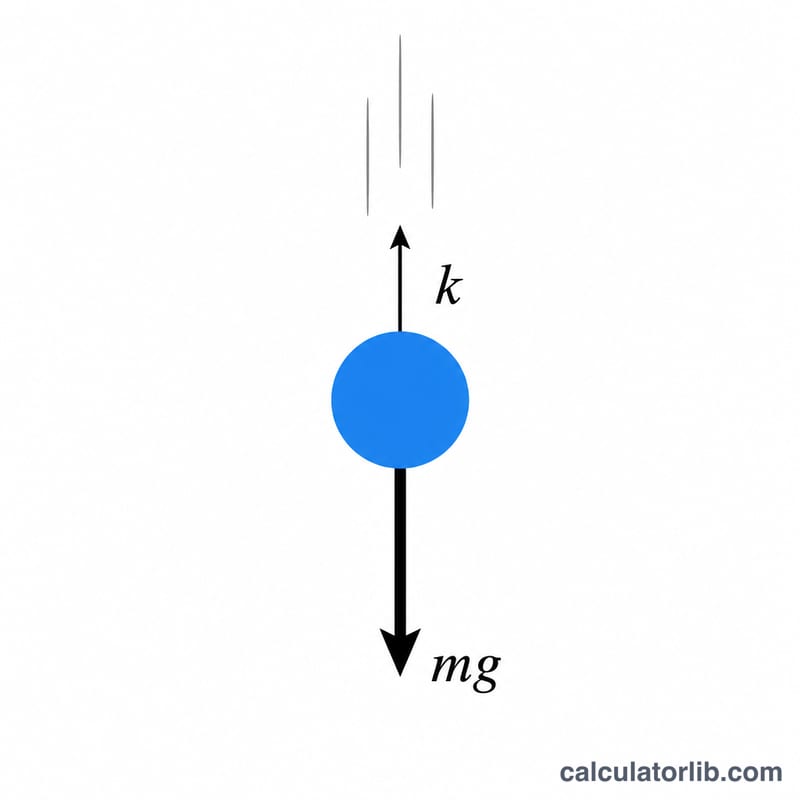
This tool models an object falling from rest under gravity while experiencing quadratic (velocity-squared) air resistance. Given the elapsed fall time, it returns how far the object has fallen and how fast it is moving, both in m/s and km/h. The model is universal physics and applies anywhere.
How to use it
Enter the object's mass (kilograms or grams), the fall time in seconds, the lumped air-resistance coefficient k in kg/m, and the gravitational acceleration g (default standard gravity 9.80665 m/s2). Press calculate to get the fall distance and speed.
The formula explained
The equation of motion is \(m\cdot\frac{dv}{dt} = m\cdot g - k\cdot v^2\). Starting from rest this has the closed-form solution:
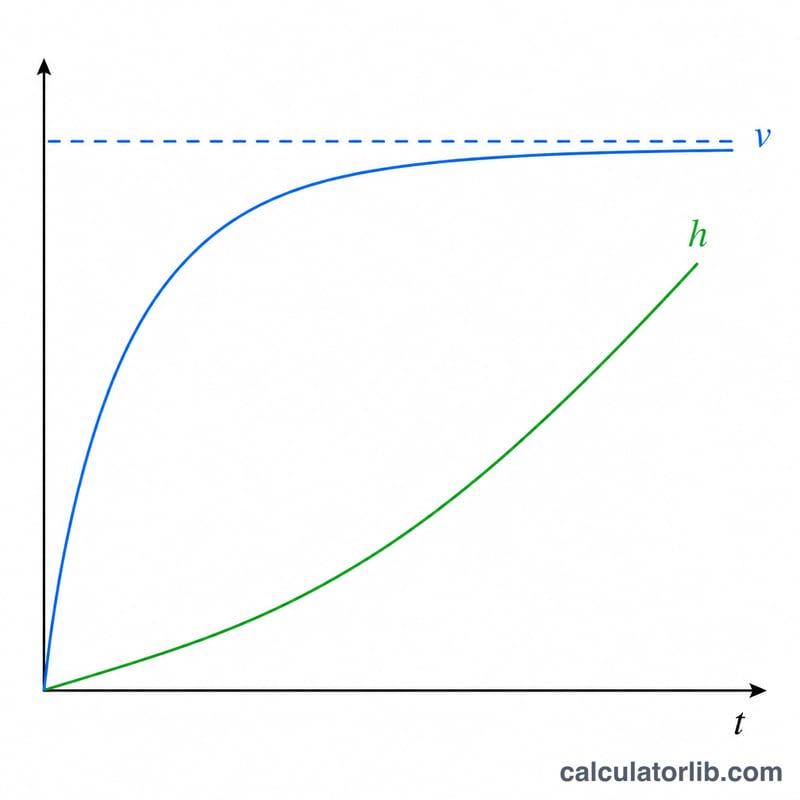
$$v(t) = \sqrt{\frac{m\cdot g}{k}}\cdot\tanh\!\left(\sqrt{\frac{g\cdot k}{m}}\cdot t\right) \quad\text{and}\quad h(t) = \frac{m}{k}\cdot\ln\!\left(\cosh\!\left(\sqrt{\frac{g\cdot k}{m}}\cdot t\right)\right).$$
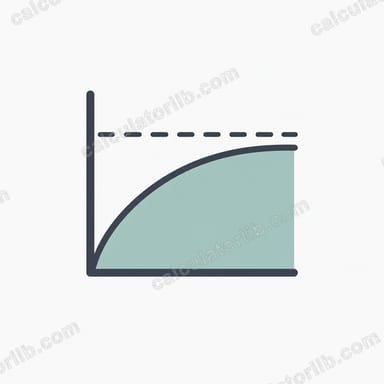
The terminal velocity is \(v_{\text{terminal}} = \sqrt{\frac{m\cdot g}{k}}\), the maximum speed the object approaches. The characteristic rate is \(a = \sqrt{\frac{g\cdot k}{m}}\). For large \(a\cdot t\) the speed saturates at terminal velocity. If \(k = 0\) the model reduces to drag-free free fall: \(v = g\cdot t\), \(h = 0.5\cdot g\cdot t^2\).
Worked example
For \(m = 72\) kg, \(t = 40\) s, \(k = 0.24\) kg/m, \(g = 9.80665\) m/s2: $$v_{\text{terminal}} = \sqrt{\frac{72\cdot 9.80665}{0.24}} = 54.23\ \text{m/s},$$ $$a = \sqrt{\frac{9.80665\cdot 0.24}{72}} = 0.1808\ \text{/s},\quad a\cdot t = 7.232.$$ Then $$v = 54.23\cdot\tanh(7.232) = 54.24\ \text{m/s} = 195.26\ \text{km/h},$$ and $$h = \frac{72}{0.24}\cdot\ln(\cosh(7.232)) = 300\cdot 6.539 = 1961.7\ \text{m}.$$ The object has essentially reached terminal velocity.
FAQ
What is the coefficient k? It is a lumped drag coefficient with units kg/m, so that \(k\cdot v^2\) yields a force in newtons. It bundles air density, the drag coefficient and cross-sectional area.
Why does speed stop increasing? Drag grows with \(v^2\); once drag balances weight the net force is zero and the object falls at constant terminal velocity.
Can I set k to zero? Yes — the calculator falls back to the classic drag-free formulas \(v = g\cdot t\) and \(h = 0.5\cdot g\cdot t^2\).