
What this calculator does
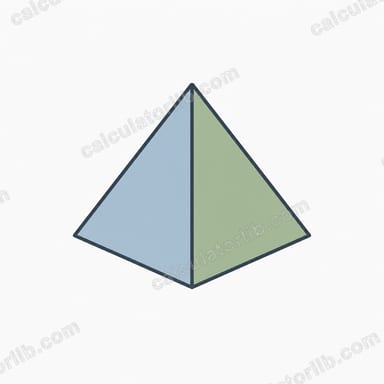
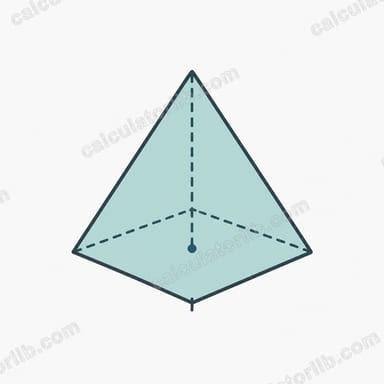
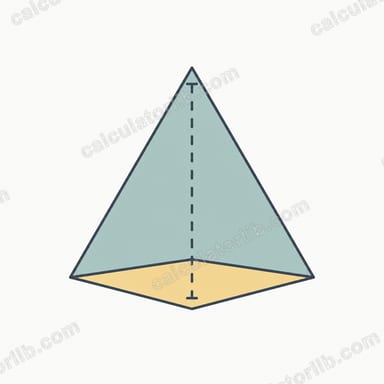
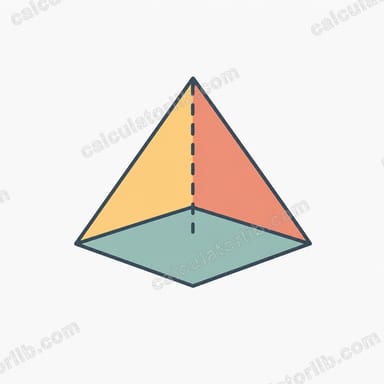
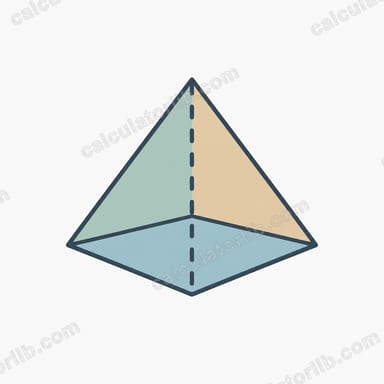
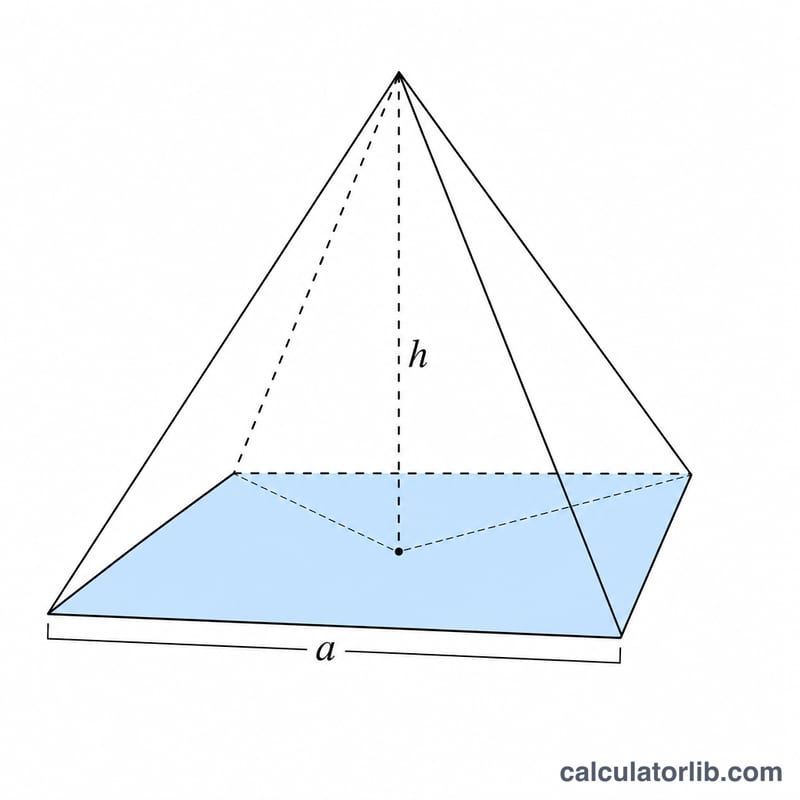
This tool computes the volume, the lateral surface area (the area of the four triangular sides), and the total surface area of a right square pyramid. A right square pyramid has a square base and an apex positioned directly above the center of that base. You only need two measurements: the base edge length a and the perpendicular height h.
How to use it
Enter the base edge length and the height in the same length unit (both in centimeters, both in inches, and so on). The results follow that unit: the volume is in cubic units (unit³) and the two areas are in square units (unit²). Both values must be greater than zero for a real pyramid.
The formulas explained
The volume is the base area times the height divided by three: \(V = \frac{1}{3} a^{2} h\). To find the side area we first need the slant height, which is the apothem of a triangular face measured from the midpoint of a base edge up to the apex: \(l = \sqrt{h^{2} + \left(\frac{a}{2}\right)^{2}}\). Each triangular face has area \(\frac{1}{2} a l\), and there are four of them, so the lateral area is \(S_{\text{side}} = 2 a l\). Adding the square base gives the total surface area \(S = a^{2} + 2 a l\). Note the slant height uses the face apothem, not the longer lateral edge.
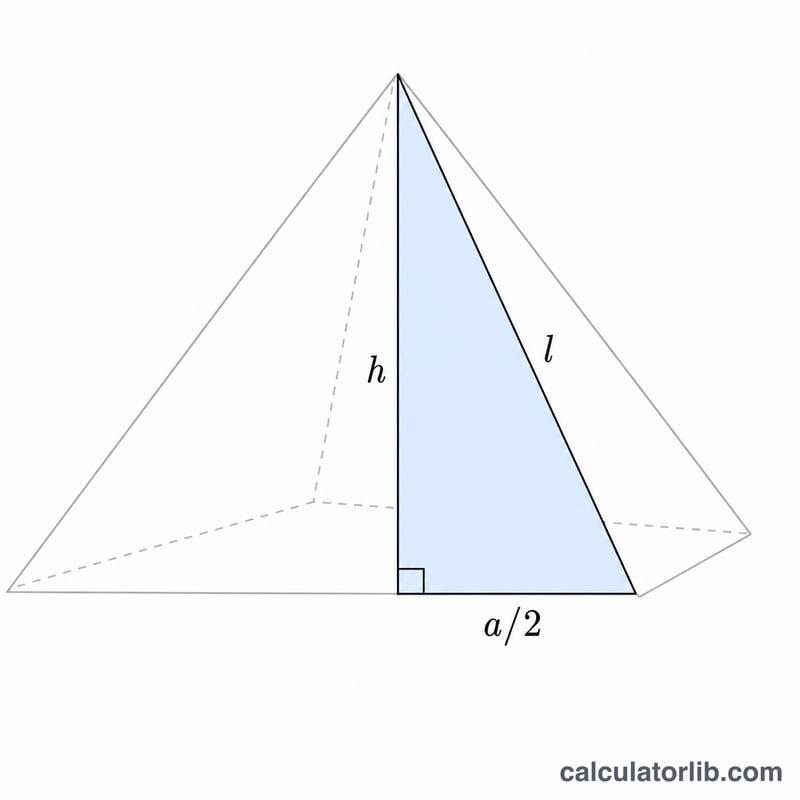
Worked example
For a base edge a = 230.4 and height h = 146.6: \(a^{2} = 53084.16\), so $$V = \frac{1}{3} \times 53084.16 \times 146.6 \approx 2{,}594{,}045.95 \text{ unit}^{3}.$$ The slant height is $$l = \sqrt{146.6^{2} + 115.2^{2}} = \sqrt{34762.6} \approx 186.4474.$$ The lateral area is \(2 \times 230.4 \times 186.4474 \approx 85{,}914.96 \text{ unit}^{2}\), and the total surface area is \(53084.16 + 85914.96 \approx 138{,}999.12 \text{ unit}^{2}\).
FAQ
Does this work for an oblique pyramid? The volume formula \(V = \frac{1}{3} a^{2} h\) holds for any pyramid with the same base and height, but the lateral-area formula assumes a right pyramid with apex over the center.
What is the difference between slant height and lateral edge? The slant height (face apothem) is \(\sqrt{h^{2} + \left(\frac{a}{2}\right)^{2}}\) and is used here. The lateral edge runs from a base corner to the apex and equals \(\sqrt{h^{2} + \left(\frac{a}{\sqrt{2}}\right)^{2}}\); do not confuse the two.
Which unit should I use? Any single length unit works as long as both inputs share it; the outputs are then automatically in that unit, its square, and its cube.