
What this calculator does
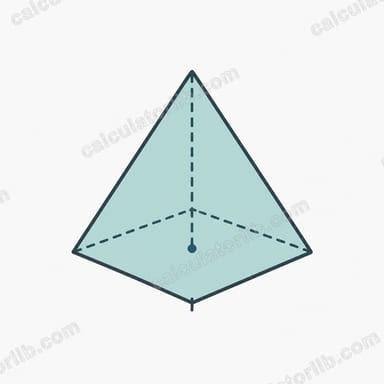
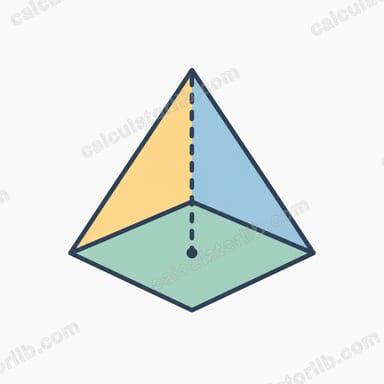
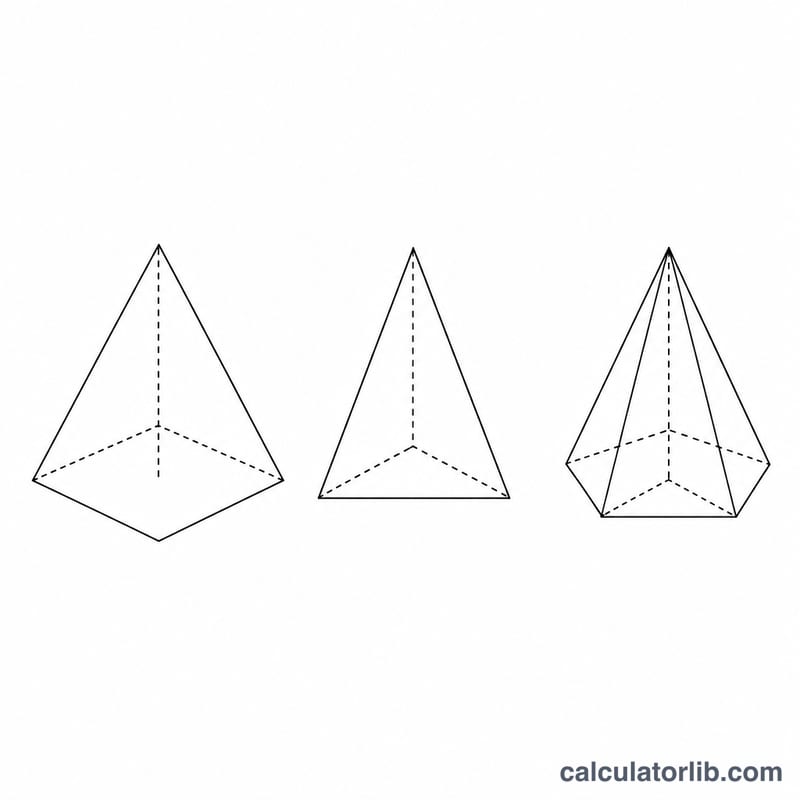
This tool computes the volume of a pyramid — a solid with a flat polygonal base that tapers to a single apex — directly from its base area and its perpendicular height. Because it relies only on the base area and the apex height, it works for any pyramid: triangular, square, pentagonal, hexagonal, or completely irregular bases. This is pure solid geometry, so it applies identically everywhere; there is no country or jurisdiction limitation.
How to use it
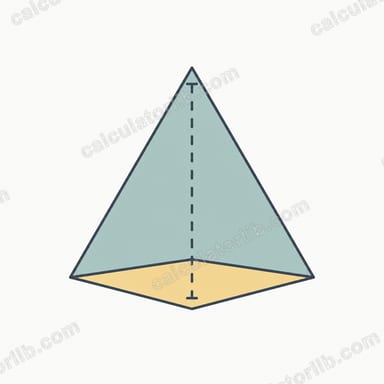
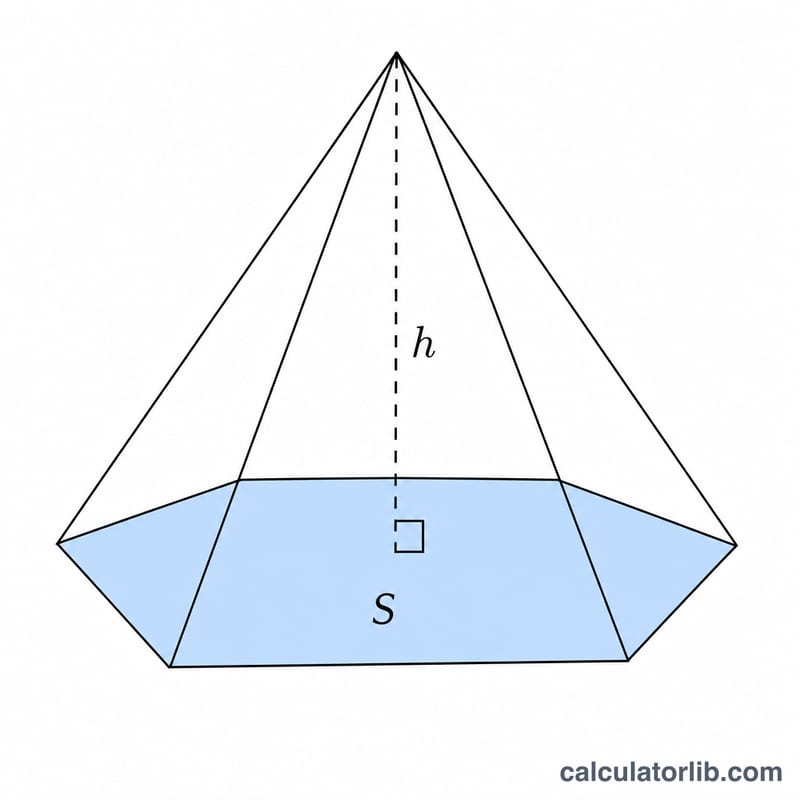
Enter the base area S and the perpendicular height h (the straight-line distance from the apex down to the plane of the base, not the slant height). Use consistent length units: if the base area is in square metres, enter the height in metres and the volume comes out in cubic metres. The calculator performs no unit conversion, so keep your units self-consistent.
The formula explained
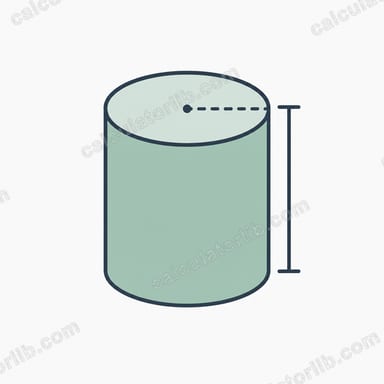
The volume of any pyramid is $$V = \frac{1}{3} \times S \times h,$$ where \(S\) is the base area and \(h\) is the perpendicular height. The one-third factor is the same constant that appears in the cone volume law: a pyramid (or cone) fills exactly one third of the prism (or cylinder) that shares its base and height. The formula is linear in both \(S\) and \(h\), so doubling either one doubles the volume.
Worked example
Suppose a square-based pyramid has a base side of 4 units, so the base area \(S = 16\), and a height \(h = 9\). Then $$V = \frac{1}{3} \times 16 \times 9 = \frac{1}{3} \times 144 = 48 \text{ cubic units}.$$ Using the defaults instead, \(S = 3\) and \(h = 2\) give $$V = \frac{1}{3} \times 3 \times 2 = 2 \text{ cubic units}.$$
FAQ
Does the base shape matter? No. As long as you supply the correct base area, the formula gives the right volume for any base polygon.
Should I use slant height or perpendicular height? Always the perpendicular height — the vertical distance from the apex to the base plane. Slant height will overestimate the volume.
What if the area or height is zero? The volume is simply 0, representing a degenerate flat solid. There is no division by an input, only by the constant 3, so this never causes an error.