
What this calculator does
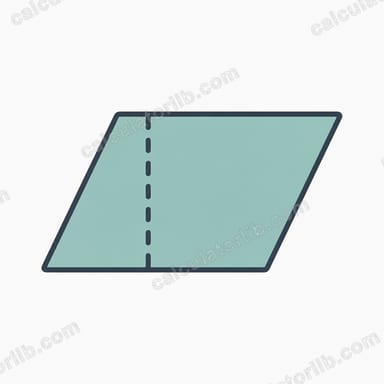
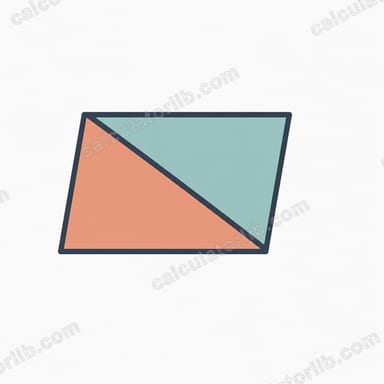
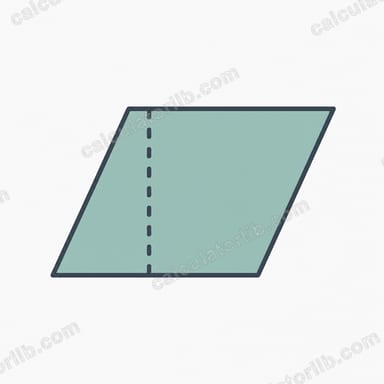
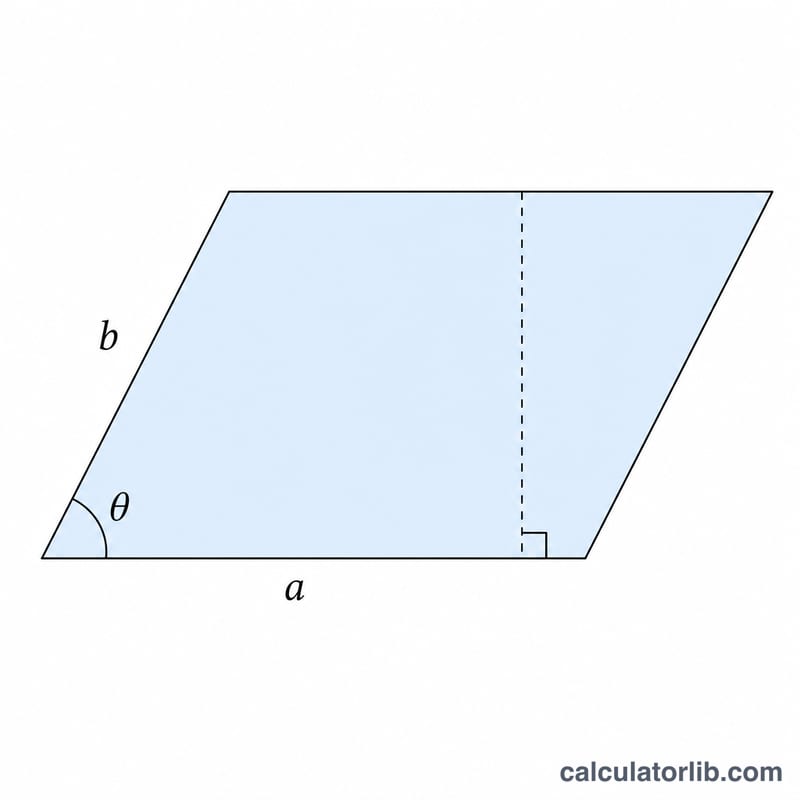
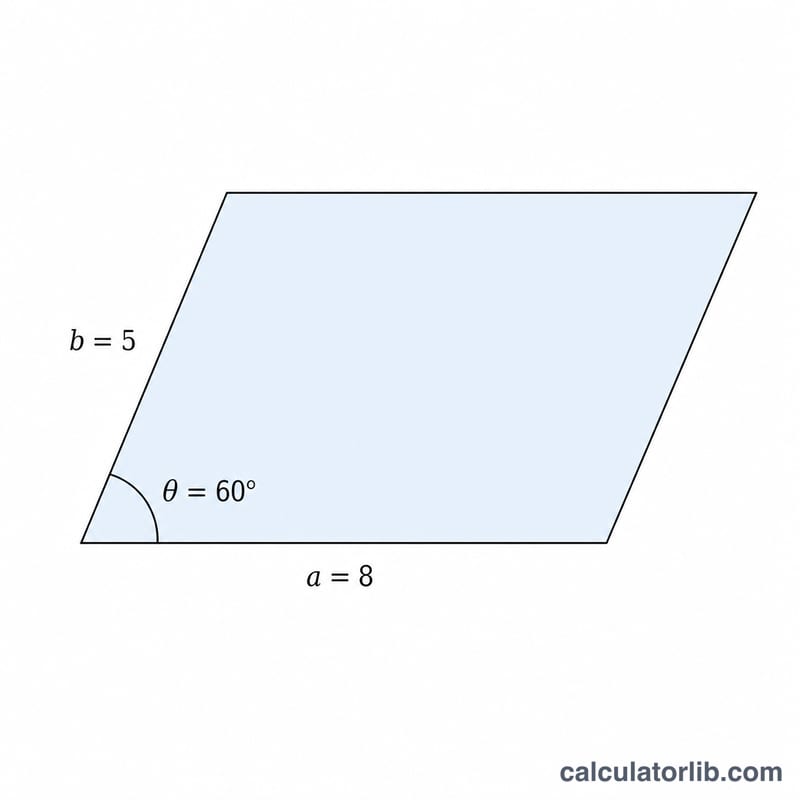
This tool finds the area and perimeter of a parallelogram when you know two adjacent side lengths and the angle between them. A parallelogram is a quadrilateral whose opposite sides are parallel and equal in length, so the two distinct side lengths a and b together with the included angle theta fully determine its shape and size.
How to use it
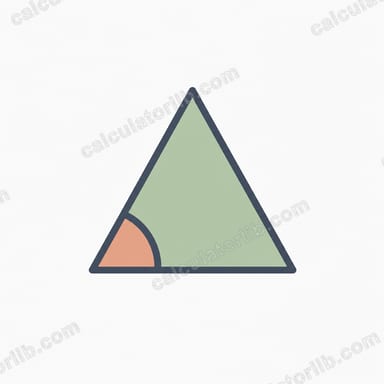
Enter the base length a and the slant side length b in any consistent unit (meters, inches, etc.). Enter the included angle theta and choose whether it is given in degrees or radians. The calculator returns the area S in square length units and the perimeter L in length units.
The formula explained
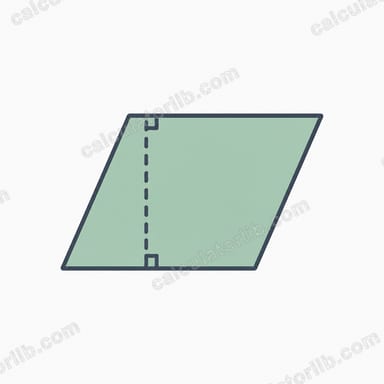
The area equals the product of the two sides times the sine of the angle between them: $$S = a \times b \times \sin(\theta)$$ The term \(b \times \sin(\theta)\) is the perpendicular height of the parallelogram, so this is really base × height. The perimeter is simply $$L = 2(a + b)$$ and does not depend on the angle. Internally a degree value is first converted to radians using \(\theta_{rad} = \theta \times \frac{\pi}{180}\) before the sine is applied.
Worked example
For a = 2, b = 1 and theta = 60 degrees: theta in radians is \(60 \times \frac{\pi}{180} = 1.04719755\), and \(\sin(60\degree) = 0.86602540\). So $$S = 2 \times 1 \times 0.86602540 = 1.73205081$$ (this is the square root of 3). The perimeter is $$L = 2 \times (2 + 1) = 6$$
FAQ
Does the angle change the perimeter? No. Perimeter depends only on the side lengths, so changing theta leaves L unchanged while S changes.
What angle gives the largest area? theta = 90 degrees, where sin = 1 and the shape is a rectangle with \(S = a \times b\). As theta approaches 0 or 180 degrees the area shrinks toward 0 (a degenerate, flat parallelogram).
Why do supplementary angles give the same area? Because \(\sin(\theta) = \sin(180\degree - \theta)\). The two interior angles of a parallelogram are supplementary and yield the same height, so either value produces the same area.