
What Is the Area of a Parallelogram?
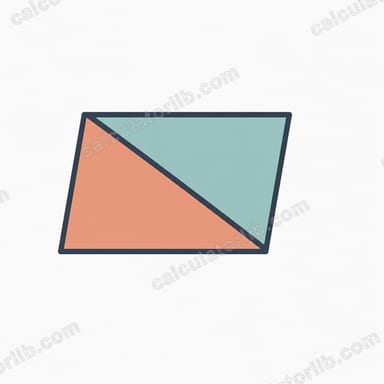
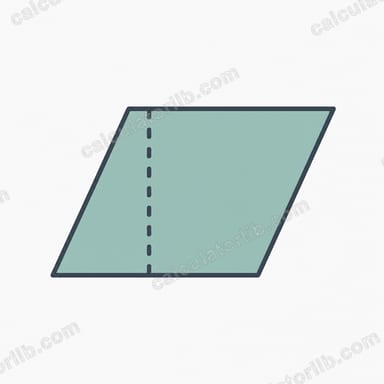
A parallelogram is a four-sided shape (quadrilateral) with two pairs of parallel sides. Its area measures how much surface the shape covers, and it is found by multiplying the length of one side (the base) by the perpendicular distance to the opposite side (the height). This tool works for any units — centimeters, meters, inches, feet — as long as the base and height use the same unit.
How to Use This Calculator
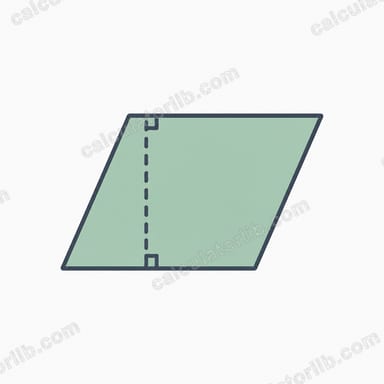
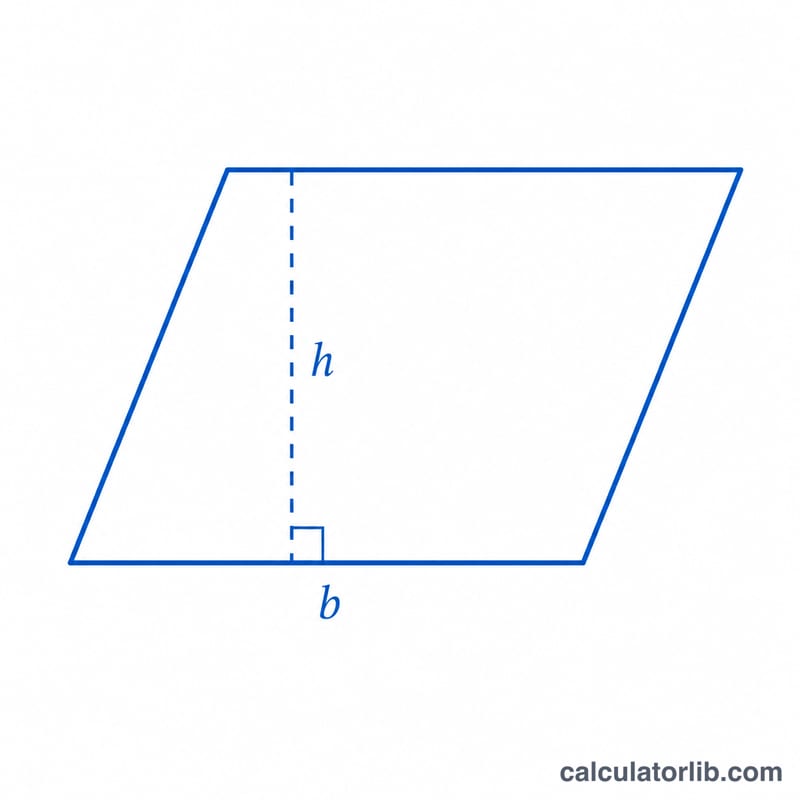
Enter the base length (b) and the perpendicular height (h) of your parallelogram, then read off the area instantly. Be sure the height is measured straight across (perpendicular) to the base, not along a slanted side. The result is expressed in square units of whatever unit you entered.
The Formula Explained
The area of a parallelogram is given by:
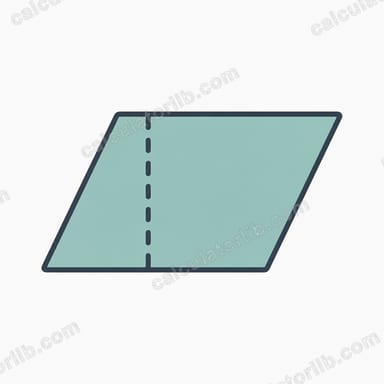
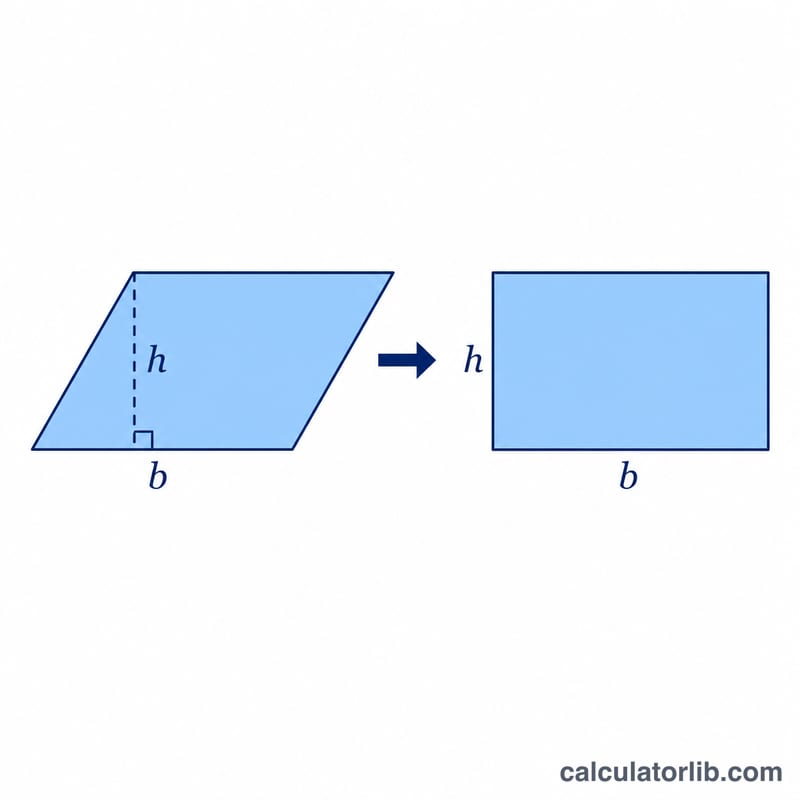
$$A = b \times h$$where b is the base and h is the perpendicular height. Even though a parallelogram leans, its area equals that of a rectangle with the same base and height — you can imagine cutting off the triangular overhang and sliding it to the other side to form a rectangle.
Worked Example
Suppose a parallelogram has a base of 10 cm and a perpendicular height of 5 cm. Then:
$$A = 10 \times 5 = 50 \text{ cm}^2$$So the parallelogram covers 50 square centimeters.
How to Calculate Parallelogram Area by Hand
The area of any parallelogram is found with the simple formula \(A = b \times h\), where \(b\) is the length of a base and \(h\) is the perpendicular height measured at a right angle to that base. Follow these steps to get an accurate result.
- Identify the base (b). Choose any one of the parallelogram's sides to serve as the base. Often the bottom side is used, but any side works as long as you pair it with the matching perpendicular height.
- Measure the perpendicular height (h), not the slant side. The height is the straight-line distance between the base and the opposite parallel side, measured at \(90^\circ\) to the base. Do not use the length of the slanted side — that value is longer than the true height and will overstate the area.
- Make sure the units match. Both the base and height must be in the same unit (for example, both in centimeters or both in inches). If one is given in centimeters and the other in meters, convert one of them first so the units agree.
- Multiply the base by the height. Apply the formula \(A = b \times h\). For example, with a base of \(b = 8\text{ cm}\) and a perpendicular height of \(h = 5\text{ cm}\): $$A = 8 \times 5 = \href{}{}$$ giving an area of 40 square centimeters.
- Label the answer in square units. Area is always expressed in squared units — \(\text{cm}^2\), \(\text{in}^2\), \(\text{m}^2\), and so on — because it measures a two-dimensional region. Always include the unit with your final number.
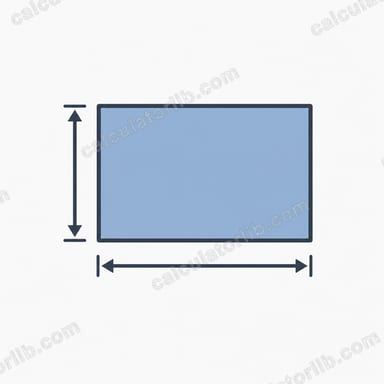
Note that a rectangle is just a special parallelogram whose height equals one of its sides, so the same logic gives \(A = l \times w\) for a rectangle.
FAQ
Is the height the same as the slanted side length? No. The height must be measured perpendicular to the base, not along the sloping side. Using the slant side will overestimate the area.
Does the formula work for rectangles and squares? Yes — a rectangle is a parallelogram with right angles, so \(A = b \times h\) applies directly.
What units should I use? Any unit is fine, but base and height must match. The area comes out in the squared version of that unit (e.g., m → m²).