
What Is This Calculator?
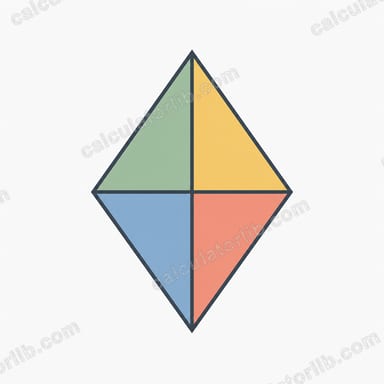
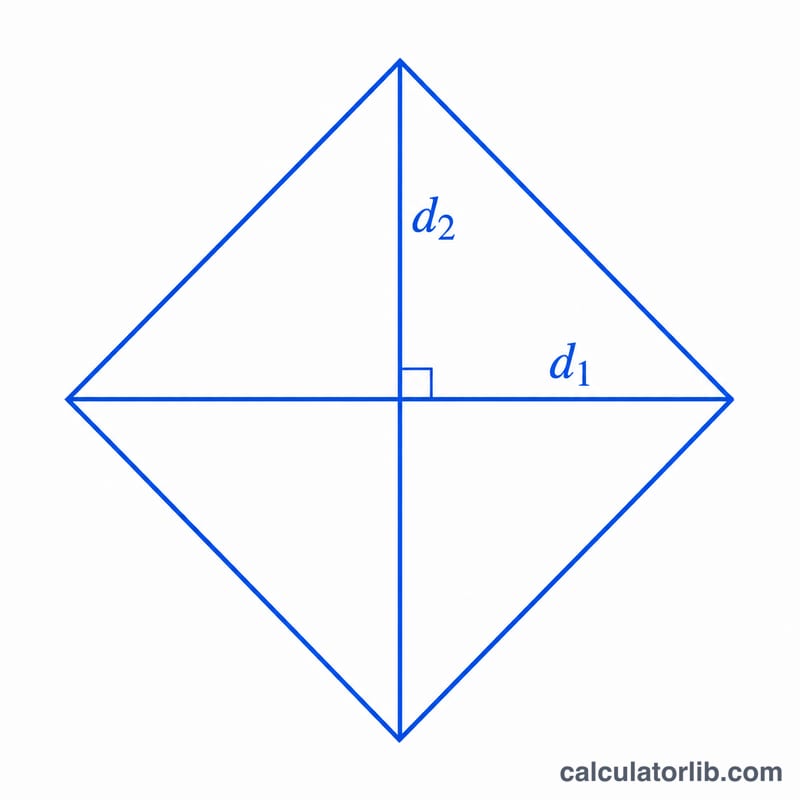
A rhombus is a quadrilateral with four equal-length sides. Its two diagonals cross at right angles and bisect each other. This calculator finds the area of a rhombus when you know the lengths of both diagonals, using the simple formula \(A = (d_1 \times d_2) / 2\). It works with any consistent unit — centimeters, inches, meters — and returns the area in the corresponding square units.
How to Use It
Enter the length of the first diagonal (\(d_1\)) and the second diagonal (\(d_2\)) in the same unit, then read the calculated area. There is no need to know the side length or any angles — the two diagonals alone fully determine the area of a rhombus.
The Formula Explained
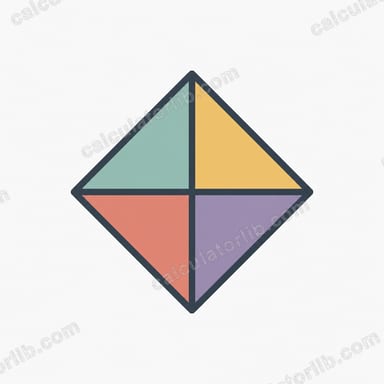
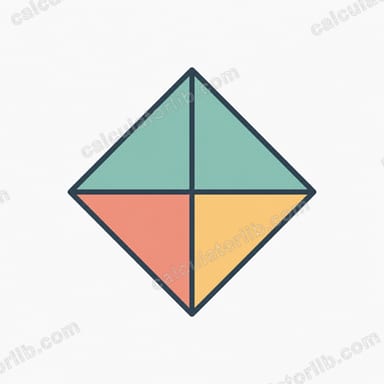
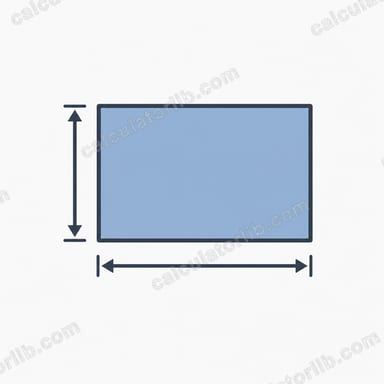
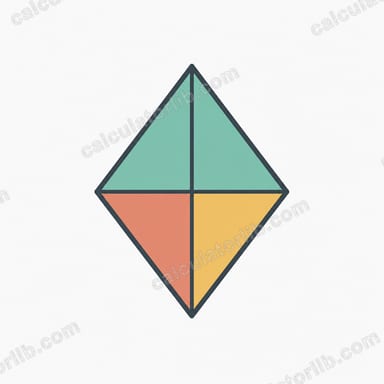
The diagonals of a rhombus split it into four congruent right triangles. Combining these triangles shows the rhombus fits inside a rectangle of dimensions \(d_1 \times d_2\), occupying exactly half of it. That gives the clean result:
$$A = \frac{d_1 \times d_2}{2}$$
where \(d_1\) and \(d_2\) are the full lengths of the two diagonals.
Worked Example
Suppose a rhombus has diagonals of 10 and 8 units. Then $$A = \frac{10 \times 8}{2} = \frac{80}{2} = 40 \text{ square units}.$$
FAQ
Do both diagonals need the same unit? Yes. Use the same unit for both so the area comes out in that unit squared.
Can I use this for a square? Yes — a square is a special rhombus where both diagonals are equal, so the formula still applies.
What if I only know the side and one angle? Then use \(A = s^2 \times \sin(\theta)\) instead; this tool specifically uses the two diagonals.