
What is a rhombus calculator?
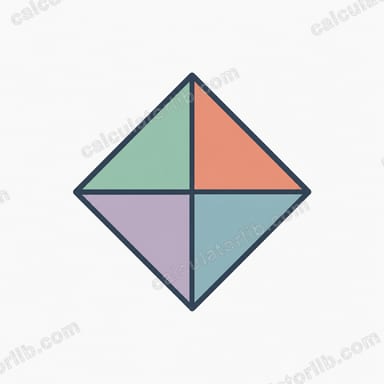
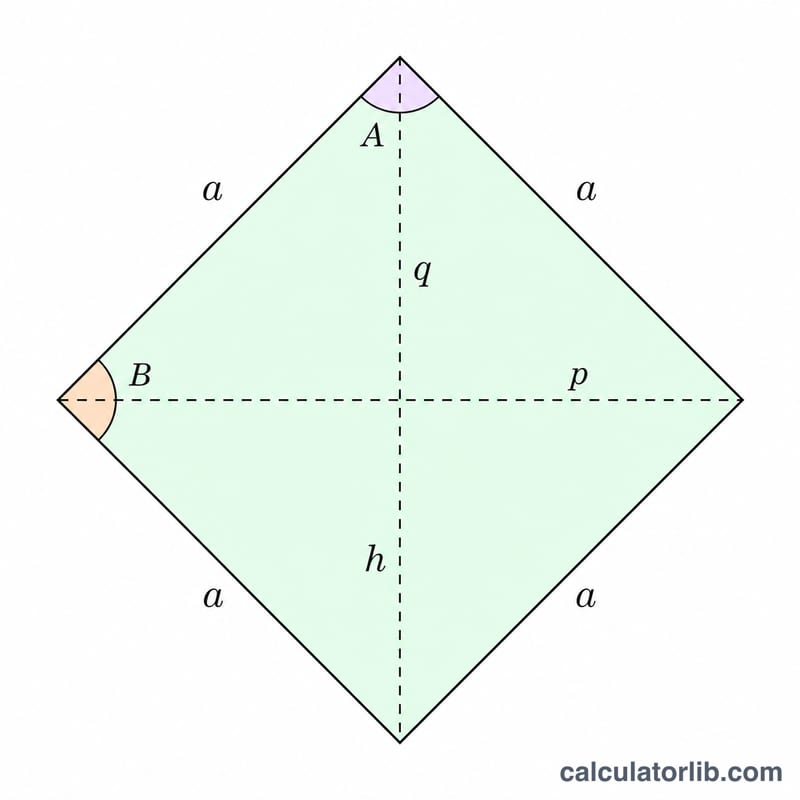
A rhombus is a quadrilateral with all four sides of equal length a. Opposite angles are equal (A = C and B = D), adjacent angles are supplementary (A + B = 180°), and the two diagonals p and q bisect each other at right angles. This calculator takes any two known properties and solves for everything else: the corner angles, both diagonals, the height, the perimeter, and the area.
How to use it
Pick a calculation from the "Choose a Calculation" menu that matches the two quantities you know — for example "Given a, h" or "Given p, q". Enter the corresponding values, choose a display unit (a label only; it does not rescale numbers) and the number of significant figures, then read the full set of results. Angles are entered and shown in degrees.
The formulas explained
The engine is built on four area identities and the diagonal relationships. Area can be written as \(K = a^2 \sin A\), as \(K = \frac{p \cdot q}{2}\), or as \(K = a \cdot h\). The height satisfies \(h = a \cdot \sin A\). The diagonals follow from \(p = 2a\cos\tfrac{A}{2}\) and \(q = 2a\sin\tfrac{A}{2}\), which combine into the parallelogram law \(p^2 + q^2 = 4a^2\), so the side recovers as \(a = \tfrac{1}{2}\sqrt{p^2 + q^2}\). The perimeter is simply \(P = 4a\).
$$K = a^2 \sin A = \frac{p \cdot q}{2} = a \cdot h$$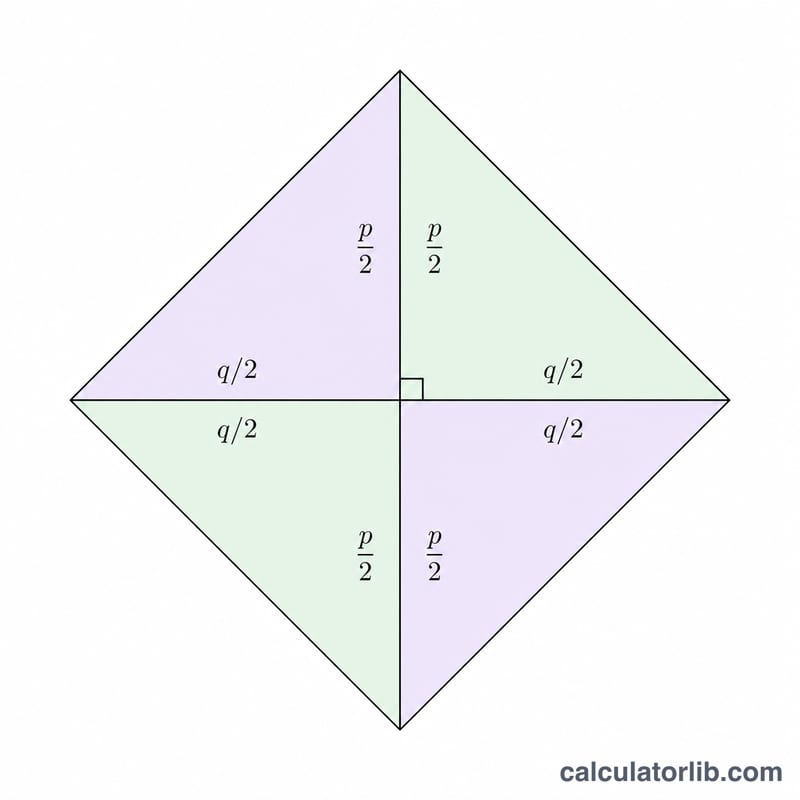
Worked example
Suppose a = 5 and h = 4. Then \(\sin A = \frac{h}{a} = 0.8\), so \(A = \arcsin(0.8) = 53.1301°\) and \(B = 180 - 53.1301 = 126.870°\). The diagonals are \(p = 2 \cdot 5 \cdot \cos(26.5651°) = 8.94427\) and \(q = 2 \cdot 5 \cdot \sin(26.5651°) = 4.47214\). The perimeter is \(P = 4 \cdot 5 = 20\) and the area is \(K = a \cdot h = 20\) (which also equals \(\frac{p \cdot q}{2} = 20\)). All three area routes agree.
FAQ
Why is the angle the acute one? Given a side with a height or area, a rhombus is shape-ambiguous between an acute angle and its supplement. We report A as the acute value and \(B = 180° - A\) as its supplement, which is fully consistent.
Does the units menu convert values? No. Every length shares one unit, so the menu only appends a label; areas are shown in that unit squared.
What if no rhombus exists? If a height exceeds the side, or a diagonal reaches 2a, the shape is impossible or degenerate; the calculator clamps trig arguments to keep results well defined.