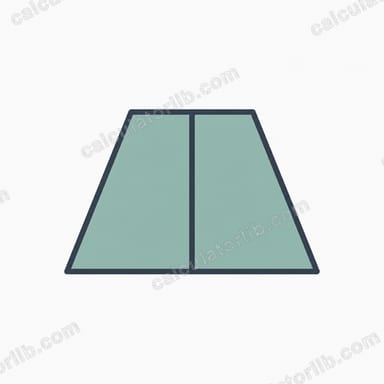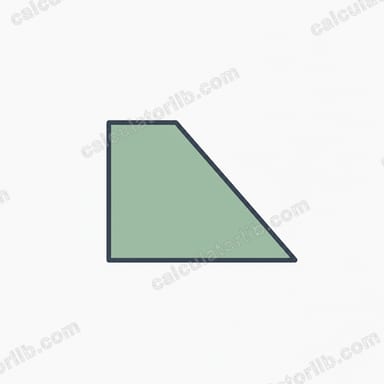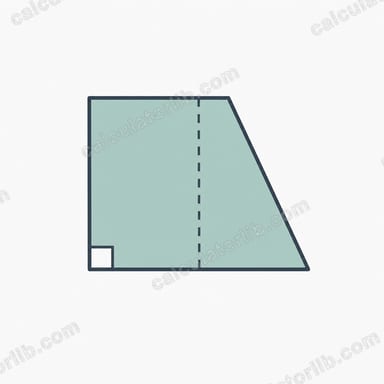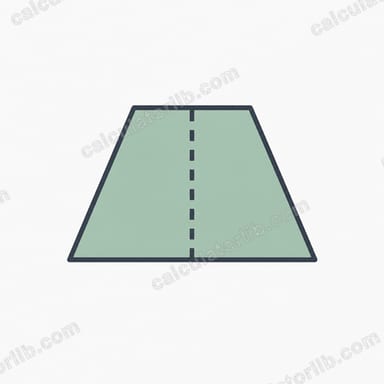

What This Trapezoid Calculator Does
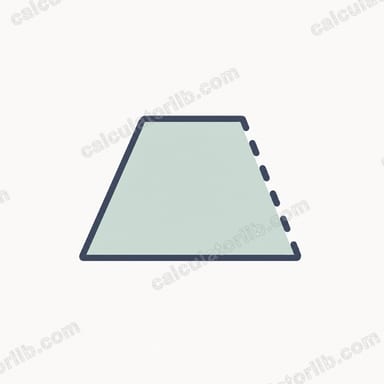
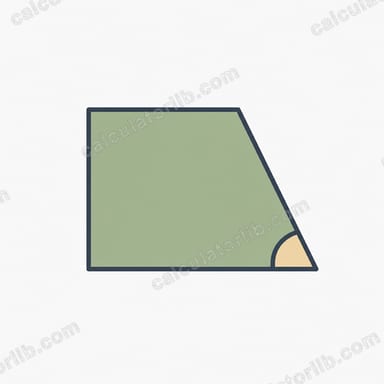
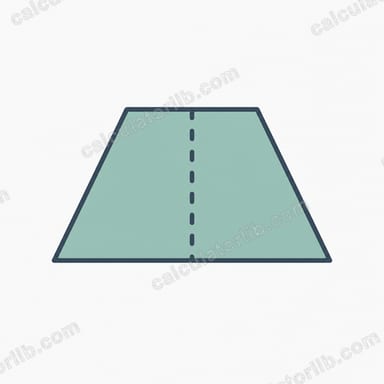
A trapezoid (called a trapezium in British English) is a quadrilateral with exactly one pair of parallel sides. This calculator solves a trapezoid for its missing side lengths, interior angles, perpendicular height, perimeter, midsegment (median) and area. It handles three families: scalene (no special symmetry), isosceles (equal legs and equal base angles) and right (one leg perpendicular to the bases).
Naming Convention
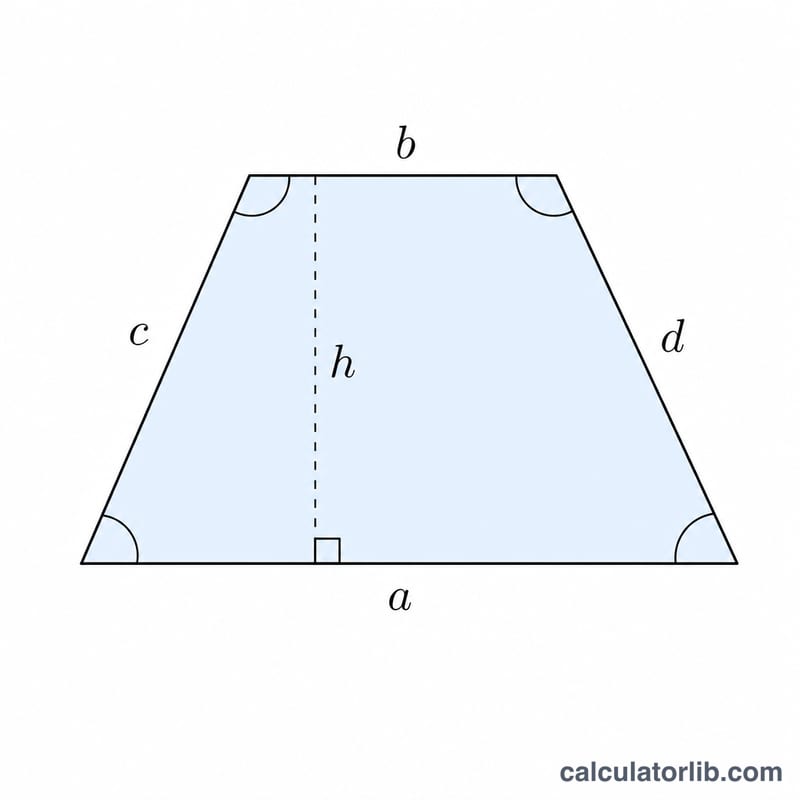
Side a is the top (shorter) parallel base, side b is the bottom (longer) parallel base. Side c is the left leg and side d is the right leg. Height h is the perpendicular distance between the parallel sides. Angles are labelled A (lower-left), B (upper-left), C (upper-right) and D (lower-right). Consecutive angles along a leg are supplementary: \(A + B = 180\deg\) and \(C + D = 180\deg\).
How To Use It
Pick a trapezoid type, then choose a calculation that matches what you already know. Enter the given values (lengths share one display unit; angles are in degrees), pick a length-unit label and the number of significant figures, and read off the full solution. Only the relevant inputs for your chosen calculation are used.
The Formula Explained
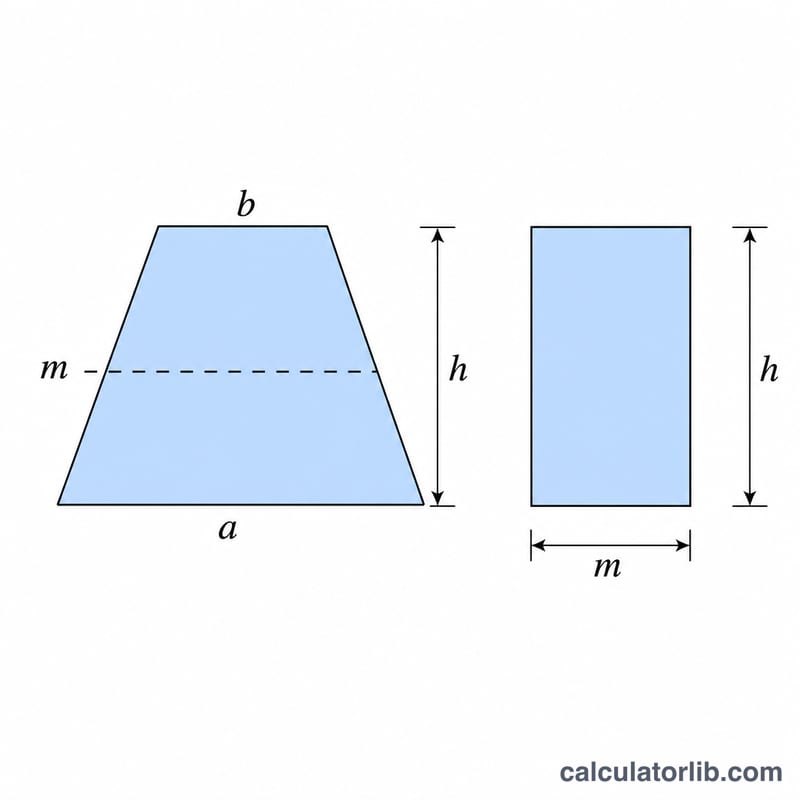
The midsegment is the average of the bases, \(m = \frac{a + b}{2}\), and the area is that midsegment times the height,
$$A = m h = \frac{a + b}{2} \times h$$Legs relate to the height and base overhang by \(h = c \sin A = d \sin D\), while horizontal closure gives \(c \cos A + d \cos D = b - a\). These relations let the tool reconstruct any missing quantity.
Worked Example
Isosceles trapezoid with \(a = 4\), \(b = 10\), \(c = 5\). The half-difference is \(k = \frac{10 - 4}{2} = 3\), so
$$h = \sqrt{5^2 - 3^2} = \sqrt{16} = 4$$The base angles are \(A = D = \operatorname{atan2}(4, 3) = 53.13\deg\) and \(B = C = 126.87\deg\). The midsegment is \(m = 7\), the perimeter is \(P = 4 + 10 + 5 + 5 = 24\), and the area is
$$A = 7 \times 4 = 28 \text{ square units}$$FAQ
Is a parallelogram a trapezoid? Under the inclusive definition yes (two pairs of parallel sides); this tool focuses on the figure with one pair of parallel bases a and b.
Why does it sometimes return no result? Some combinations are geometrically impossible, for example a leg too short to span the base overhang (a negative square-root radicand). Check that b is the longer base and that legs are long enough.
Does it convert between units? No. All lengths use one chosen unit and the area is reported in that unit squared; the unit label is for display only.