What is the Trapezoid Side Calculator?
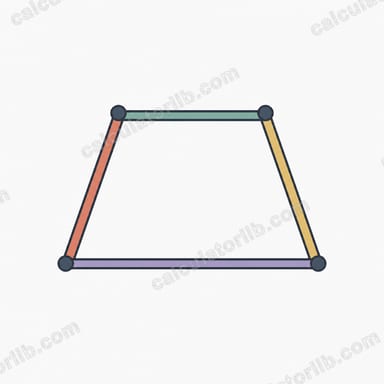
A trapezoid (or trapezium) is a four-sided polygon. Its perimeter is simply the sum of all four side lengths. If you know the perimeter and three of the four sides, you can easily find the missing fourth side by subtraction. This calculator does that instantly for you.
How to Use It
Enter the total perimeter (P) of the trapezoid, then enter the three side lengths you already know (a, b, and c). The calculator subtracts the sum of the known sides from the perimeter and returns the length of the unknown side (d). Use the same unit for every value — centimeters, meters, inches, or any consistent length unit.
The Formula Explained
The perimeter of any trapezoid is \(P = a + b + c + d\). Rearranging to solve for the unknown side gives $$d = P - (a + b + c)$$ Because perimeter is just a total of the parts, finding one missing part only requires subtracting the parts you already have.

Worked Example
Suppose a trapezoid has a perimeter of 30 and three known sides of 8, 6, and 10. The sum of the known sides is $$8 + 6 + 10 = 24$$ The unknown side is therefore $$d = 30 - 24 = 6$$ The calculator returns 6 as the missing side length.

Trapezoid Terms and Variables Explained
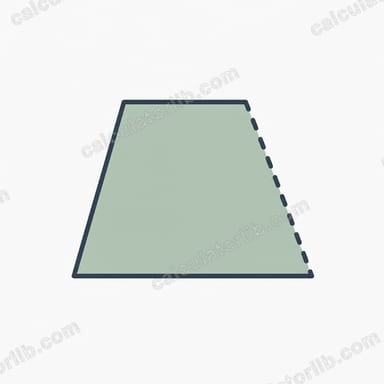
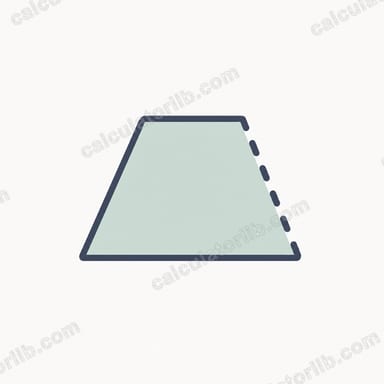
- Trapezoid (US) / trapezium (UK): a quadrilateral with one pair of parallel sides. In American English this shape is a trapezoid. In British English it is usually called a trapezium. (In the US, "trapezium" can mean a quadrilateral with no parallel sides, so check which convention your source uses.) The strict definition requires exactly one pair of parallel sides. Inclusive definitions allow at least one pair, which makes a parallelogram a trapezoid too.
- Parallel sides (bases): the two sides that never meet however far they are extended. They are often called the top base and bottom base.
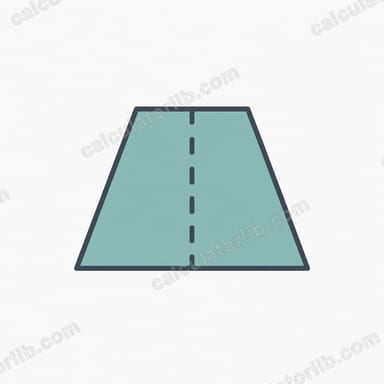
- Legs: the two non-parallel sides. If the legs are equal in length, the trapezoid is isosceles.
- Perimeter (P): the total distance around the shape, which is the sum of all four side lengths.
- a, b, c: the three side lengths you already know. They are in the same unit as the perimeter.
- d: the unknown fourth side you want to find.
The perimeter relation is \(P = a + b + c + d\), so the missing side is \(d = P - (a + b + c)\). Addition does not depend on order, so the formula is the same whichever side is unknown, whether it is a base or a leg. Just enter the three known sides as a, b and c. Keep all lengths in the same unit.
Missing Side Results for Different Inputs
Each row applies \(d = P - (a + b + c)\). A valid side must be greater than zero.
| Perimeter P | Side a | Side b | Side c | Missing side d | Valid? |
|---|---|---|---|---|---|
| 30 | 8 | 6 | 10 | 6 | Valid: positive result (30 − 24 = 6) |
| 50 | 15 | 10 | 12 | 13 | Valid: positive result (50 − 37 = 13) |
| 24.5 | 7.5 | 5 | 6 | 6 | Valid: decimals work the same way (24.5 − 18.5 = 6) |
| 40 | 12 | 8 | 10 | 10 | Valid: if 12 and 8 are the bases, both legs are 10, an isosceles trapezoid (40 − 30 = 10) |
| 20 | 9 | 6 | 8 | -3 | Invalid: the three known sides already total 23, which is more than the perimeter of 20 |
A negative or zero result means the inputs are inconsistent, so check the perimeter and the three side lengths. A positive result only means the sum works out. For a real trapezoid, the four lengths must also be geometrically possible. In particular, the difference between the bases must be less than the sum of the legs.
FAQ
Can the result be negative? If the result is negative or zero, your inputs are inconsistent — the three known sides already exceed (or equal) the perimeter, which is geometrically impossible for a real trapezoid.
Does it matter which side is unknown? No. The math is the same regardless of which side (a, b, c, or d) is missing — just enter the three sides you know.
Do I need angles or height? No. Perimeter depends only on side lengths, so angles and height are not required for this calculation.