
What Is an Isosceles Trapezoid?
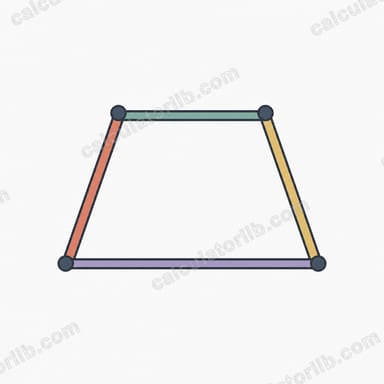
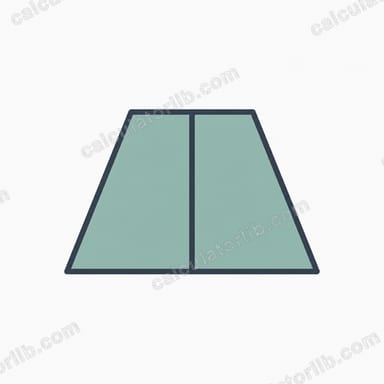
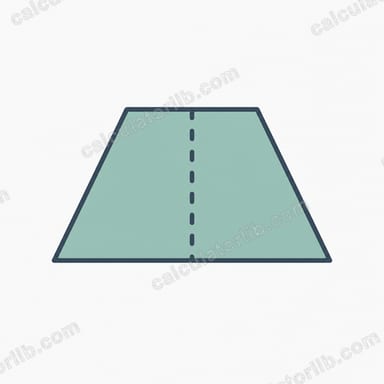
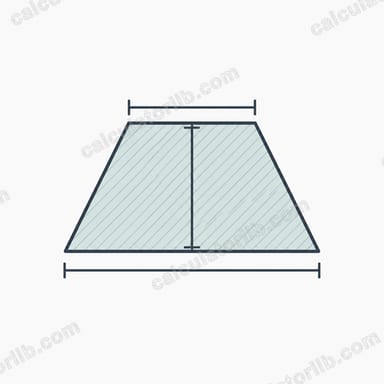
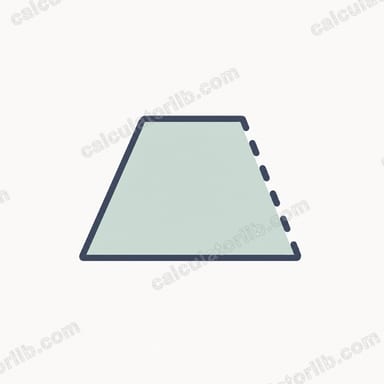
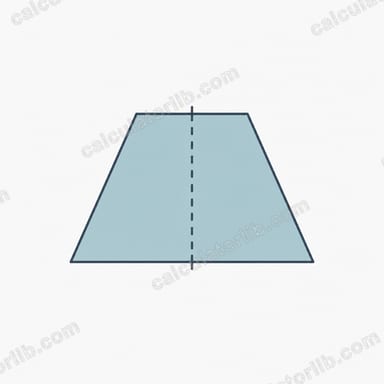
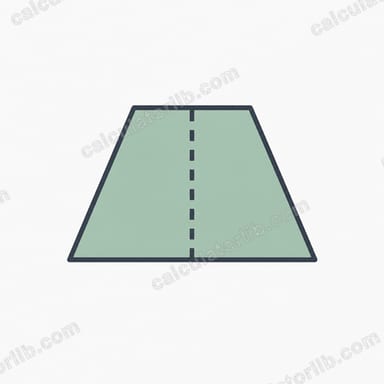
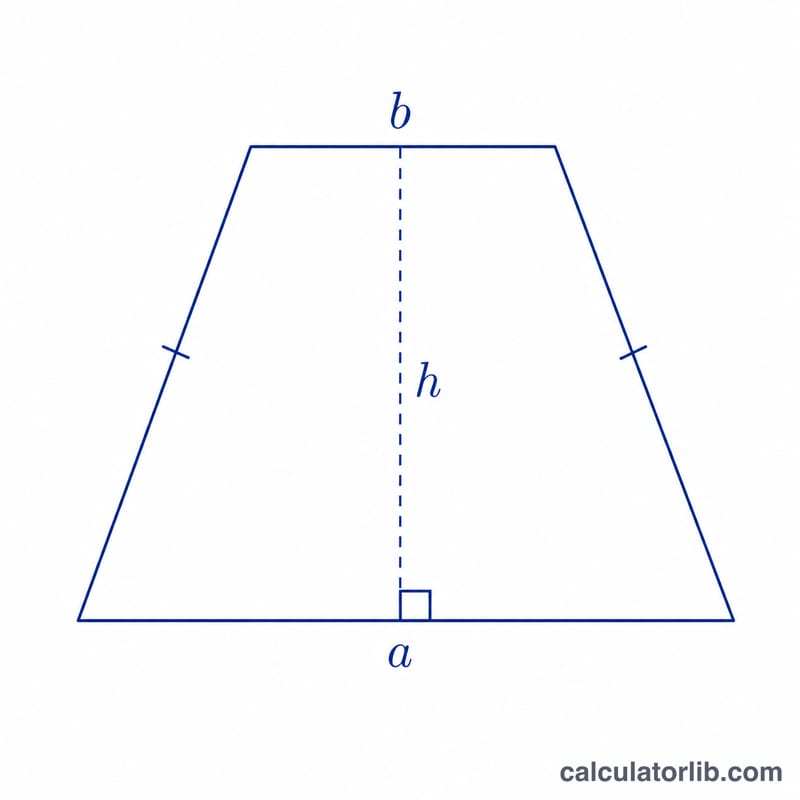
An isosceles trapezoid is a four-sided figure with one pair of parallel sides (the bases, a and b) and two equal-length non-parallel sides (the legs). Because the legs are equal, the figure is symmetric about a vertical axis. This calculator finds its area, leg length, and perimeter from the longer base, the shorter base, and the perpendicular height.
How to Use the Calculator
Enter the longer base a, the shorter base b, and the height h (the perpendicular distance between the bases). All measurements must use the same unit. The tool instantly returns the area in square units along with the slanted leg length and the full perimeter.
The Formulas Explained
The area of any trapezoid is the average of the two parallel sides multiplied by the height:
$$A = \frac{a + b}{2} \times h$$
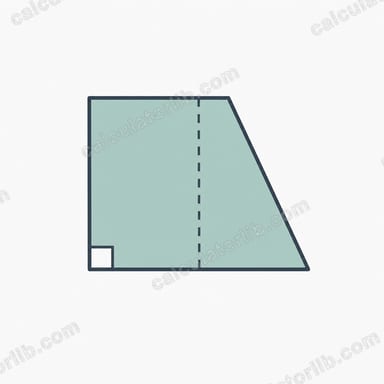
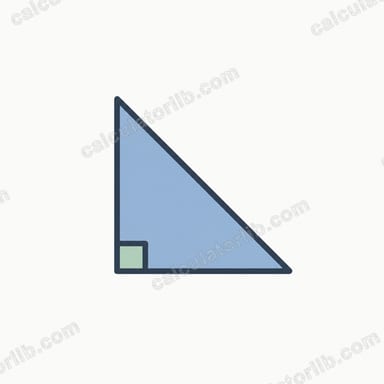
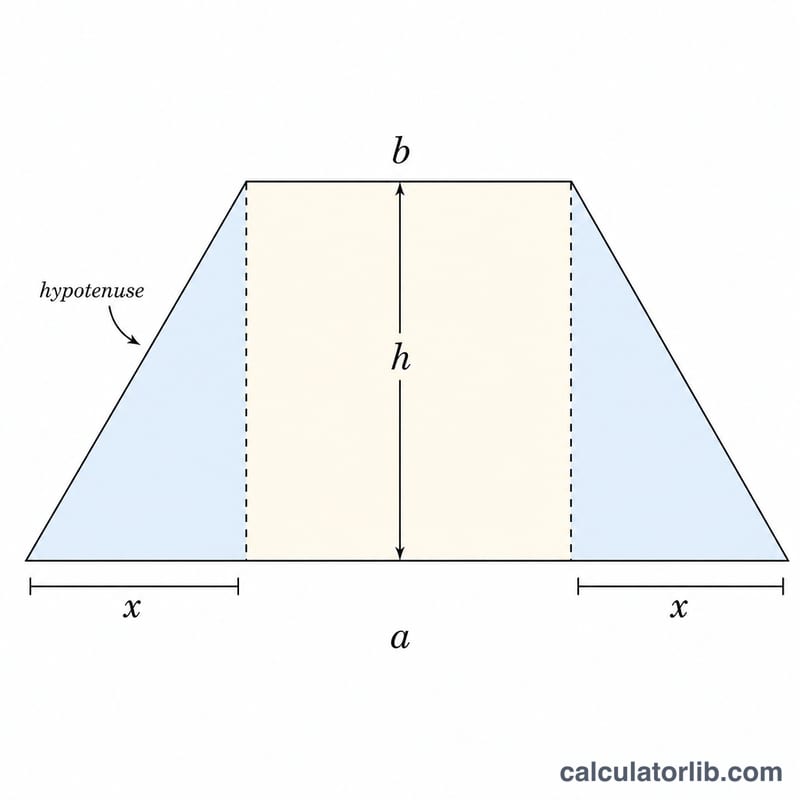
For an isosceles trapezoid each base overhangs the shorter base by \(\frac{a - b}{2}\) on each end. The leg forms the hypotenuse of a right triangle with legs h and \(\frac{a - b}{2}\), so:
$$\text{leg} = \sqrt{h^{2} + \left(\frac{a - b}{2}\right)^{2}}$$
The perimeter sums all four sides:
$$P = a + b + 2 \times \text{leg}$$
Worked Example
Suppose \(a = 8\), \(b = 4\), and \(h = 3\). The area is $$\frac{8 + 4}{2} \times 3 = 6 \times 3 = 18.$$ The half-difference is \(\frac{8 - 4}{2} = 2\), so the leg $$= \sqrt{3^{2} + 2^{2}} = \sqrt{13} \approx 3.606.$$ The perimeter is $$8 + 4 + 2 \times 3.606 = 19.21.$$
FAQ
Does the longer base have to be a? The formulas use the absolute difference internally, so the result is correct as long as you supply both base lengths, though labeling a as the longer base keeps things intuitive.
What units should I use? Any unit works—just keep them consistent. The area will be in those units squared.
What if a equals b? Then the shape is a rectangle and the leg simply equals the height.