
What is a Right Trapezoid?
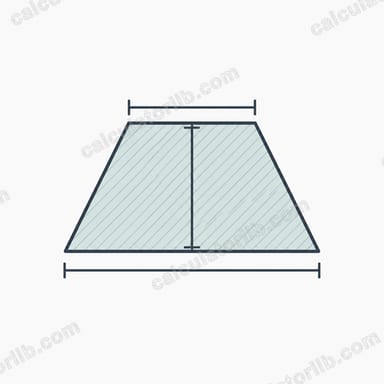
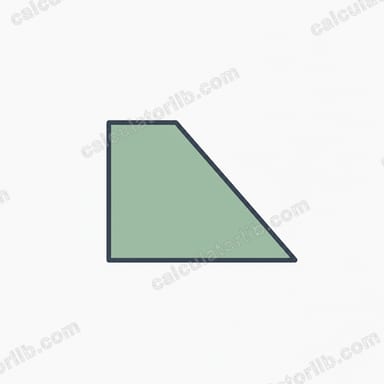
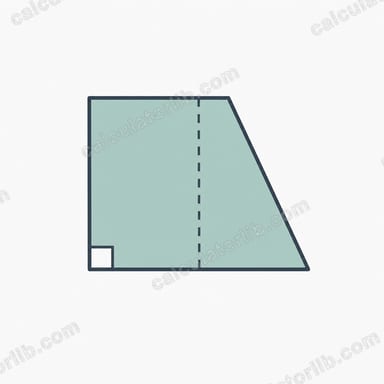
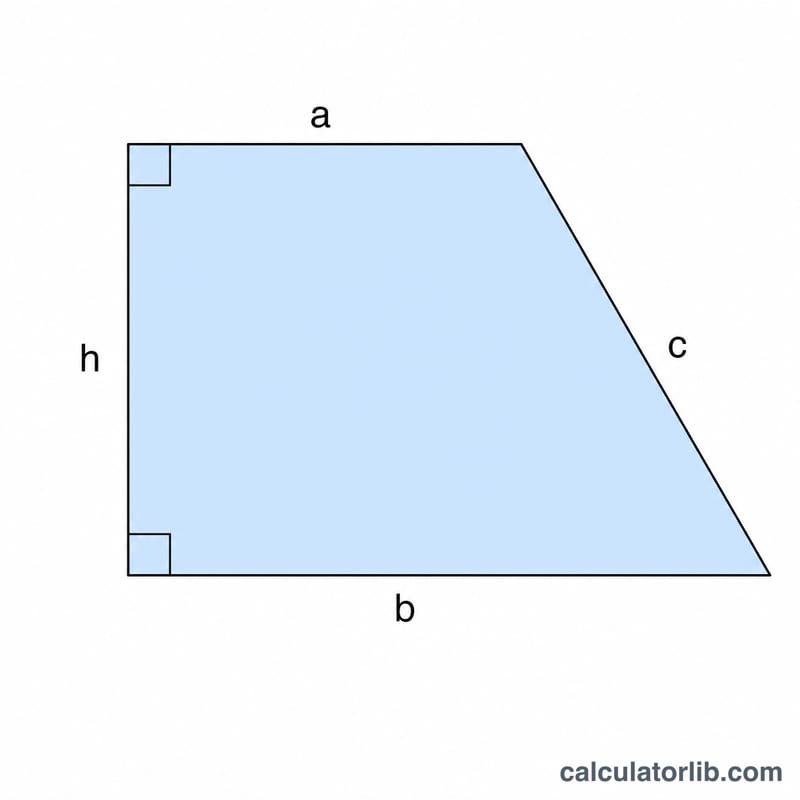
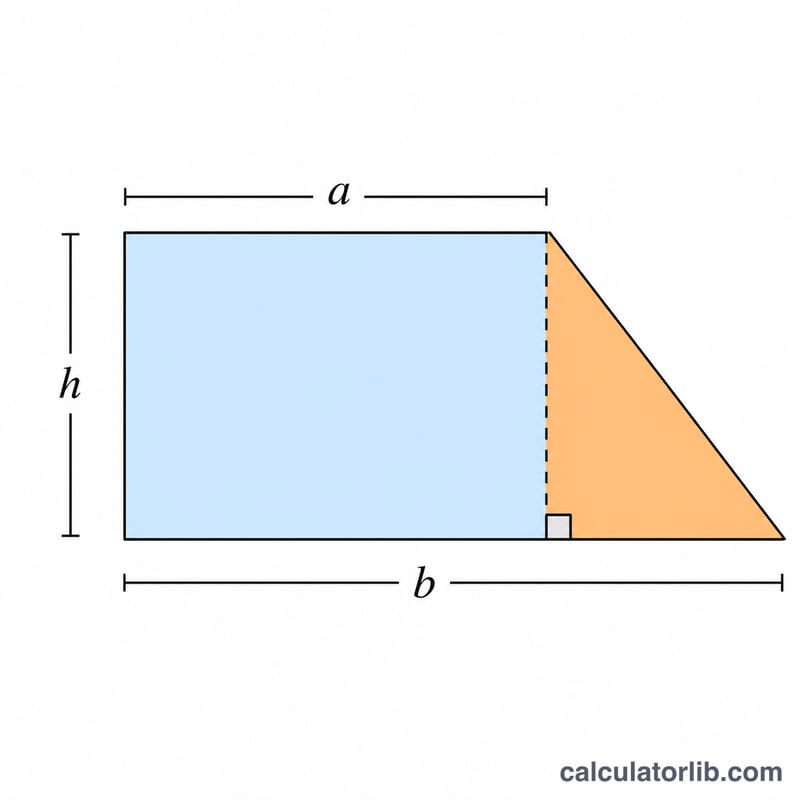
A right trapezoid (or right trapezium) is a four-sided shape with one pair of parallel sides and two right angles. The two parallel sides are usually called a (the shorter top) and b (the longer bottom). The side joining them at right angles is the height h, which doubles as one of the legs. The remaining side is the slanted leg c. This calculator finds the area, the slant leg, and the perimeter from just these three measurements.
How to Use the Calculator
Enter the length of the shorter parallel side a, the longer parallel side b, and the perpendicular height h in any consistent unit (cm, m, in, ft). The result returns the area in square units along with the slant leg and total perimeter.
The Formula Explained
The area uses the standard trapezoid formula — the average of the parallel sides times the height:
$$\text{Area} = \frac{a + b}{2} \cdot h$$
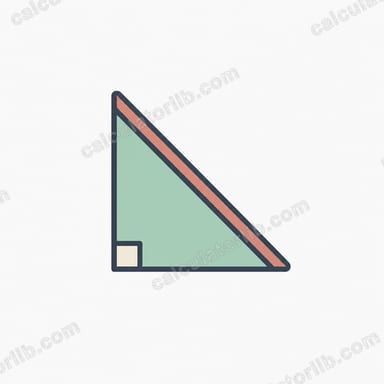
Because two angles are right angles, the slanted leg forms a right triangle with horizontal run \((b - a)\) and vertical rise \(h\), so by the Pythagorean theorem:
$$c = \sqrt{h^{2} + (b - a)^{2}}$$
The perimeter is simply \(a + b + h + c\).
Worked Example
Suppose \(a = 4\), \(b = 10\), \(h = 8\). The area is $$\frac{4 + 10}{2} \cdot 8 = 7 \cdot 8 = \mathbf{56}$$ square units. The horizontal run is \(b - a = 6\), so the slant leg is $$\sqrt{8^{2} + 6^{2}} = \sqrt{64 + 36} = \sqrt{100} = \mathbf{10}.$$ The perimeter is \(4 + 10 + 8 + 10 = \mathbf{32}\) units.
FAQ
Does it matter which side is a or b? The area is the same either way since it uses \((a + b)\). The slant leg uses \(|b - a|\), so the calculator handles the difference correctly.
What units does it use? Any unit — just keep them consistent. The area comes out in those units squared.
Can a equal b? If \(a = b\) the slant leg equals \(h\) and the shape is a rectangle, which the formulas still compute correctly.