
What is a spherical cap?
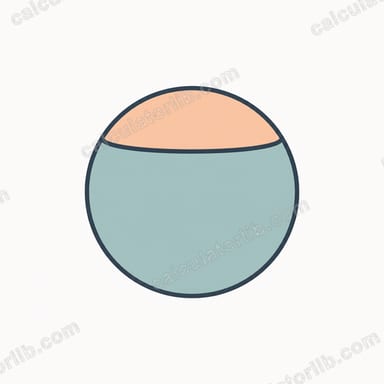
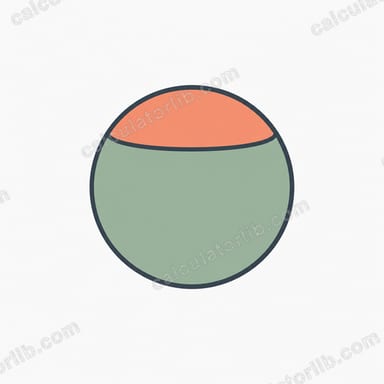
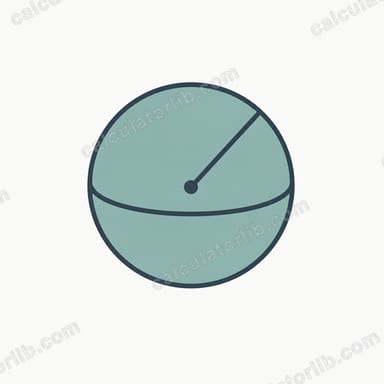
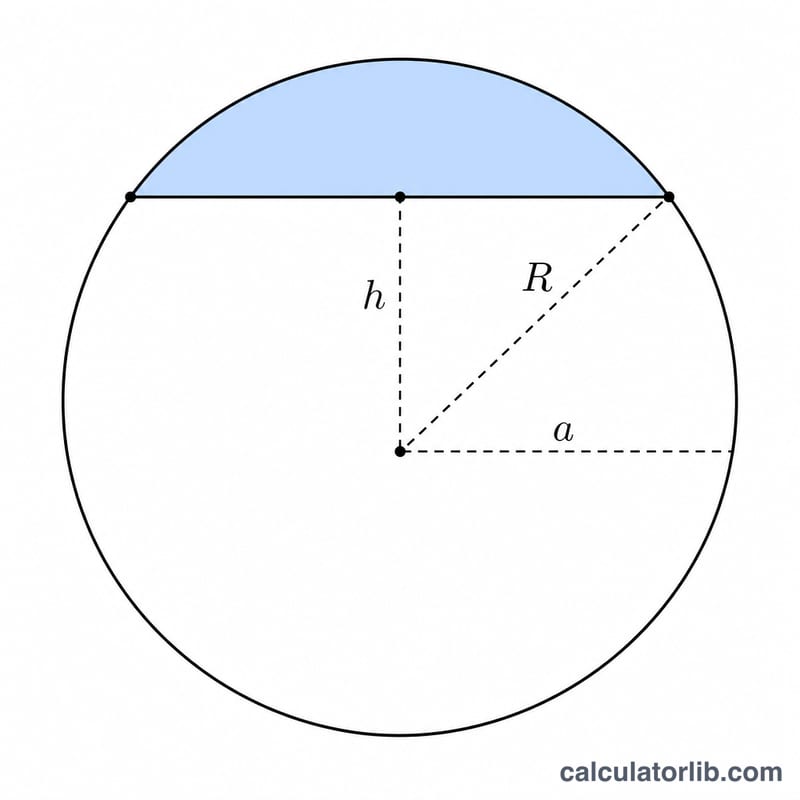
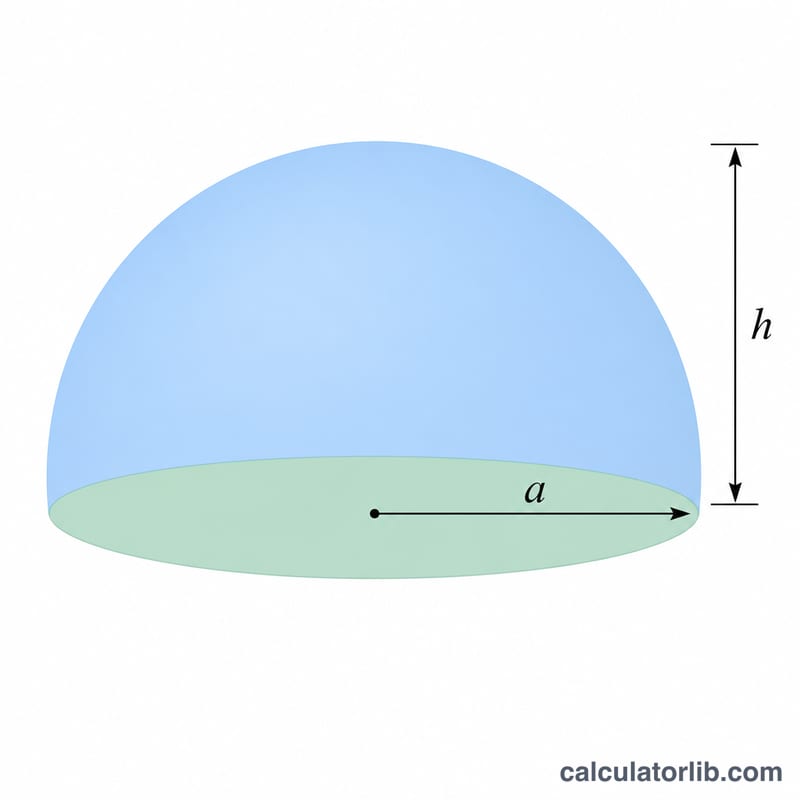
A spherical cap is the solid you get when you slice a sphere with a flat plane and keep one of the two pieces. Equivalently, it is the solid of revolution produced by rotating a circular segment (the "bow shape" between a chord and its arc) about the diameter that bisects the chord at right angles. This calculator works from two measurements: the base radius a (half the chord, the radius of the flat circular face) and the cap height h (the sagitta, measured from the base plane to the top of the cap). It is pure geometry and works in any consistent length unit.
How to use it
Enter the base radius a and the height h in the same length unit (both in cm, both in inches, etc.). The calculator returns the base area B, the total surface area A, the volume V, and the radius r of the parent sphere. Areas come out in unit² and the volume in unit³.
The formulas explained
The parent sphere radius is recovered from the geometry of the chord: \(r = \frac{a^{2} + h^{2}}{2h}\). The volume of the cap is $$V = \frac{1}{6}\cdot\pi\cdot h\cdot(3a^{2} + h^{2}).$$ The curved (spherical) part of the surface is \(2\pi r h\), and the flat base disc is \(\pi a^{2}\); the total surface reported here is their sum, $$A = \pi a^{2} + 2\pi r h.$$ When \(h = r\) the cap is a hemisphere; when \(h = 2r\) it is the full sphere.
Worked example
Take \(a = 3\) and \(h = 2\). Then $$r = \frac{3^{2} + 2^{2}}{2\cdot 2} = \frac{13}{4} = 3.25.$$ Base area $$B = \pi\cdot 3^{2} = 9\pi \approx 28.27433.$$ Curved surface \(= 2\pi\cdot 3.25\cdot 2 = 13\pi \approx 40.8407\), so total surface $$A = 9\pi + 13\pi = 22\pi \approx 69.11504.$$ Volume $$V = \frac{1}{6}\cdot\pi\cdot 2\cdot(27 + 4) = \frac{31}{3}\pi \approx 32.46724.$$
FAQ
Does the surface area include the flat base? Yes. The "total surface area A" adds the flat circular base (\(\pi a^{2}\)) to the curved spherical surface (\(2\pi r h\)). The curved-only value is shown separately.
What unit do I use? Any length unit, as long as a and h share it. Areas are then in that unit squared and volume in that unit cubed.
Why must the height be greater than zero? A height of zero would make the divisor in \(r = \frac{a^{2} + h^{2}}{2h}\) vanish and describes a degenerate cap with no volume.