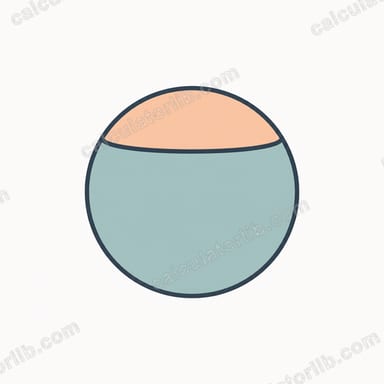

What is a spherical cap?
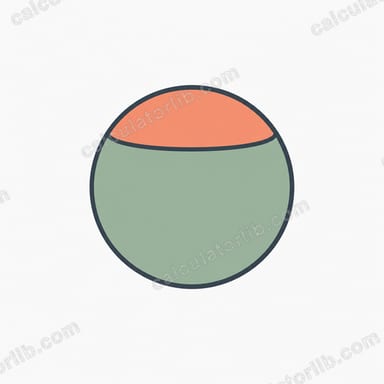
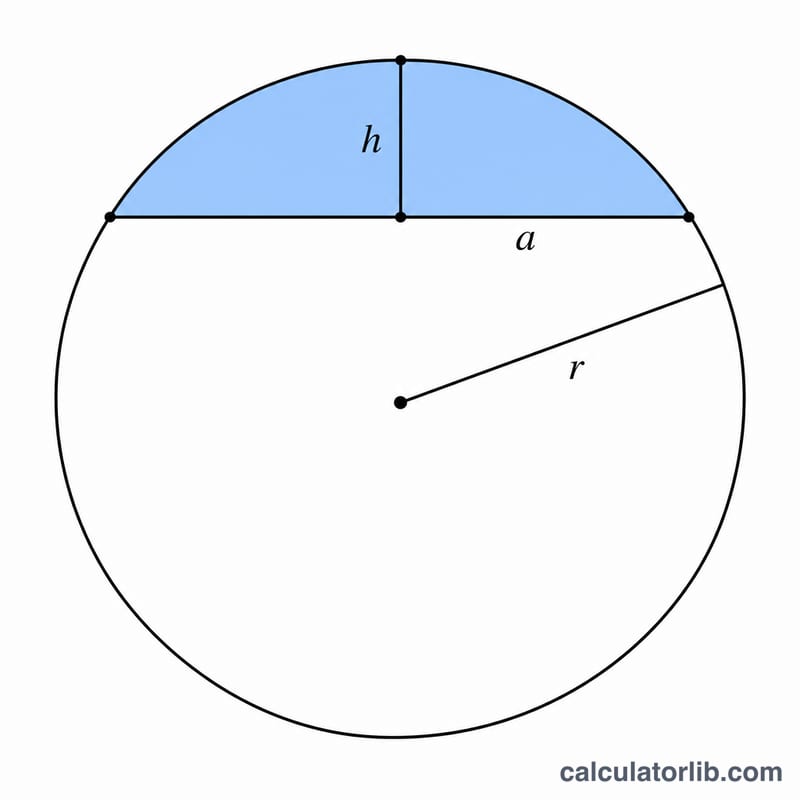
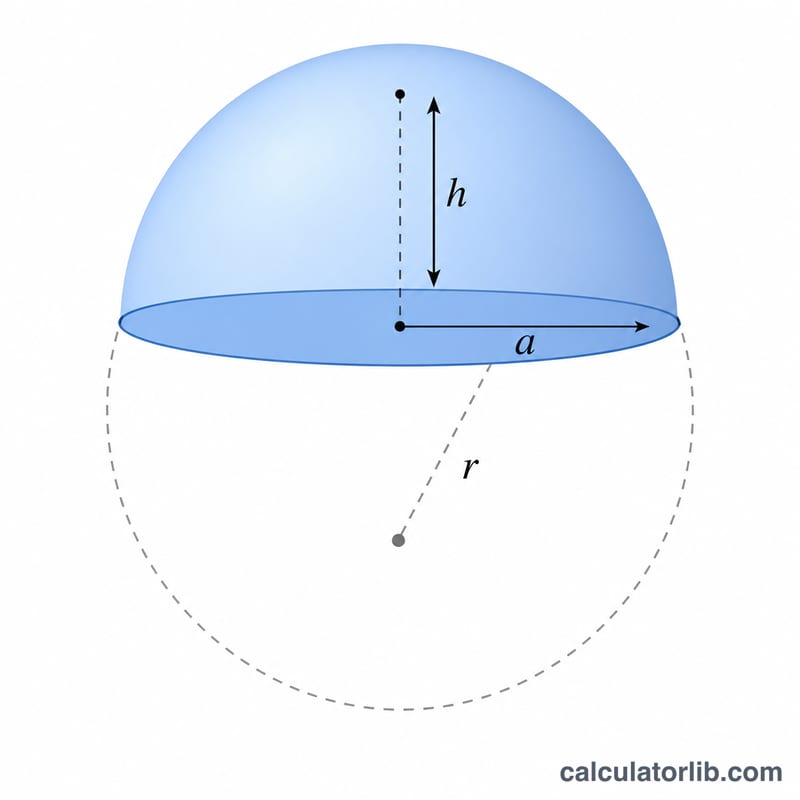
A spherical cap is the portion of a sphere cut off by a plane. It is defined by the sphere's radius r and the cap's height h (the perpendicular distance from the cutting plane to the top of the cap). When h equals r the cap is exactly a hemisphere, and when h equals 2r it is the whole sphere.
How to use this calculator
Enter the sphere radius and the cap height in the same units. The calculator returns the cap volume, the curved (lateral) surface area, the flat base circle area, the total surface area, and the radius of the base circle. The cap height is automatically clamped to lie between 0 and the diameter 2r.
The formulas explained
The volume is $$V = \frac{\pi h^{2}}{3}\left(3r - h\right).$$ The curved surface area is $$A = 2\pi r h.$$ The base of the cap is a circle whose radius \(a\) satisfies \(a^{2} = h(2r - h)\), so the base area is \(\pi a^{2}\) and the total surface area is the curved area plus the base area.
Worked example
For \(r = 5\) and \(h = 2\): $$V = \frac{\pi\cdot 4}{3}\left(15 - 2\right) = \frac{4\pi}{3}\cdot 13 \approx 54.4543 \text{ cubic units}.$$ Curved area \(= 2\pi\cdot 5\cdot 2 = 20\pi \approx 62.8319\). Base radius \(a = \sqrt{2\cdot 8} = 4\), so base area \(= 16\pi \approx 50.2655\) and total area \(\approx 113.0973\).
FAQ
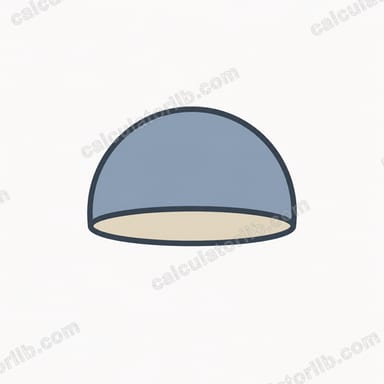
What if h = r? You get a hemisphere: with \(r = 3\), \(h = 3\), $$V = \frac{\pi\cdot 9}{3}\left(9 - 3\right) = 3\pi\cdot 6 = 18\pi \approx 56.5487.$$
What units does it use? Any consistent unit — output volume is in cubic units and areas in square units.
Can h be larger than the diameter? No. The tool clamps h to a maximum of 2r, the full sphere.