
What is a hemispherical frustum (spherical cap)?
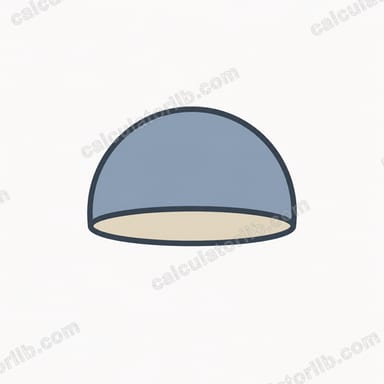
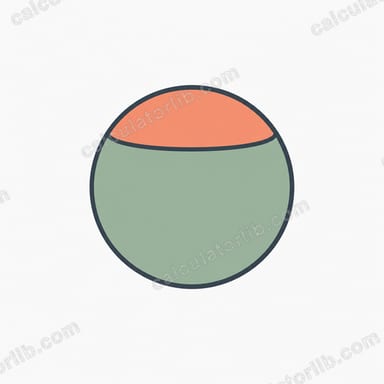
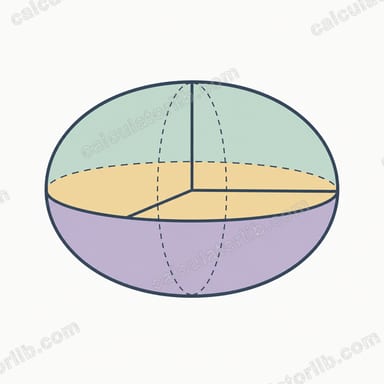
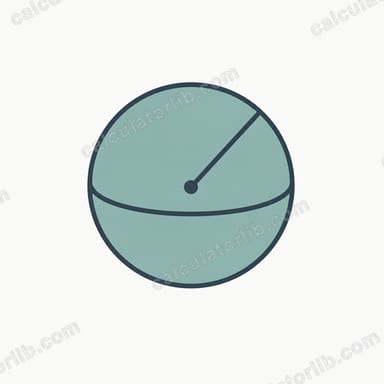
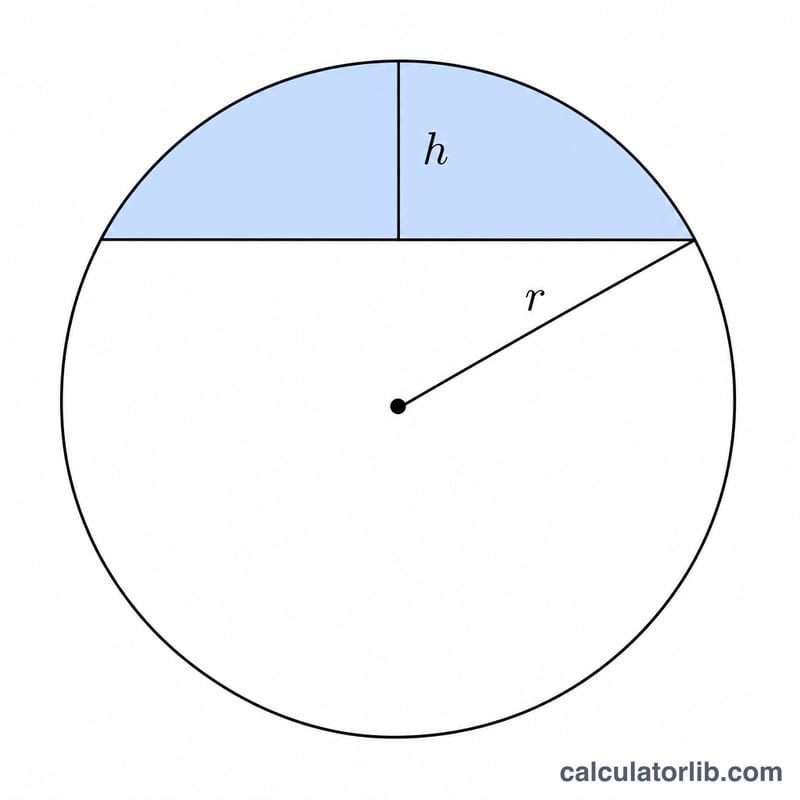
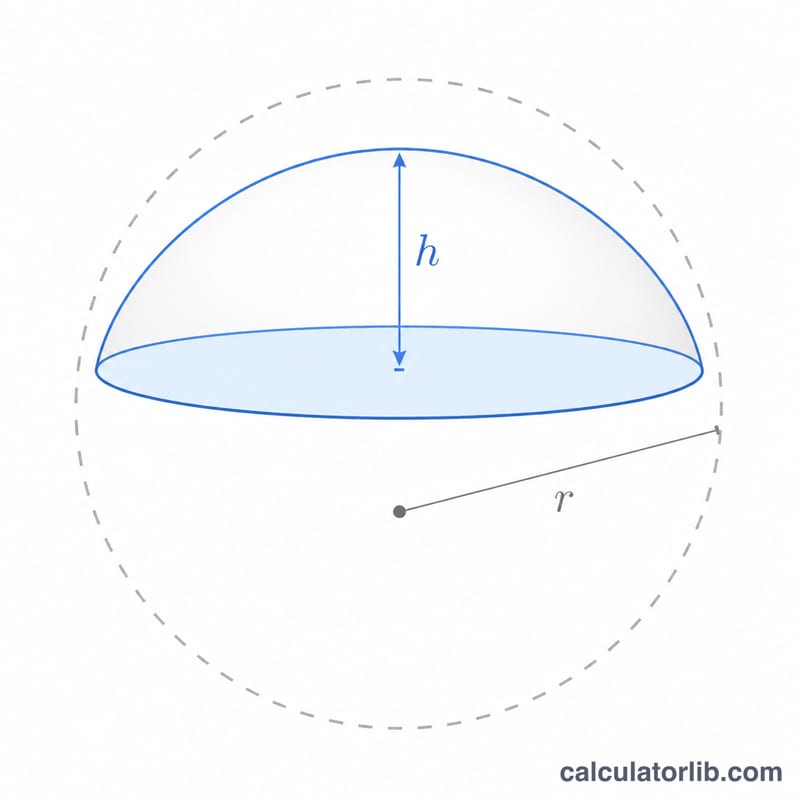
A spherical cap is the solid you get when a sphere of radius r is sliced by a single horizontal plane and you keep the dome-shaped piece above (or below) that plane. Its height h is measured from the flat cut face up to the top of the sphere. This tool restricts h to be no greater than r, so the largest possible solid is exactly a hemisphere. The flat circular cut has radius a, where \(a^2 = h(2r - h)\).
How to use the calculator
Enter the sphere radius r and the cap height h in the same length unit (centimeters, inches, meters — your choice; results follow as that unit cubed and squared). Make sure 0 < h ≤ r. The calculator returns the volume, the total surface area (curved dome plus flat base), and useful intermediate values: the dome area, the base disk area, and the base circle radius a.
The formulas explained
The cap volume is $$V = \frac{\pi h^2}{3}(3r - h)$$ The curved spherical surface is the spherical zone $$2\pi r h$$ a neat result from Archimedes. The flat base is a circle of area $$\pi a^2 = \pi h(2r - h)$$ Adding these gives the total surface area $$S = 2\pi r h + \pi h(2r - h) = \pi h(4r - h)$$
Worked example
For \(r = 1\) and \(h = 0.5\): $$a = \sqrt{0.5 \times 1.5} = \sqrt{0.75} \approx 0.8660$$ $$V = \pi \times \frac{0.25}{3} \times 2.5 = \pi \times 0.20833 \approx 0.65450$$ $$\text{Curved area} = 2\pi \times 1 \times 0.5 = \pi \approx 3.14159$$ $$\text{Base area} = 0.75\pi \approx 2.35619$$ $$\text{Total } S = \pi \times 0.5 \times 3.5 = 1.75\pi \approx 5.49779$$
FAQ
Why is h limited to r? The original tool models "at most a hemisphere," so it caps the height at the sphere radius. Mathematically a cap can have h up to 2r, but this version stays within h ≤ r.
Does the surface area include the flat disk? Yes. The reported total surface area is the curved dome plus the flat circular cut. If you only need the dome, use the curved-area row.
What happens at h = r? You get a perfect hemisphere: \(V = \frac{2}{3}\pi r^3\), \(\text{dome} = 2\pi r^2\), \(\text{base} = \pi r^2\).