
What is a spherical cap?
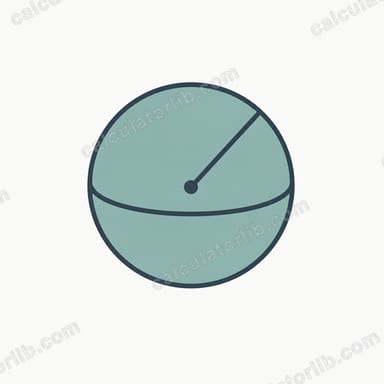
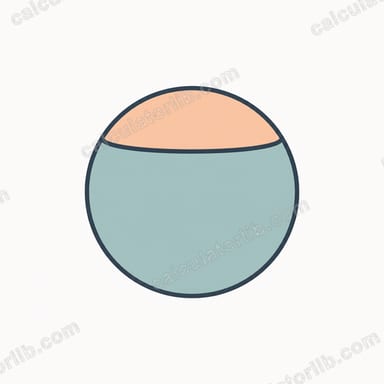
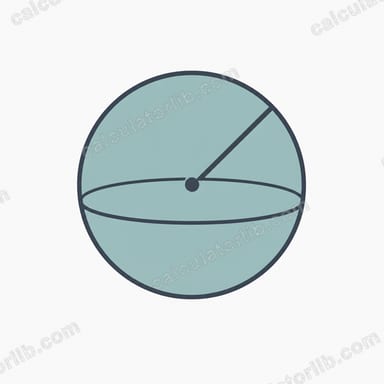
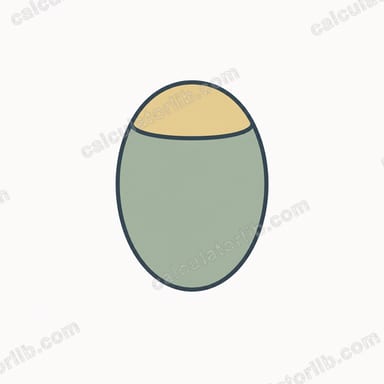
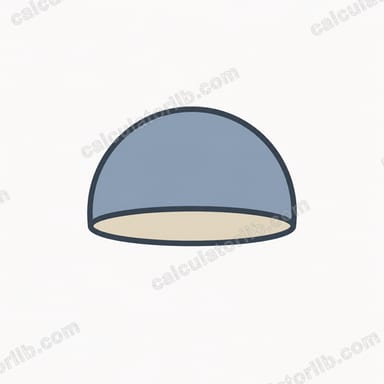
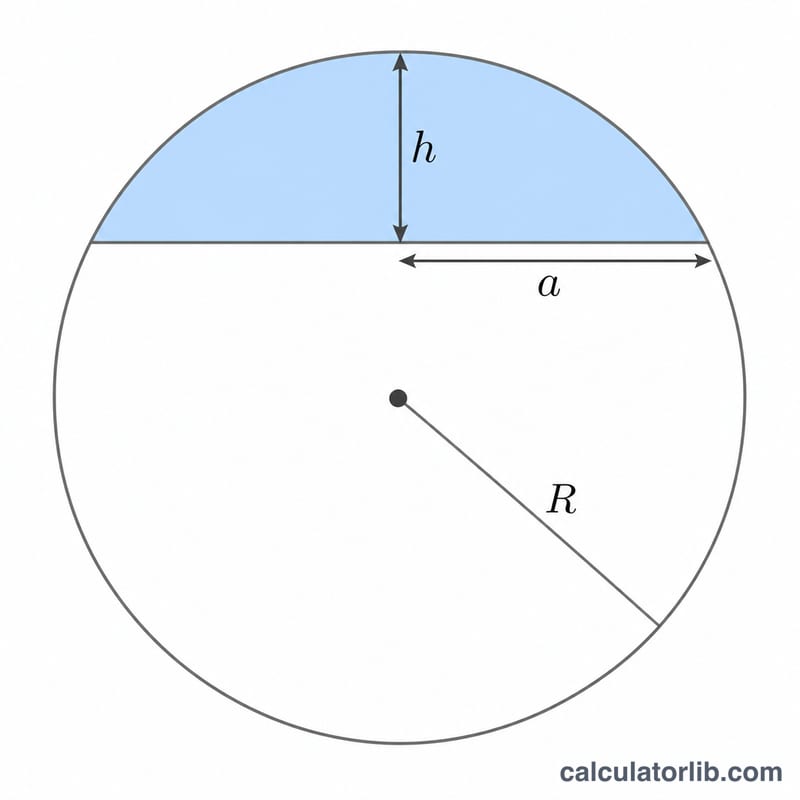
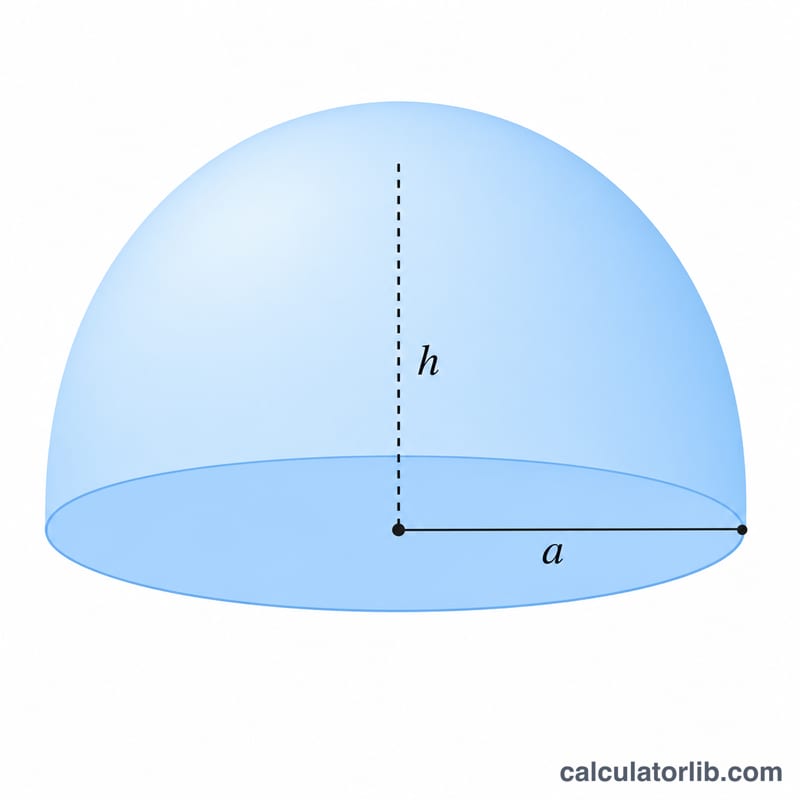
A spherical cap (also called a spherical dome or a truncated sphere with one base) is the solid that remains when you slice a sphere with a single flat plane and keep the smaller "cut-off" piece. It is defined by the sphere radius \(R\) and the cap height \(h\) — the distance from the cutting plane to the top of the dome. This is a universal geometry tool: the formulas apply identically everywhere, in any unit of length.
How to use it
Enter the sphere radius \(R\) and the cap height \(h\), then choose a length unit (the same unit is used for both inputs and for the results). The constraint is \(0 < h \le 2R\): when \(h = 2R\) the cap becomes the whole sphere, and when \(h = R\) it is exactly a hemisphere. The calculator returns the flat base radius \(a\), the cap volume, the curved (spherical) surface area, the flat base area, and the total surface area.
The formulas explained
The base radius comes from the right-triangle relation \(a^2 = h(2R - h)\), so $$a = \sqrt{h(2R - h)}.$$ The volume is $$V = \frac{\pi h^2}{3}(3R - h).$$ The curved area of the cap is \(S_{\text{curved}} = 2\pi R h\), while the flat circular base has area \(S_{\text{base}} = \pi a^2 = \pi h(2R - h)\). The total surface area adds the two: $$S_{\text{total}} = 2\pi R h + \pi h(2R - h).$$
Worked example
Take \(R = 10\) cm and \(h = 4\) cm. Then $$a = \sqrt{4 \times 16} = \sqrt{64} = 8 \text{ cm}.$$ The volume is $$V = \frac{\pi \times 16}{3}(30 - 4) = \frac{416}{3}\pi \approx 435.63 \text{ cm}^3.$$ The curved area is \(2\pi \times 10 \times 4 = 80\pi \approx 251.33\) cm², the base area is \(\pi \times 64 = 64\pi \approx 201.06\) cm², and the total surface area is \(144\pi \approx 452.39\) cm².
FAQ
What if h equals 2R? The cap is the full sphere: \(V = \frac{4}{3}\pi R^3\), curved area \(= 4\pi R^2\), and the base radius is 0.
What if h equals R? You get a hemisphere: \(V = \frac{2}{3}\pi R^3\), curved area \(= 2\pi R^2\), and \(a = R\).
Can the cap height exceed the diameter? No. The cutting plane cannot remove more than the whole sphere, so \(h\) must satisfy \(0 < h \le 2R\); larger values are rejected.