

What Is an Absolute Value Equation?
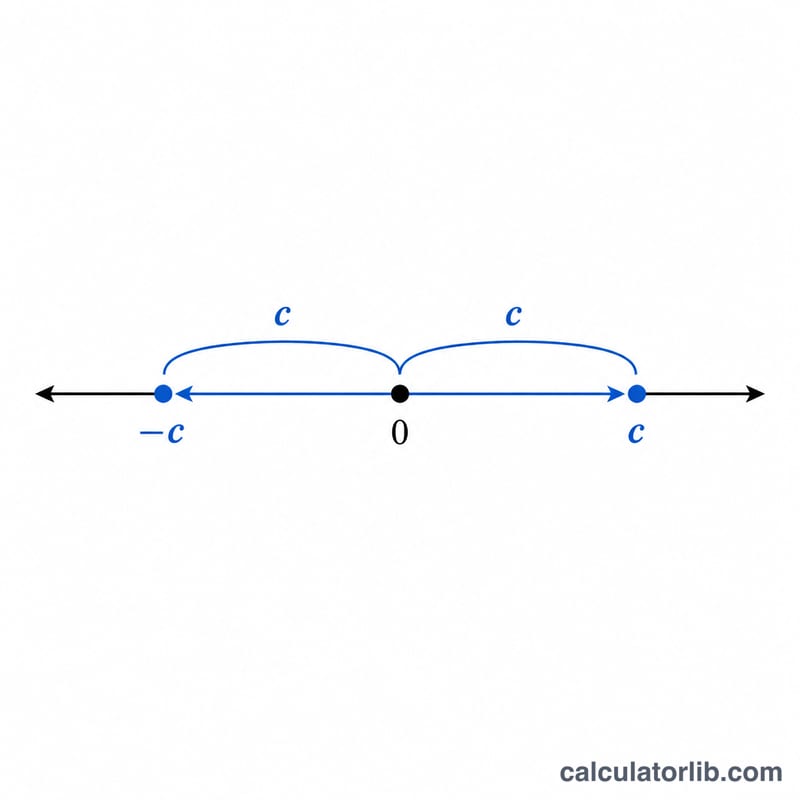
An absolute value equation has the form \(|ax + b| = c\), where the expression inside the absolute value bars must equal a fixed distance \(c\) from zero. Because absolute value measures distance, the quantity inside can be either positive or negative, which is why these equations usually produce two solutions. This calculator solves any equation written as \(|ax + b| = c\) for the variable \(x\).
How to Use the Calculator
Enter the three numbers \(a\), \(b\), and \(c\) from your equation. For example, \(|2x - 3| = 5\) means \(a = 2\), \(b = -3\), and \(c = 5\). Click calculate and the tool returns both possible values of \(x\), a single value when \(c = 0\), or a "no solution" message when \(c\) is negative.
The Formula Explained
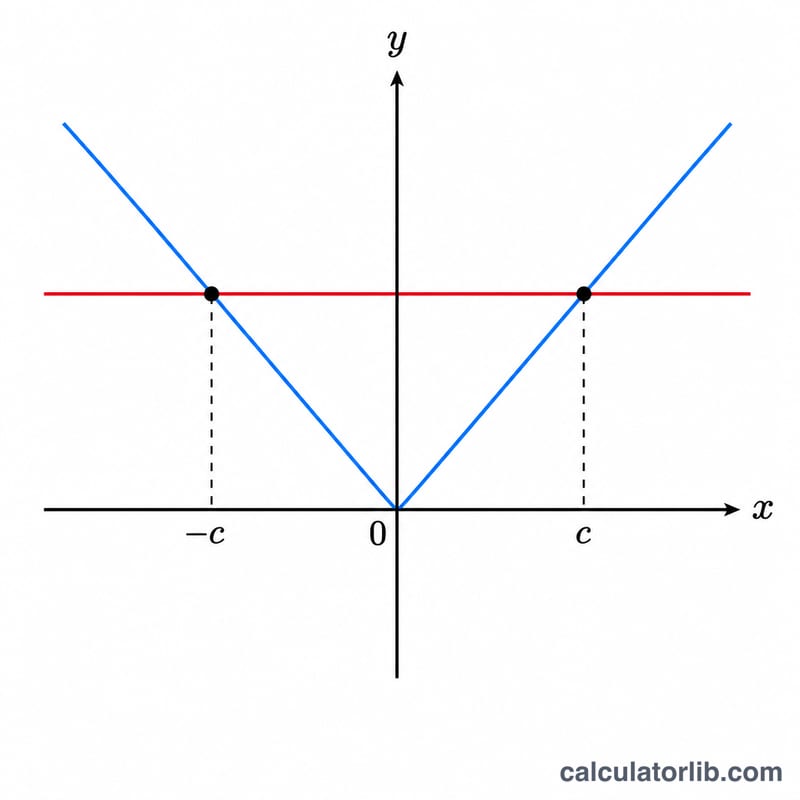
To remove the absolute value, we split the equation into two cases: \(ax + b = c\) and \(ax + b = -c\). Solving each for \(x\) gives $$x = \frac{c - b}{a} \;\text{ and }\; x = \frac{-c - b}{a}.$$ If \(c < 0\) there is no solution, because absolute value is never negative. If \(c = 0\) the two cases collapse into one solution. The coefficient \(a\) must not be zero, otherwise there is no variable to solve for.
Worked Example
Solve \(|2x - 3| = 5\). Here \(a = 2\), \(b = -3\), \(c = 5\). First solution: $$x = \frac{5 - (-3)}{2} = \frac{8}{2} = 4.$$ Second solution: $$x = \frac{-5 - (-3)}{2} = \frac{-2}{2} = -1.$$ So \(x = 4\) or \(x = -1\). You can verify: \(|2(4) - 3| = |5| = 5\) ✓ and \(|2(-1) - 3| = |-5| = 5\) ✓.
FAQ
Why do absolute value equations have two answers? Because both a positive and a negative quantity have the same absolute value, the inside expression can equal \(+c\) or \(-c\).
When is there no solution? When \(c\) is negative. An absolute value is always zero or positive, so it can never equal a negative number.
What if c equals zero? Then \(|ax + b| = 0\) forces \(ax + b = 0\), giving exactly one solution: \(x = \frac{-b}{a}\).