
What Is the Vertex of an Absolute Value Graph?
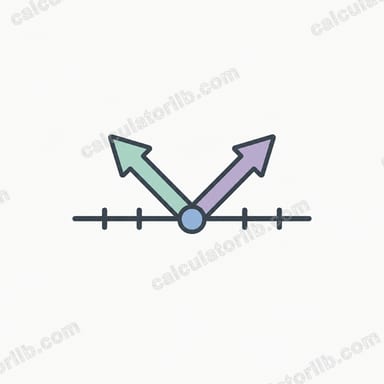
The graph of an absolute value function is a V shape (or an upside-down V). The single point where the two straight rays meet — the sharp corner where the graph changes direction — is called the vertex. For a function written in the general form \(y = a|bx + c| + d\), the vertex is the most important feature: it locates the minimum or maximum of the graph and sits on the axis of symmetry. This calculator finds the vertex \((h, k)\) along with the axis of symmetry, opening direction, ray slopes, extreme value, range, and domain.
How to Use This Calculator
Enter the four coefficients \(a\), \(b\), \(c\), and \(d\) from your equation \(y = a|bx + c| + d\). The calculator returns the vertex \((h, k)\), the axis of symmetry \(x = h\), whether the graph opens up or down, the slopes of the two rays, the minimum or maximum value, and the range and domain. Both \(a\) and \(b\) must be non-zero; if either is zero the graph collapses to a horizontal line and has no vertex.
The Formula Explained
The V turns exactly where the quantity inside the absolute value bars equals zero, because \(|0| = 0\) is the smallest value the bars can produce. Setting the inside to zero, \(bx + c = 0\), gives the vertex x-coordinate:
$$h = -\frac{c}{b}, \qquad k = d$$The y-coordinate is simply \(d\), since at \(x = h\) the bars contribute nothing and \(y = a \cdot 0 + d = d\). The axis of symmetry is the vertical line \(x = h\). Away from the vertex the graph is made of two straight rays whose slopes are \(+a|b|\) on the right and \(-a|b|\) on the left, so both rays have magnitude \(|ab|\). If \(a > 0\) the graph opens upward and \(k\) is a minimum; if \(a < 0\) it opens downward and \(k\) is a maximum. The domain is always all real numbers.
Worked Example
Find the vertex of \(y = 2|x - 3| + 1\). Here \(a = 2\), \(b = 1\), \(c = -3\), and \(d = 1\).
$$h = -\frac{c}{b} = -\frac{-3}{1} = 3, \qquad k = d = 1$$So the vertex is \((3, 1)\) and the axis of symmetry is \(x = 3\). Because \(a = 2 > 0\), the graph opens upward, so \(k = 1\) is the minimum value and the range is \(y \ge 1\). The two rays have slopes \(+2\) and \(-2\), each of magnitude \(2\). The domain is all real numbers.
FAQ
Where is the vertex of an absolute value function? It is the corner where the two rays meet. For \(y = a|bx + c| + d\) the vertex is \(\left(-\frac{c}{b},\, d\right)\) — set the inside of the bars to zero to find the x-coordinate, and read \(d\) for the y-coordinate.
How do I find the axis of symmetry? The axis of symmetry is the vertical line through the vertex, \(x = -\frac{c}{b}\). The graph is a mirror image on either side of this line.
Does the coefficient a move the vertex? No. The value of \(a\) only changes how steep the V is and whether it opens up or down; the vertex stays at \(\left(-\frac{c}{b},\, d\right)\). The sign of \(a\) decides whether \(k\) is a minimum when \(a > 0\) or a maximum when \(a < 0\).