
What is a Z critical value?
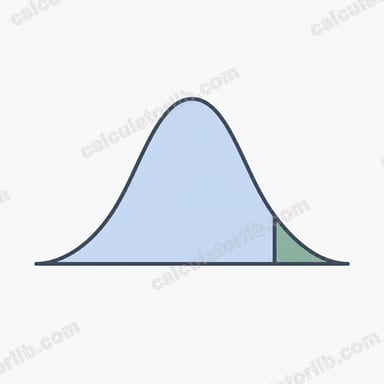
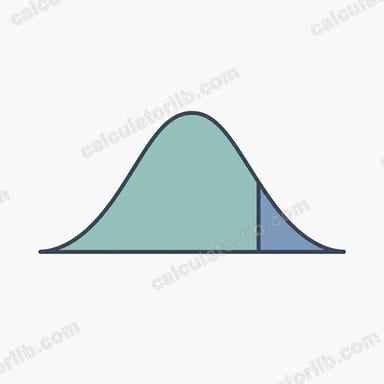
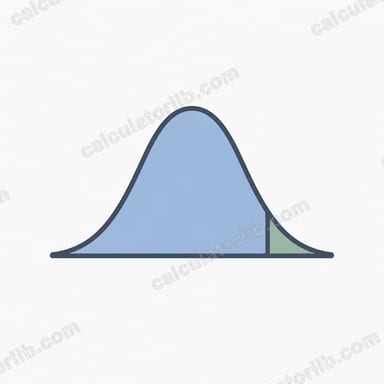
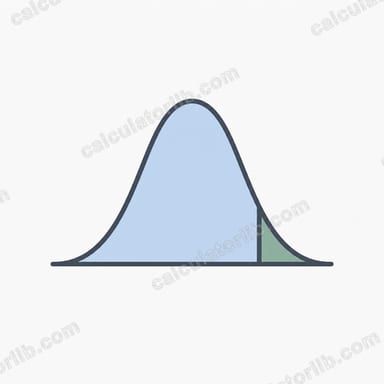
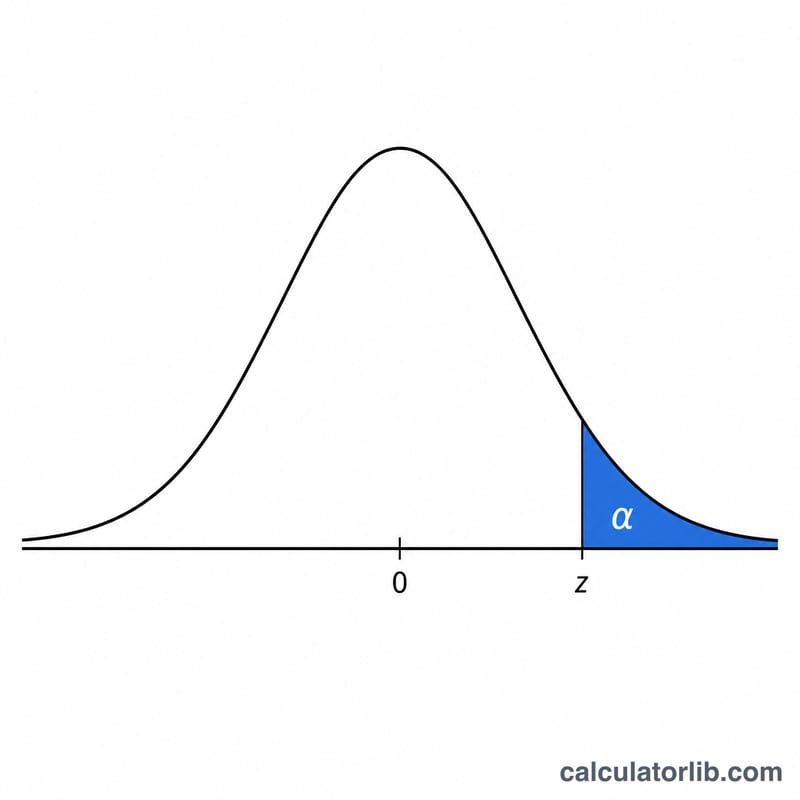
A z critical value is the cutoff point on the standard normal distribution that separates the rejection region from the non-rejection region in a hypothesis test. It is found by inverting the standard normal cumulative distribution function (CDF), often written as \(\Phi^{-1}\) or invNorm. The value you choose depends on your significance level \(\alpha\) and whether your test is one-tailed or two-tailed.
How to use this calculator
Enter your significance level \(\alpha\) (commonly 0.05, 0.01, or 0.10) and select the test type. For a two-tailed test the calculator splits \(\alpha\) evenly between both tails and returns the \(\pm\) critical value \(\Phi^{-1}(1 - \alpha/2)\). For a one-tailed test it returns the single cutoff \(\Phi^{-1}(1 - \alpha)\), which you apply as \(+z\) for an upper-tail test or \(-z\) for a lower-tail test.
The formula explained
For a one-tailed test, all of \(\alpha\) sits in one tail, so you need the z value with a cumulative probability of \(1 - \alpha\). For a two-tailed test, \(\alpha\) is split so each tail holds \(\alpha/2\), meaning the upper cutoff has cumulative probability \(1 - \alpha/2\). This calculator evaluates the inverse normal using a high-accuracy rational approximation (Acklam's algorithm), giving results accurate to many decimal places.
$$z_{crit} = \Phi^{-1}\!\left(1 - \frac{\text{Significance Level }(\alpha)}{2}\right)$$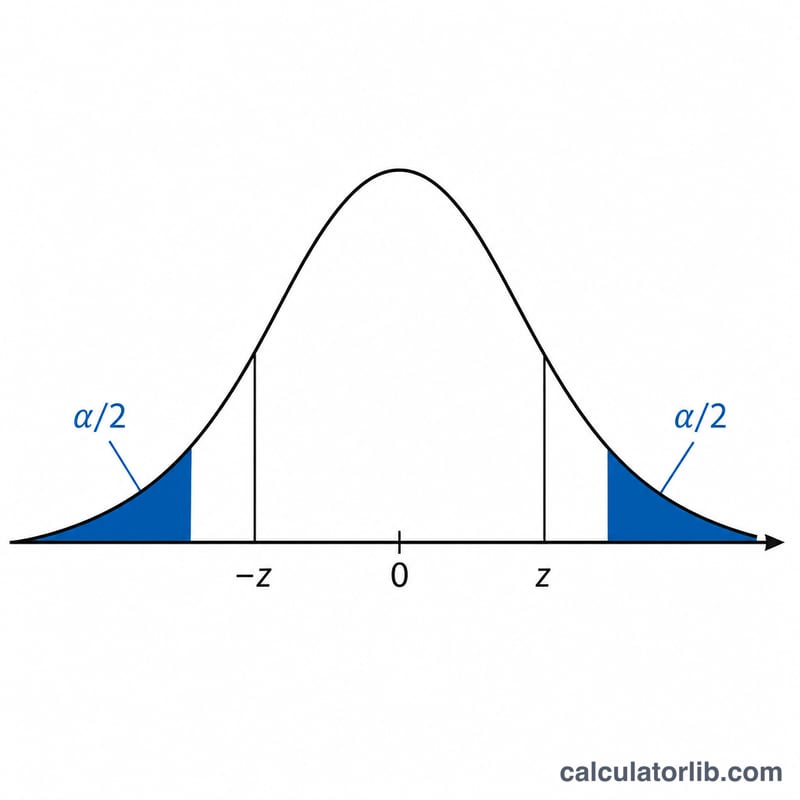
Worked example
Suppose \(\alpha = 0.05\) and you run a two-tailed test. Then \(1 - \alpha/2 = 0.975\), and
$$\Phi^{-1}(0.975) \approx 1.95996$$So your critical values are \(\pm 1.96\) — the familiar number used for 95% confidence intervals. For a one-tailed test at \(\alpha = 0.05\), the cutoff is \(\Phi^{-1}(0.95) \approx 1.6449\).
FAQ
When do I reject the null hypothesis? Reject \(H_0\) if your test statistic falls beyond the critical value (in absolute terms for a two-tailed test).
Why is the two-tailed value larger than the one-tailed value? Because \(\alpha\) is split across two tails, each tail keeps only \(\alpha/2\), pushing the cutoff farther out.
Should I use a z or t critical value? Use z when the population standard deviation is known or the sample is large; use t for small samples with an estimated standard deviation.