
What is a Critical Z Value?
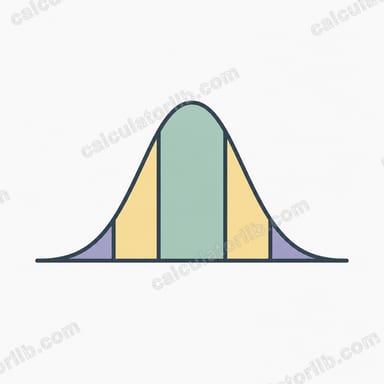
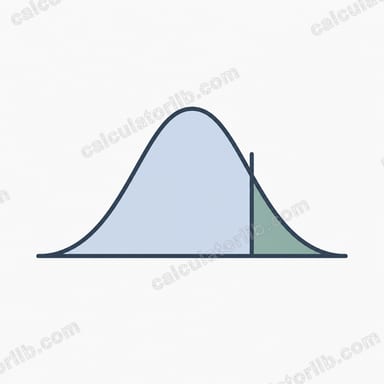
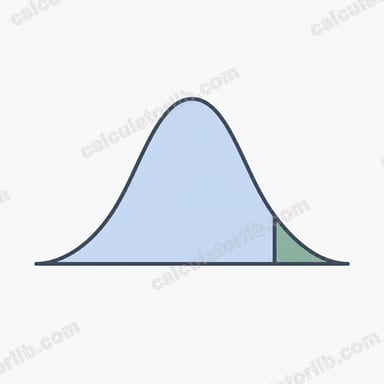
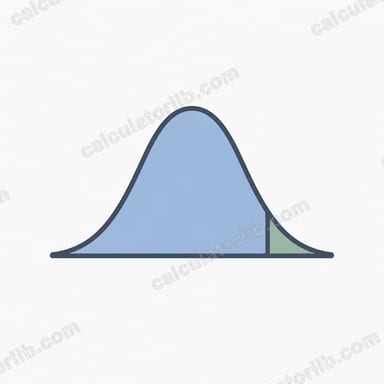
A critical z value (often written z*) marks the boundary of the rejection region in a standard normal distribution. It is the z-score that corresponds to a chosen confidence level or significance level (α). For example, the famous \(z^* = 1.96\) comes from a 95% two-tailed confidence level. This calculator inverts the standard normal cumulative distribution function (CDF) so you can go straight from a confidence level to the matching z value.
How to Use It
Enter your confidence level as a percentage (for example, 95 for 95%). Then choose whether your test is two-tailed (the usual choice for confidence intervals and two-sided hypothesis tests) or one-tailed (for a directional test). The calculator returns the critical z value along with the significance level α and the cumulative probability it looked up.
The Formula Explained
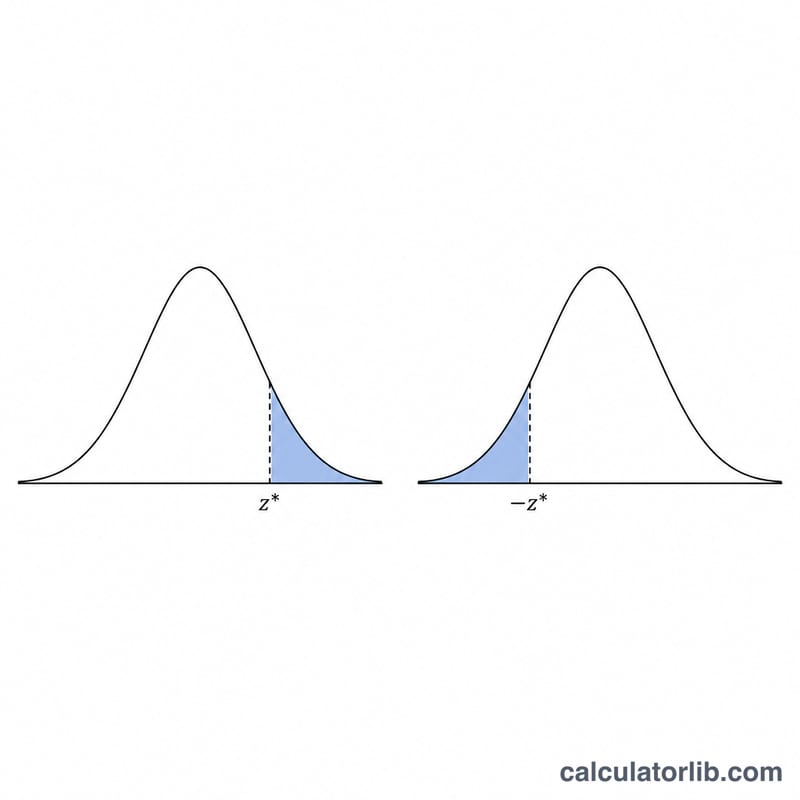
First convert the confidence level to a significance level: \(\alpha = 1 - \text{confidence}\). For a two-tailed test, the area split between both tails is \(\alpha\), so each tail holds \(\alpha/2\). The critical value is the inverse normal at \(1 - \alpha/2\), written
$$z^* = \Phi^{-1}\!\left(1 - \frac{\alpha}{2}\right)$$For a one-tailed test, all of \(\alpha\) sits in a single tail, so
$$z = \Phi^{-1}\!\left(1 - \alpha\right)$$Here \(\Phi^{-1}\) is the quantile (inverse CDF) of the standard normal distribution, computed using a high-accuracy rational approximation.
Worked Example
Suppose you want a 95% two-tailed critical value. Then
$$\alpha = 1 - 0.95 = 0.05, \quad \frac{\alpha}{2} = 0.025$$The cumulative probability is \(1 - 0.025 = 0.975\). Looking up \(\Phi^{-1}(0.975)\) gives \(z^* \approx 1.95996\), the classic 1.96 used in confidence intervals.
FAQ
Why is 95% confidence z = 1.96? Because 0.975 of the area lies to the left of 1.96 under the standard normal curve, leaving 2.5% in each tail.
What is the difference between one- and two-tailed? A two-tailed test splits \(\alpha\) across both tails (so \(z^*\) is larger); a one-tailed test puts all of \(\alpha\) in one tail.
What z value matches 99% confidence? Two-tailed, it is about \(2.5758\).