
What Is a Z-Score to P-Value Calculator?
This tool converts a standardized test statistic (a z-score) into a p-value using the standard normal distribution. The p-value tells you the probability of observing a result at least as extreme as your data, assuming the null hypothesis is true. It is one of the most common steps in hypothesis testing across psychology, biology, economics, and quality control.
How to Use It
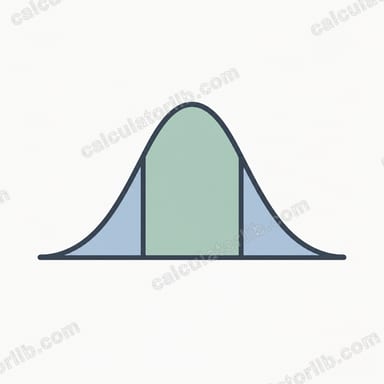
Enter your z-score and choose whether your test is two-tailed (you care about deviations in either direction) or one-tailed (you only care about one direction). The calculator returns the p-value plus the cumulative probability \(\Phi(z)\). Compare the p-value to your significance level (commonly 0.05): if p is smaller, the result is statistically significant.
The Formula Explained
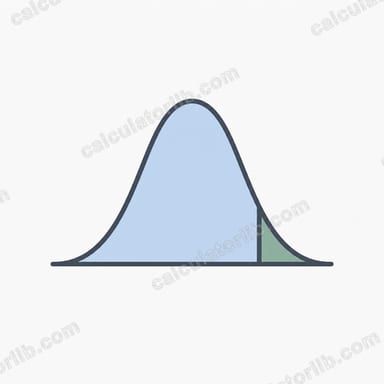
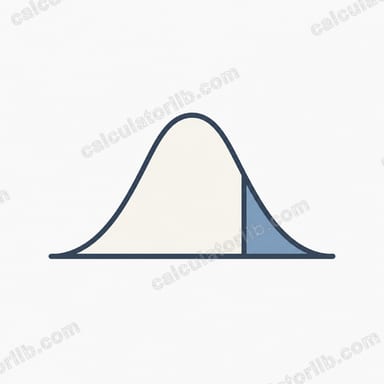
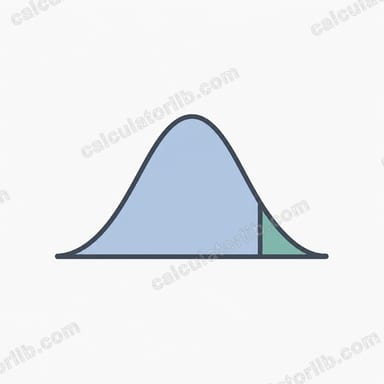
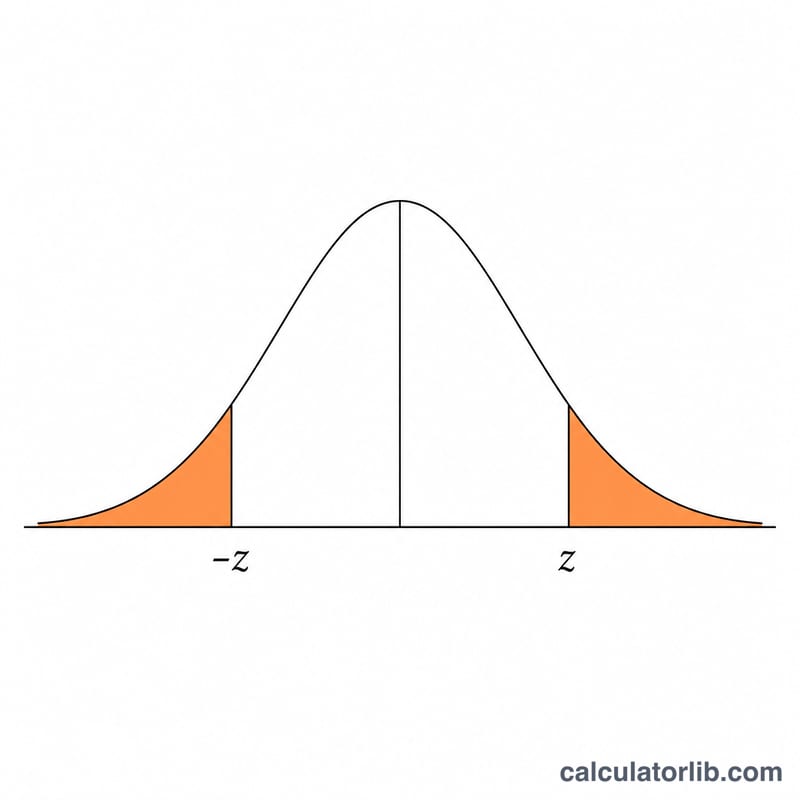
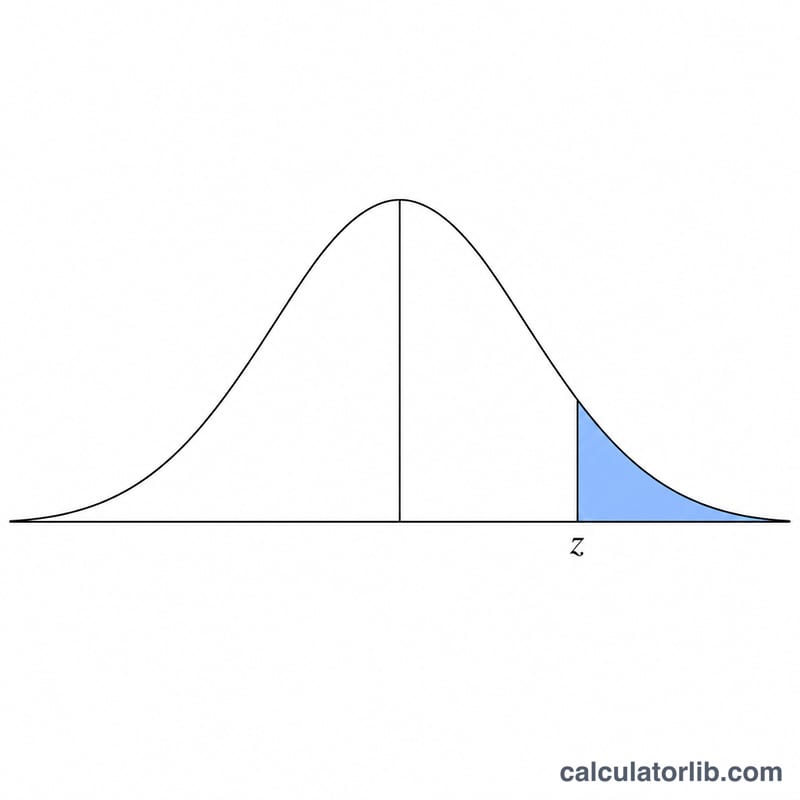
Let \(\Phi\) be the cumulative distribution function (CDF) of the standard normal distribution. For a two-tailed test, $$p = 2\left[1 - \Phi\left(\left|z\right|\right)\right]$$ doubling the upper-tail area because extreme values on both sides count. For a one-tailed (upper) test, $$p = 1 - \Phi\left(z\right)$$ This calculator evaluates \(\Phi\) with a high-accuracy polynomial approximation (Abramowitz & Stegun 7.1.26), accurate to about 7 decimal places.
Worked Example
Suppose \(z = 1.96\) on a two-tailed test. \(\Phi(1.96) \approx 0.975\), so $$1 - \Phi(1.96) \approx 0.025$$ Multiplying by 2 gives \(p \approx 0.05\) — exactly the classic 5% threshold, which is why \(z = 1.96\) is the famous critical value for a 95% confidence level.
FAQ
What does a small p-value mean? A small p-value (e.g. below 0.05) suggests the observed data would be unlikely under the null hypothesis, so you may reject it.
Should I use one-tailed or two-tailed? Use two-tailed unless you have a clear directional hypothesis decided before collecting data. Two-tailed is more conservative.
Can I enter a negative z-score? Yes. For a two-tailed test the sign does not change the result. For a one-tailed upper test, a negative z produces a p-value above 0.5.