
What is a Z-Score?
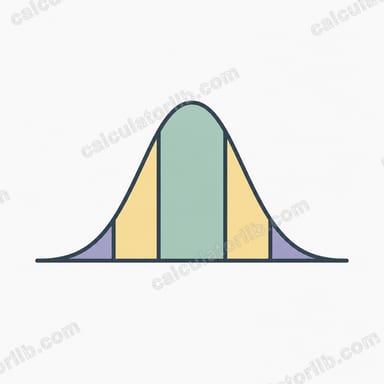
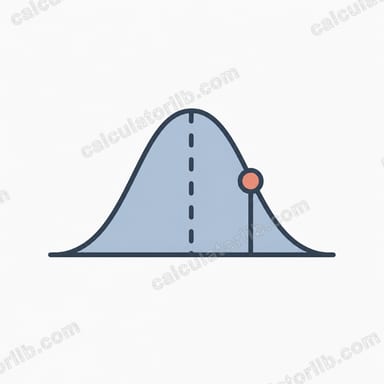
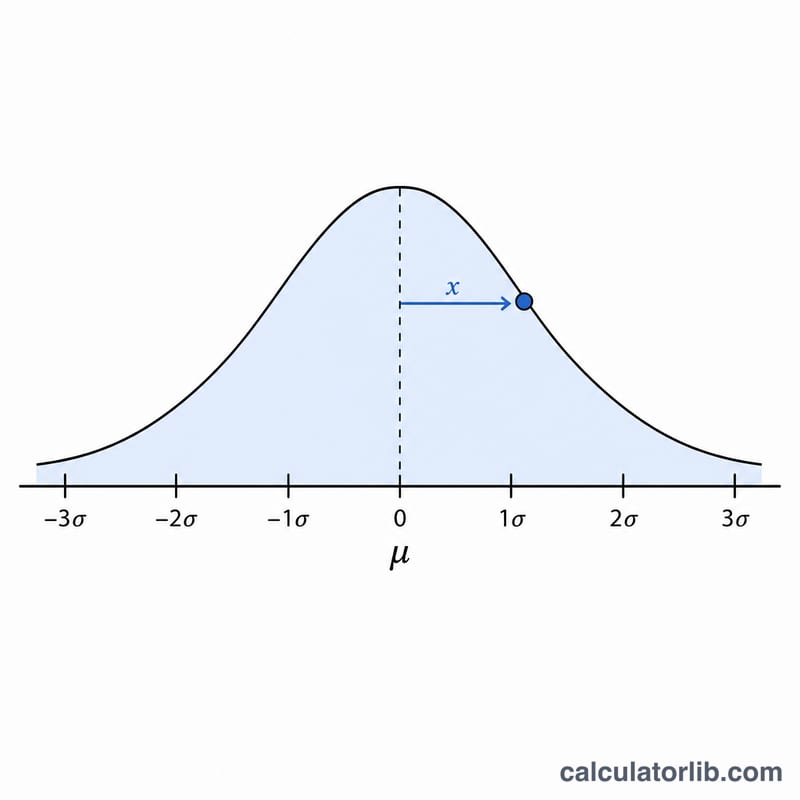
A z-score (also called a standard score) tells you how many standard deviations a data point lies above or below the mean of its distribution. A positive z-score means the value is above the mean, a negative z-score means it is below, and a z-score of 0 means it equals the mean. Z-scores let you compare values from different distributions on a common scale.
How to Use This Calculator
Enter three numbers: the raw value x you want to standardize, the population mean μ, and the standard deviation σ. The calculator instantly returns the z-score and the raw deviation \((x - \mu)\). Standard deviation cannot be zero, since dividing by zero is undefined.
The Formula Explained
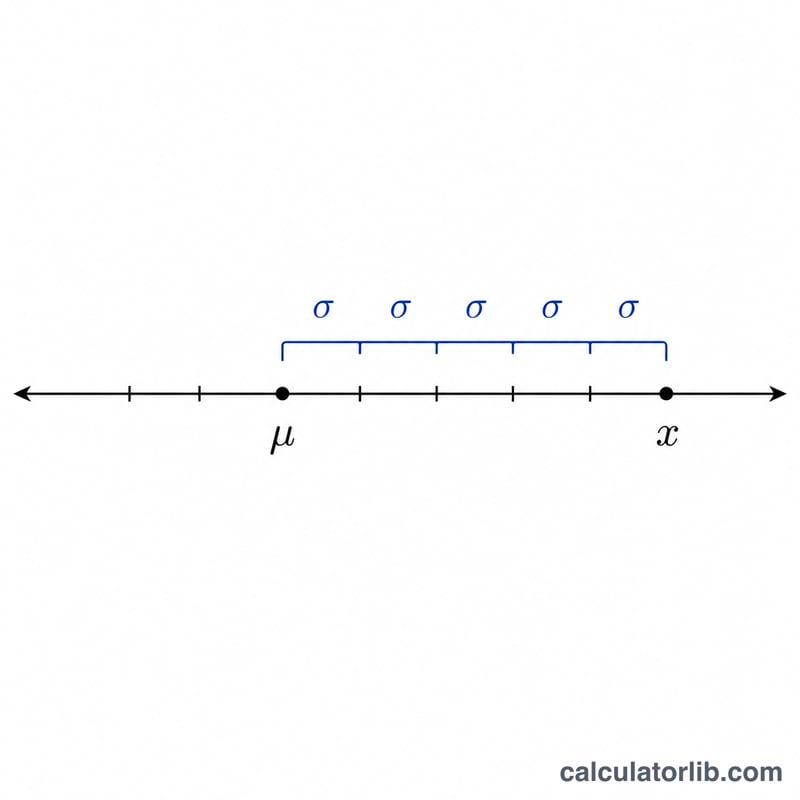
The z-score is defined as $$z = \frac{\text{Raw value }(x) - \text{Mean }(\mu)}{\text{Std.\ dev.\ }(\sigma)}$$ First subtract the mean from the value to find the deviation, then divide by the standard deviation to express that deviation in standard-deviation units. This rescaling is the same transformation used to convert any normal distribution into the standard normal distribution with mean 0 and standard deviation 1.
Worked Example
Suppose a student scores 85 on a test where the class mean is 70 and the standard deviation is 10. The deviation is \(85 - 70 = 15\). Dividing by 10 gives $$z = \frac{15}{10} = 1.5$$ The student scored 1.5 standard deviations above the average.
FAQ
What does a negative z-score mean? It means the value is below the mean. For example, \(z = -2\) is two standard deviations below average.
What is a "good" z-score? It depends on context. In testing, higher (more positive) is usually better; in quality control, values closer to 0 indicate being on target.
Should I use population or sample standard deviation? Use whichever σ best describes your reference group. The formula is identical; just plug in the appropriate standard deviation.