
What Is a Percentile-to-Z-Score Calculator?
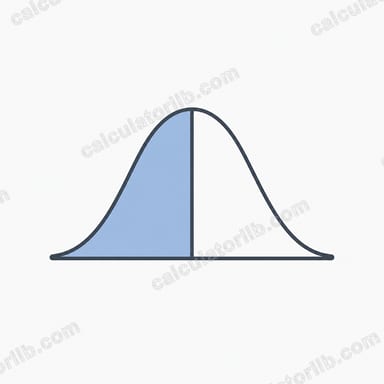
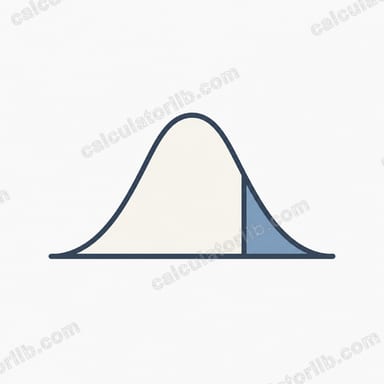
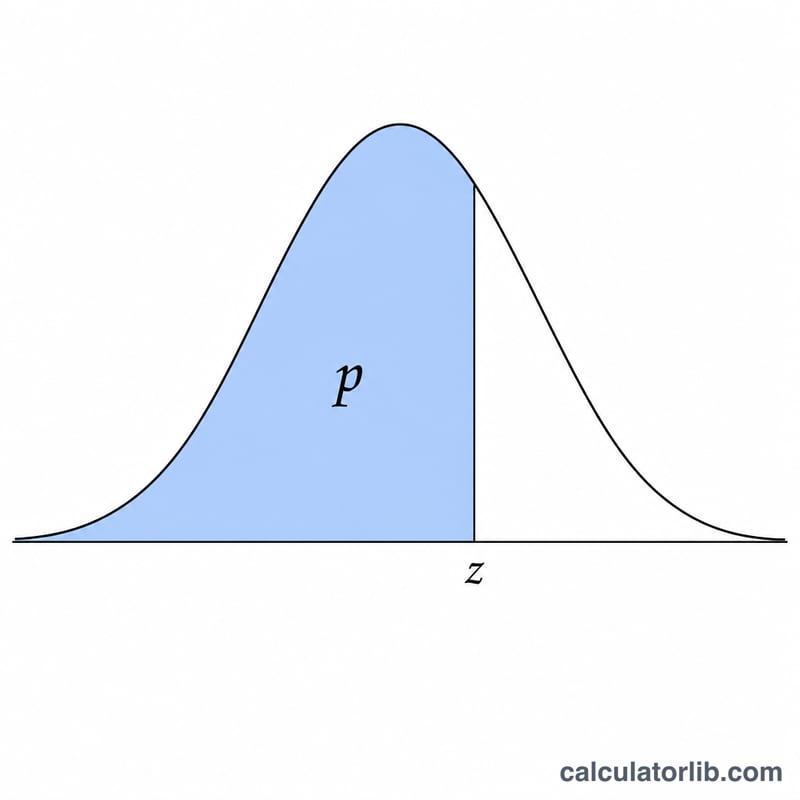
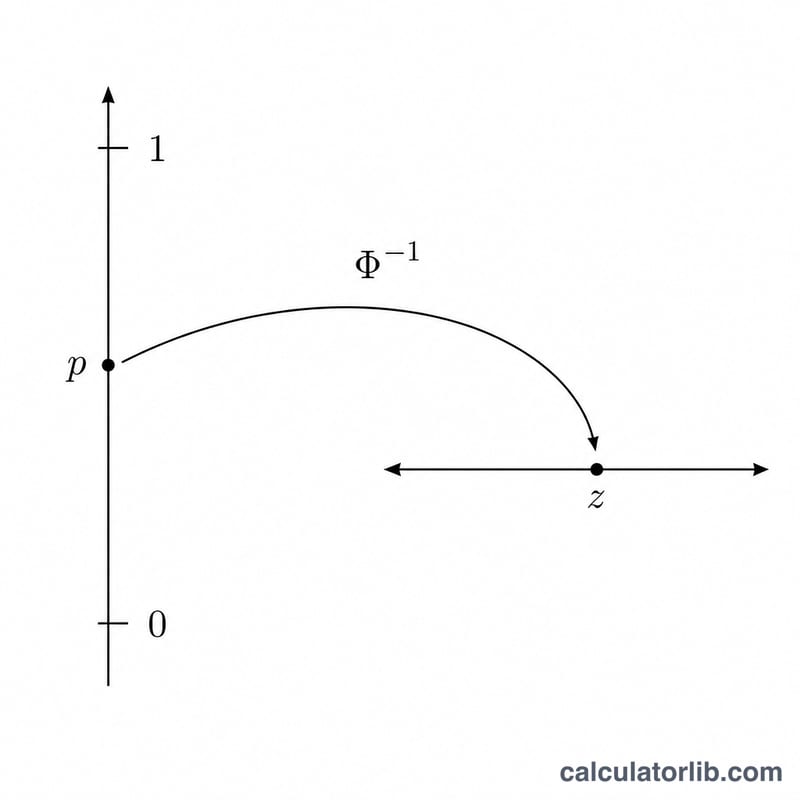
This tool converts a percentile into its corresponding z-score on the standard normal distribution (mean 0, standard deviation 1). A z-score tells you how many standard deviations a value lies above or below the mean. Because percentiles describe the share of data below a point, finding the z-score requires the inverse of the normal cumulative distribution function, written \(\Phi^{-1}\).
How to Use It
Enter a percentile between 0 and 100 — for example, 90 means "90% of values fall below this point." The calculator returns the z-score. Percentiles below 50 produce negative z-scores (below the mean), exactly 50 gives 0, and values above 50 give positive z-scores.
The Formula Explained
If \(p\) is the percentile divided by 100, then
$$z = \Phi^{-1}(p)$$where \(\Phi\) is the standard normal CDF. There is no simple closed form for \(\Phi^{-1}\), so this calculator uses Acklam's rational approximation, which is accurate to roughly \(1\times10^{-9}\) across the full range.
Worked Example
Suppose you want the z-score for the 97.5th percentile. Set \(p = 0.975\). The inverse normal CDF returns
$$z = \Phi^{-1}(0.975) \approx 1.9600$$This is the familiar critical value used for a 95% confidence interval (since 2.5% lies in each tail).
FAQ
What z-score equals the 50th percentile? Exactly 0, since the median of a normal distribution sits at the mean.
Why can't I enter 0 or 100? The z-scores for 0 and 100 are negative and positive infinity. The calculator clamps extreme inputs to return a very large finite value instead.
Is this for a standard normal distribution? Yes. To convert to a real distribution with mean \(\mu\) and standard deviation \(\sigma\), use \(x = \mu + z\cdot\sigma\).