
What is Cohen's d?
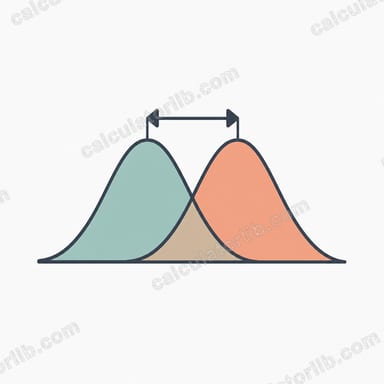
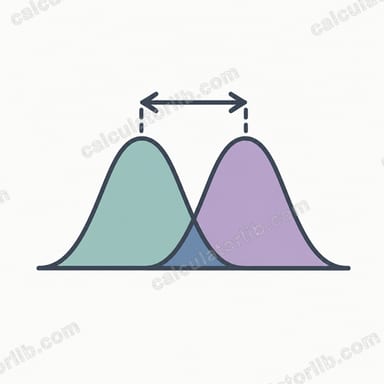
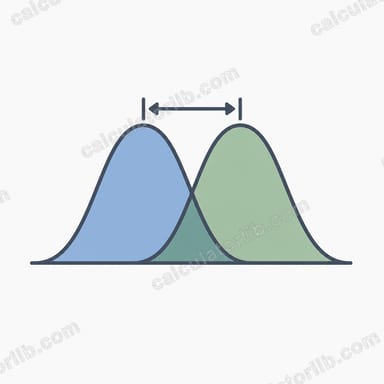
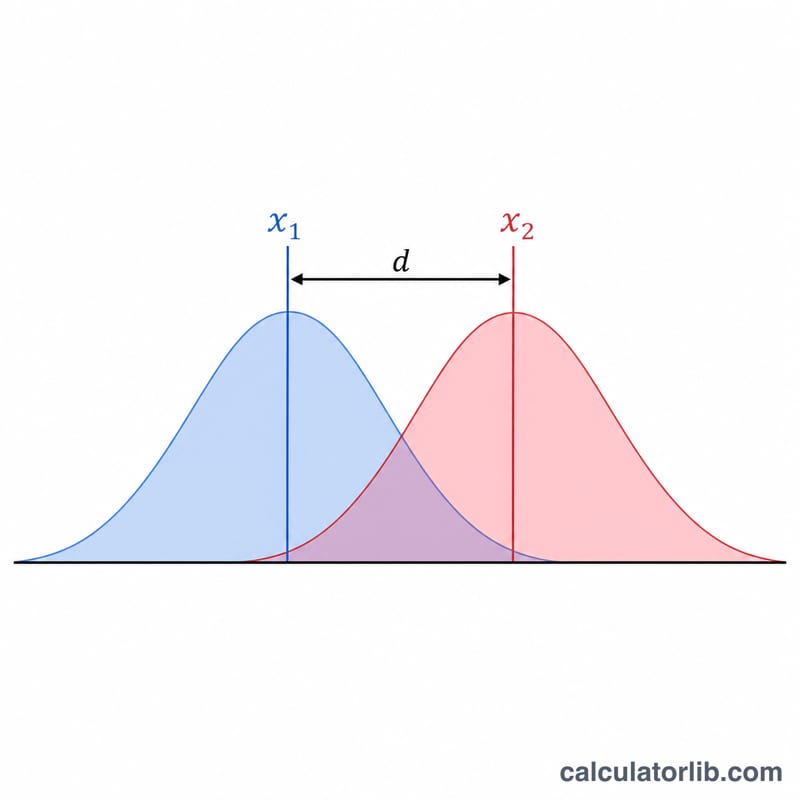
Cohen's d is a standardized measure of effect size that expresses the difference between two group means in units of pooled standard deviation. Unlike a p-value, which only tells you whether a difference is statistically significant, Cohen's d tells you how large the difference actually is, making it ideal for comparing results across studies or planning sample sizes for power analysis.
How to use this calculator
Enter the mean, standard deviation, and sample size for each of your two groups. The calculator computes the pooled standard deviation, then divides the difference in means by it to give Cohen's d. It also classifies the magnitude using Cohen's conventional benchmarks.
The formula explained
The pooled standard deviation weights each group's variance by its degrees of freedom:
$$s_\text{pooled} = \sqrt{\frac{(n_1-1)s_1^{2} + (n_2-1)s_2^{2}}{n_1+n_2-2}}$$Cohen's d is then
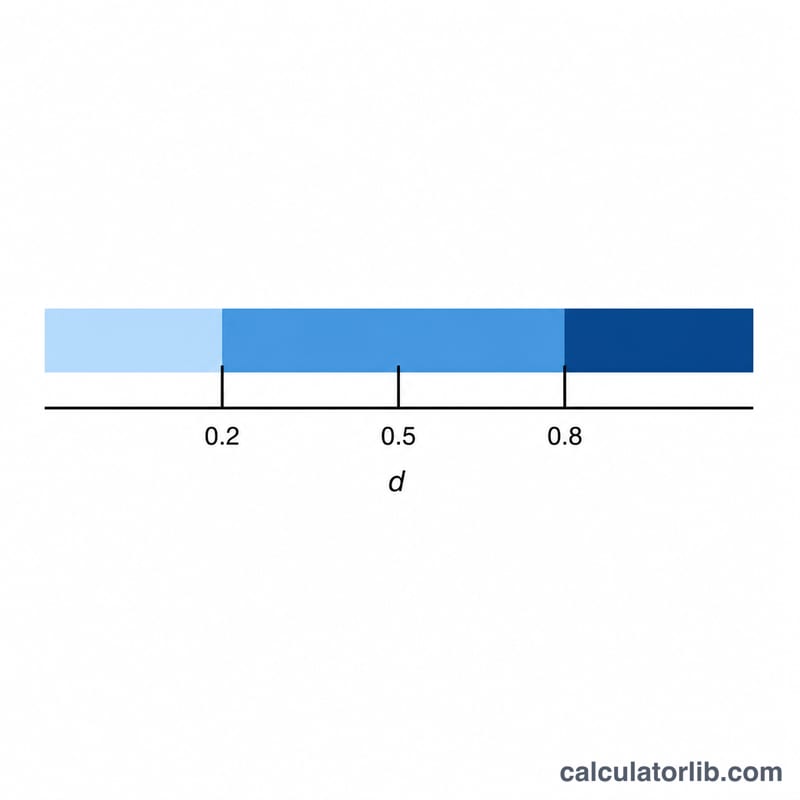
$$d = \frac{\bar{x}_1 - \bar{x}_2}{s_\text{pooled}}$$By convention, \(|d| \approx 0.2\) is small, \(0.5\) is medium, and \(0.8\) or more is large.
Worked example
Suppose group 1 has mean 25, SD 12, n 40, and group 2 has mean 18, SD 9, n 30. The pooled variance is
$$\frac{(39)(144) + (29)(81)}{68} = \frac{5616 + 2349}{68} = 117.1324$$so \(s_\text{pooled} \approx 10.8228\). Cohen's d =
$$\frac{25 - 18}{10.8228} \approx 0.647$$a medium effect.
FAQ
Does the sign of d matter? The sign just shows which group has the higher mean; the magnitude is what matters for effect size, so it is often reported as an absolute value.
Why use pooled SD instead of one group's SD? Pooling combines information from both samples, giving a more stable estimate of the common spread, which is appropriate when variances are roughly equal.
What if my groups have different sizes? That's fine — the degrees-of-freedom weighting handles unequal sample sizes automatically.