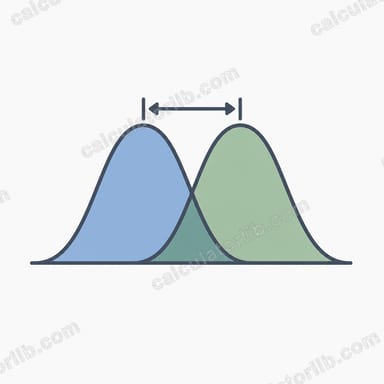

What is Cohen's d?
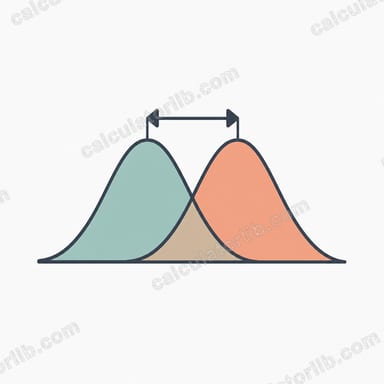
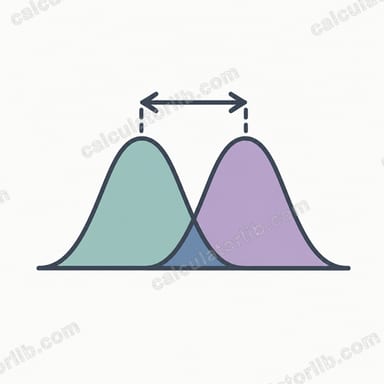
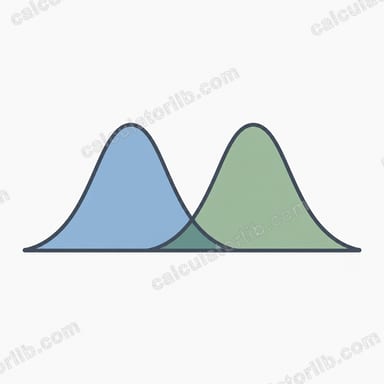
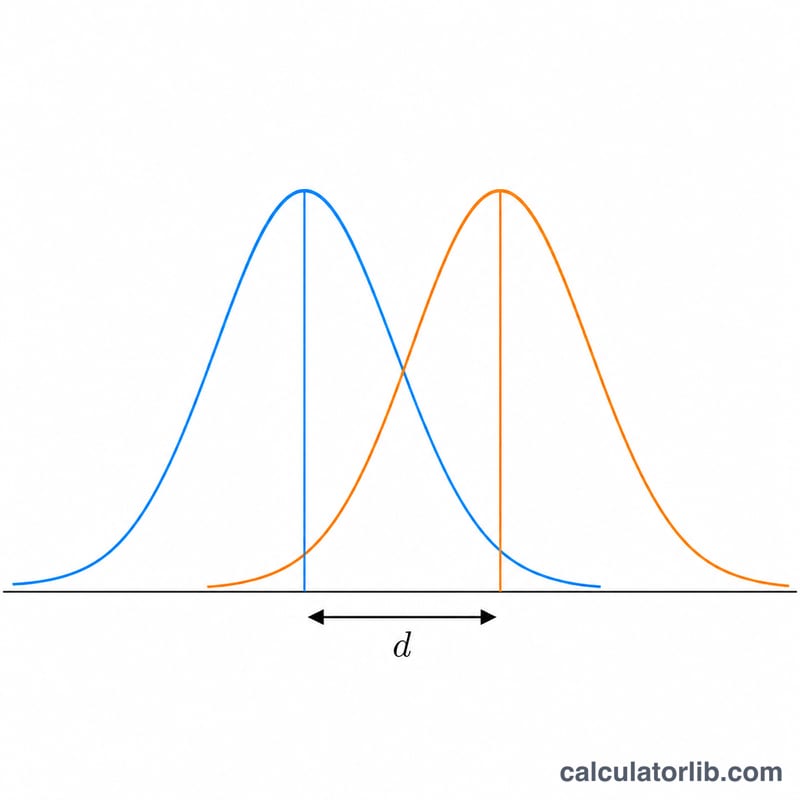
Cohen's d is a standardized measure of effect size that expresses the difference between two group means in units of standard deviation. It is widely used in psychology, education, and medicine to quantify how large a difference is, independent of sample size. Unlike a p-value, which only tells you whether a difference is statistically significant, Cohen's d tells you how meaningful that difference is.
How to use this calculator
Enter the mean, standard deviation, and sample size for each of your two groups. The calculator computes the pooled standard deviation and divides the difference in means by it to give Cohen's d. It also classifies the result as negligible, small, medium, or large using Cohen's conventional benchmarks.
The formula explained
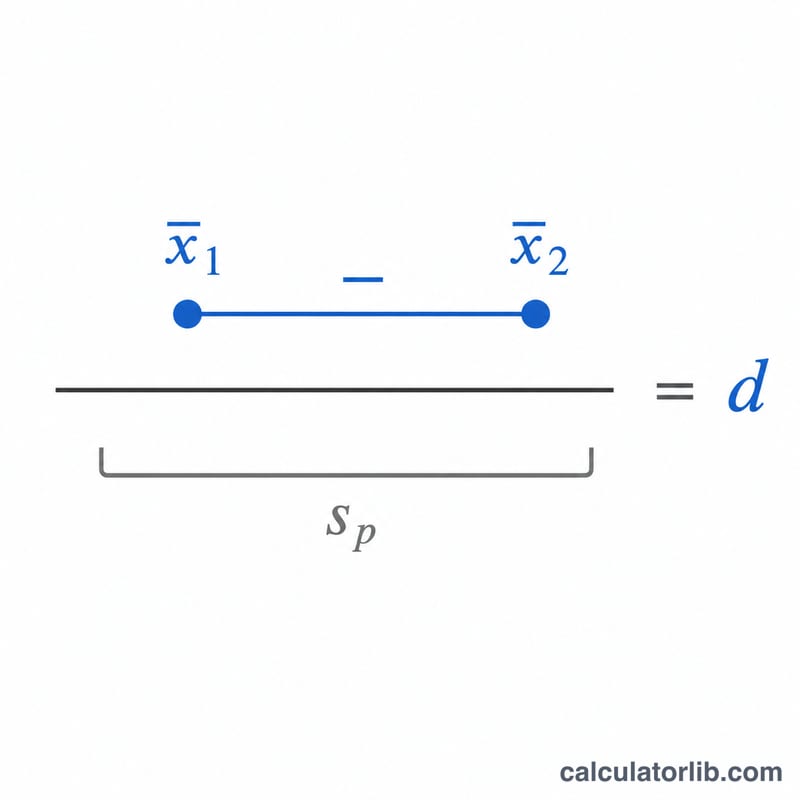
The effect size is $$d = \frac{\bar{x}_1 - \bar{x}_2}{s_p}.$$ The pooled standard deviation is $$s_p = \sqrt{\frac{(n_1-1)\cdot s_1^2 + (n_2-1)\cdot s_2^2}{n_1 + n_2 - 2}}.$$ This weights each group's variance by its degrees of freedom, giving a single combined spread used to standardize the mean difference.
Worked example
Suppose Group 1 has mean 100, SD 10, n 30, and Group 2 has mean 90, SD 12, n 30. The pooled variance is $$\frac{(29\cdot 100)+(29\cdot 144)}{58} = \frac{2900+4176}{58} = 122.$$ So \(s_p = \sqrt{122} \approx 11.0454\), and \(d = (100-90)/11.0454 \approx 0.905\) — a large effect.
FAQ
What counts as a large effect? By Cohen's rules of thumb, 0.2 is small, 0.5 medium, and 0.8 or above large.
Can d be negative? Yes — a negative value simply means Group 2's mean is higher than Group 1's. The magnitude (absolute value) is what matters for size.
Do the sample sizes need to be equal? No. The pooled formula weights by degrees of freedom, so unequal group sizes are handled correctly.