
What Is Effect Size?
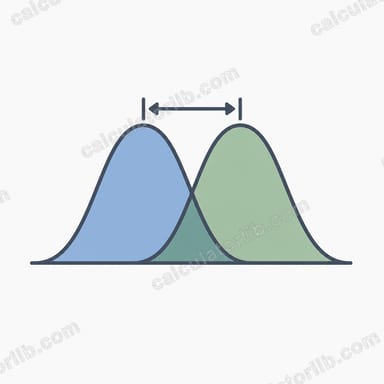
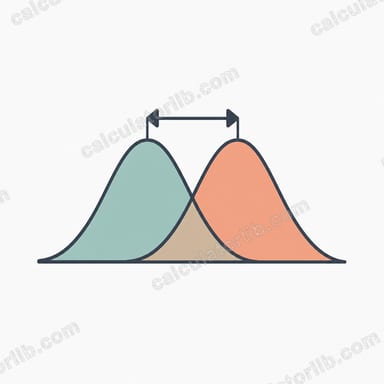
Effect size measures the magnitude of a difference between two groups, independent of sample size. While a p-value tells you whether a difference is statistically significant, the effect size tells you how big and practically meaningful that difference is. The most common metric for comparing two means is Cohen's d, the standardized difference between group means expressed in pooled standard deviation units.
How to Use This Calculator
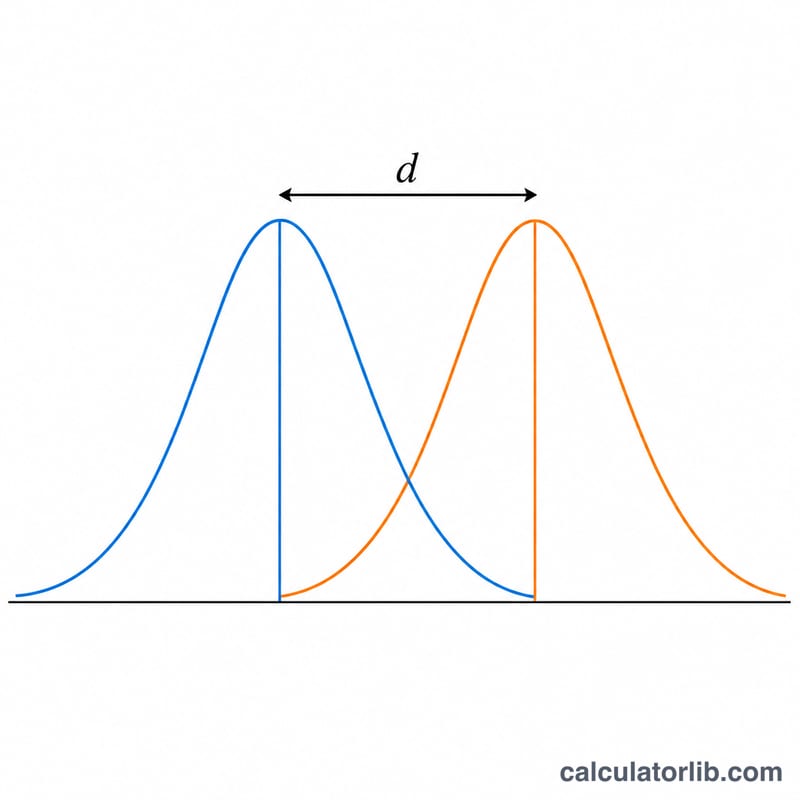
Enter the mean, standard deviation, and sample size for each of your two groups. The calculator computes the pooled standard deviation, then divides the difference in means by it to produce Cohen's d. It also classifies the result so you can interpret its practical importance at a glance.
The Formula Explained
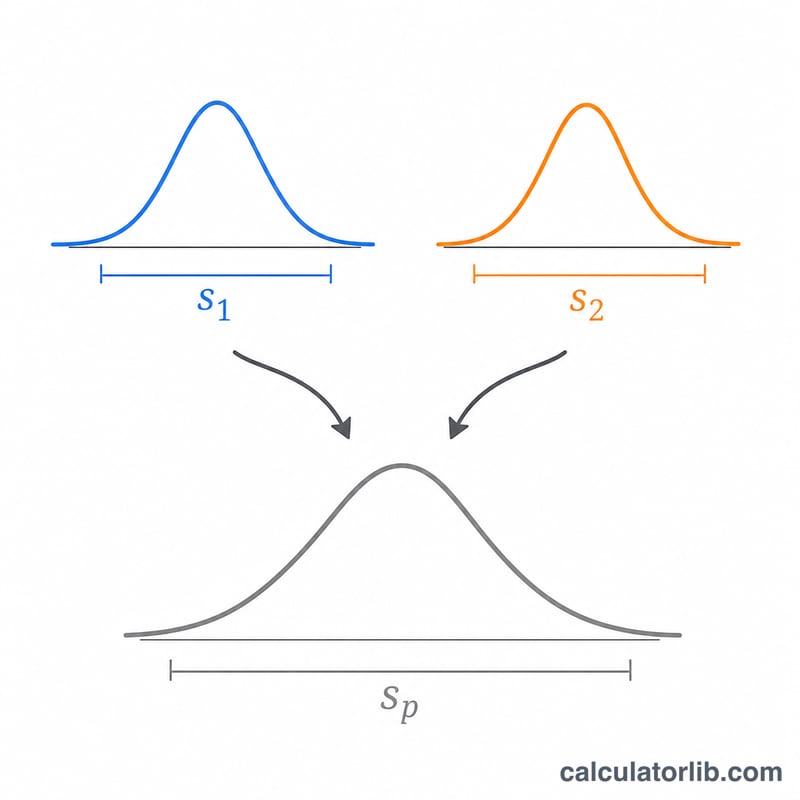
The pooled standard deviation combines both groups' variability, weighting each by its degrees of freedom (\(n - 1\)):
$$s_p = \sqrt{\frac{(n_1 - 1)\,s_1^{2} + (n_2 - 1)\,s_2^{2}}{n_1 + n_2 - 2}}$$Cohen's d is then
$$d = \frac{\text{mean}_1 - \text{mean}_2}{s_p}$$By convention, \(|d| \approx 0.2\) is a small effect, \(0.5\) medium, and \(0.8\) or greater large.
Worked Example
Suppose Group 1 has mean 100, SD 15, \(n = 30\), and Group 2 has mean 90, SD 15, \(n = 30\). Since both SDs are equal, the pooled SD is 15. Cohen's d =
$$d = \frac{100 - 90}{15} = 0.667$$a medium-to-large effect.
FAQ
What's a "good" effect size? It depends on context — in some fields a d of 0.3 is meaningful, in others you need 0.8+. Compare to typical effects in your domain.
Can d be negative? Yes. A negative d simply means Group 2 had the higher mean; the magnitude (absolute value) is what matters for interpretation.
Why pooled SD instead of one group's SD? Pooling assumes the groups share a common variance and gives a more stable estimate of the standardization unit.