
What is the TV Size Calculator?
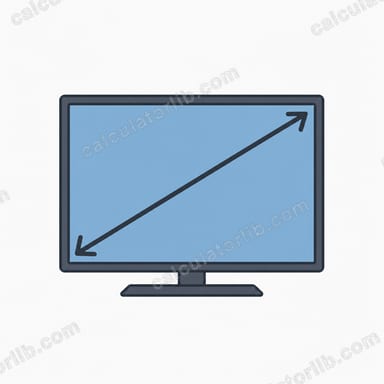
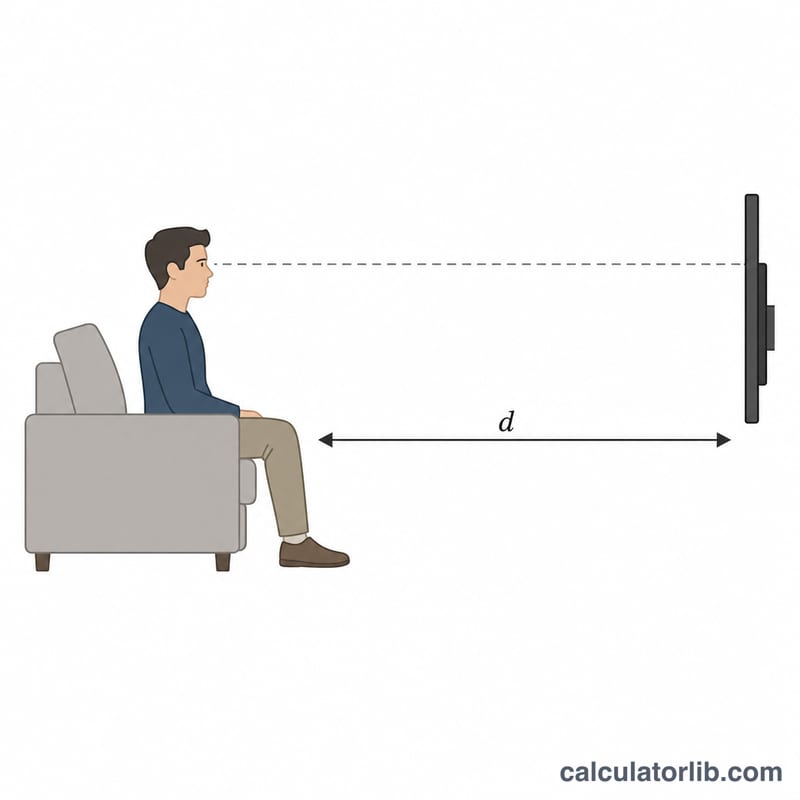
This tool recommends the best television screen size for your room based on how far you sit from the screen. A TV that is too small feels underwhelming, while one that is too large can show pixelation or force uncomfortable eye movement. By dividing your viewing distance by a chosen distance factor, you get a recommended diagonal that balances immersion and comfort, plus the corresponding 16:9 width and height.
How to Use It
Measure the distance from your seat to where the TV will sit, then enter it and pick the unit (inches, feet, or centimeters). Choose a distance factor: about 1.2 for an immersive, cinema-like field of view (THX), 1.6 for a balanced mix (close to SMPTE recommendations), 2.0 for a comfortable everyday setup, or 2.5 for casual viewing from farther away. The calculator returns the recommended diagonal and screen dimensions.
The Formula Explained
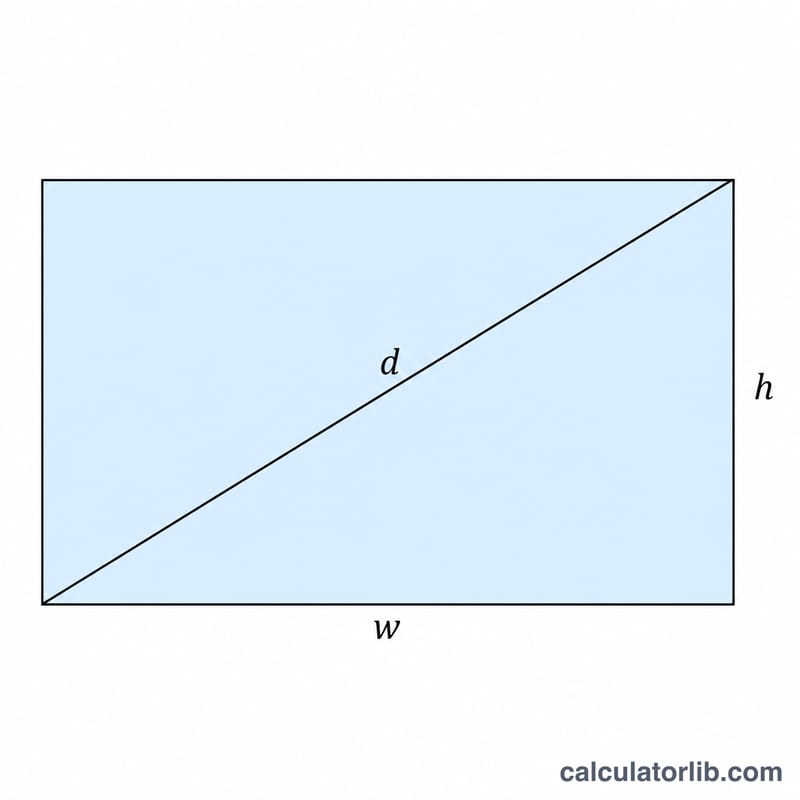
The core relationship is $$\text{diagonal} = \dfrac{\text{viewing distance}}{\text{distance factor}}$$ with all values in inches. A smaller factor means you sit relatively closer, so a larger screen is recommended. From the diagonal, the 16:9 width and height are found using the Pythagorean theorem: since width:height = 16:9, the diagonal is \(\sqrt{16^2 + 9^2} \approx 18.358\) "units," so \(\text{width} = \text{diagonal} \times 16 / 18.358\) and \(\text{height} = \text{diagonal} \times 9 / 18.358\).
Worked Example
Suppose you sit 9 feet from the TV (108 inches) and want a balanced setup with a factor of 1.6. $$\text{Diagonal} = 108 \div 1.6 = \textbf{67.5 inches}$$ — so a 65" or 70" TV fits well. The screen would be about 58.8 in wide and 33.1 in tall.
FAQ
Which distance factor should I pick? If you love big, immersive screens choose 1.2–1.6; if you prefer a relaxed view, 2.0–2.5.
Does this assume 16:9? Yes — virtually all modern flat-panel TVs use the 16:9 aspect ratio.
Should I round up or down? TVs come in fixed sizes (55", 65", 75"), so pick the nearest available size to the recommendation.