What is the TV Mounting Height Calculator?
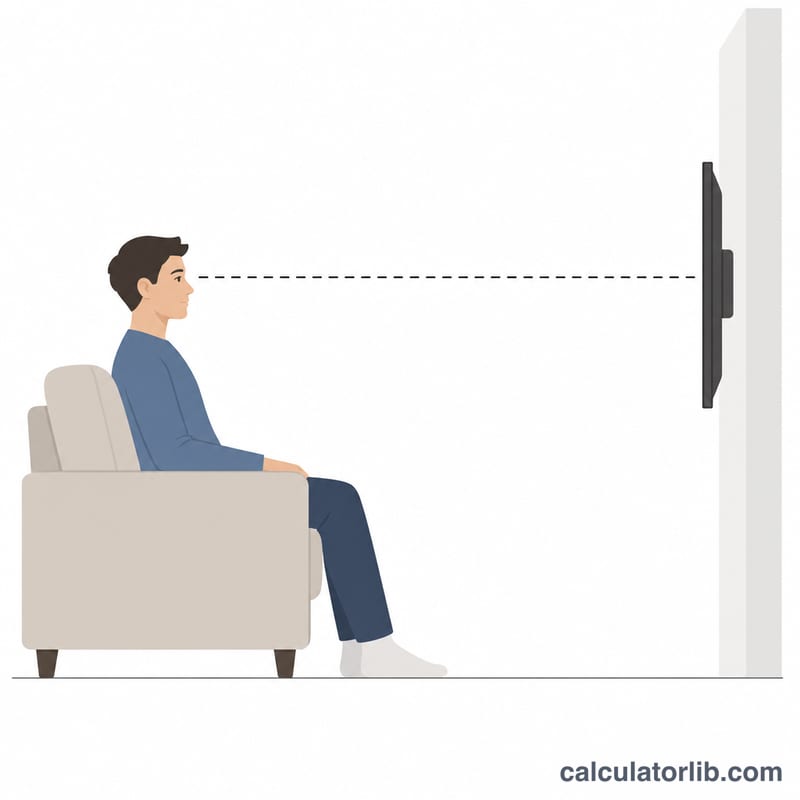
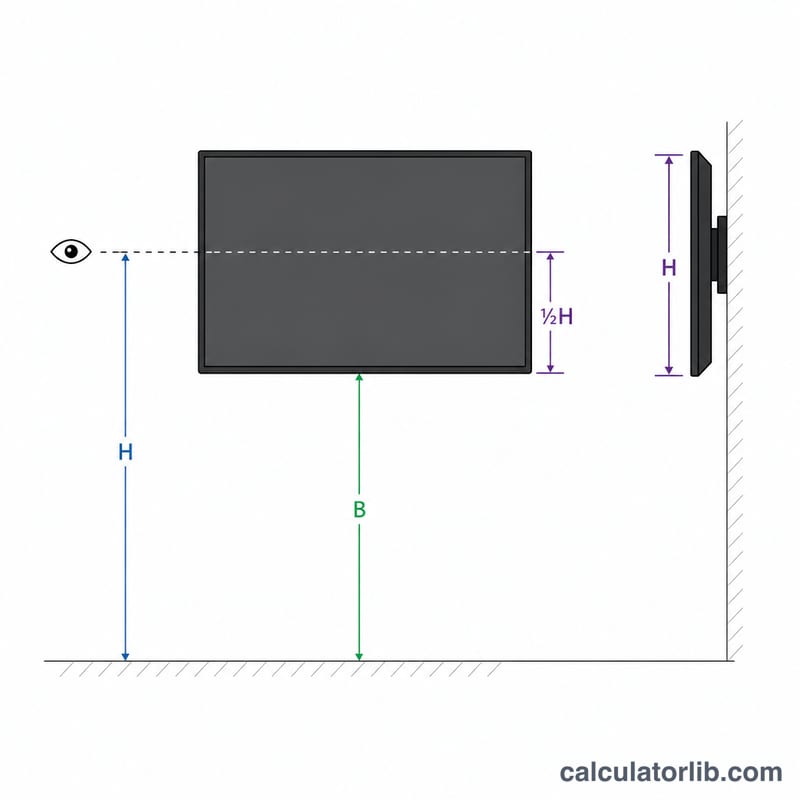
This tool tells you exactly how high to mount your television so the center of the screen lines up with your eye level when you're sitting down — the position recommended by interior designers and AV installers for the most comfortable, fatigue-free viewing. Instead of guessing where to drill, you get the precise bottom-edge height of the mount in inches above the floor.
How to use it
Sit in your usual viewing spot and measure from the floor to your eyes — for most people this is 40–45 inches. Enter that as your seated eye level. Then enter the screen's vertical height (not the diagonal). Finally, add a tilt adjustment: if you're mounting higher than eye level (for example above a fireplace) and tilting the screen down, enter a positive number of inches to lower the center accordingly. Leave it at 0 for a flush, eye-level mount.
The formula explained
The math is simple: $$\text{Mount Height} = \text{Eye Level} - \text{Tilt} - \frac{\text{TV Height}}{2}$$. The center of the screen should sit at your eye level, so we subtract half the screen height to get the bottom edge, then subtract any tilt adjustment that intentionally shifts the center.
Worked example
Suppose your seated eye level is 42 inches and your TV screen is 27 inches tall with no tilt. Center height = \(42 - 0 = 42\) in. Bottom edge = $$42 - \frac{27}{2} = 42 - 13.5 = 28.5 \text{ inches}$$ above the floor. The top edge sits at \(42 + 13.5 = 55.5\) inches.
TV Screen Height by Diagonal Size (16:9)
For a 16:9 screen, the visible height is about diagonal × 0.490 and the width about diagonal × 0.872. The last column applies \(\text{Mount Height} = \text{Eye Level} - \text{Tilt} - \frac{ \text{TV Height}}{2}\) with a seated eye level of 42 in and no tilt adjustment (0), so the center of the screen sits at eye level. The result is the height of the bottom edge of the screen above the floor.
| Diagonal (in) | Screen height (in) | Screen width (in) | Bottom-edge mount height at 42 in eye level (in) |
|---|---|---|---|
| 32 | 15.68 | 27.90 | 34.16 |
| 43 | 21.07 | 37.50 | 31.47 |
| 50 | 24.50 | 43.60 | 29.75 |
| 55 | 26.95 | 47.96 | 28.53 |
| 65 | 31.85 | 56.68 | 26.08 |
| 75 | 36.75 | 65.40 | 23.63 |
| 85 | 41.65 | 74.12 | 21.18 |
Worked example (50 in TV): height = 50 × 0.490 = 24.5 in, so bottom edge = 42 − 0 − 24.5 ÷ 2 = 42 − 12.25 = 29.75 in.
These are approximations for the visible screen only. Actual dimensions vary by model because of the bezel and the frame, so check your TV's spec sheet. The mount's bracket position relative to the screen bottom also affects where you drill.
Typical Seated Eye Level and Viewing Ranges
The figures below are commonly cited AV installer and ergonomic guidance, not a strict standard. Your own body, furniture and room layout matter more than any single number.
| Item | Typical range |
|---|---|
| Seated eye level, sofa or dining chair (floor to eyes) | about 38–46 in |
| Seated eye level, low seating or bed viewing | about 28–36 in |
| Screen center target | at or close to seated eye level |
| Vertical tilt | about 0–15 degrees downward |
- Measure it yourself: sit in your normal viewing position and measure from the floor to your eyes, then enter that as the eye level.
- Center at eye level: the calculator places the middle of the screen at eye level, then subtracts any tilt adjustment you enter.
- Tilt: a mount hung higher than eye level, such as above a fireplace, usually needs a downward tilt of up to about 15 degrees. The calculator's tilt field is an adjustment in inches, not degrees, so convert it for your setup.
- Check the result: mark the position with painter's tape before drilling, and confirm the viewing angle from every main seat.
FAQ
What is screen height vs. screen size? The advertised size (e.g. 55") is the diagonal. For a 16:9 TV, the screen height is roughly the diagonal \(\times 0.49\). A 55" TV is about 27 inches tall.
How high should a TV be above a fireplace? Mantels often force a higher mount. Add a positive tilt adjustment and angle the screen down 10–15° to reduce neck strain.
Does this work in centimeters? Yes — the formula is unit-agnostic. Enter all values in centimeters and the result will be in centimeters.