
What is the Delay and Reverb Time Calculator?
This tool converts your track's tempo into precise delay and reverb times in milliseconds. Tempo-synced delays make echoes fall exactly on the beat, glueing effects to the groove instead of muddying it. Whether you set delays manually on outboard gear or fine-tune reverb pre-delay in your DAW, this calculator gives you the exact figures for any note value.
How to use it
Enter your song's tempo in BPM, choose a note value (quarter, eighth, sixteenth, etc.), and read off the result. You get the straight delay time plus dotted and triplet variations, and the matching frequency in Hz — handy for tuning LFOs or filter movement to tempo.
The formula explained
One quarter note lasts 60000 / BPM milliseconds (60000 ms = one minute). Multiplying by a note value scales that to other durations: 1 = quarter note, 0.5 = eighth, 0.25 = sixteenth, 2 = half, 4 = whole. Dotted notes are 1.5× longer; triplets are 2/3 of the straight value. The frequency equals 1000 divided by the delay time in ms.
$$\text{Delay (ms)} = \frac{60000}{\text{Tempo (BPM)}} \times \text{Note Value}$$The dotted, triplet, and frequency variants are:
$$\text{Dotted (ms)} = \frac{60000}{\text{Tempo (BPM)}} \times \text{Note Value} \times 1.5$$$$\text{Triplet (ms)} = \frac{60000}{\text{Tempo (BPM)}} \times \text{Note Value} \times \frac{2}{3}$$$$\text{Frequency (Hz)} = \frac{1000}{\dfrac{60000}{\text{Tempo (BPM)}} \times \text{Note Value}}$$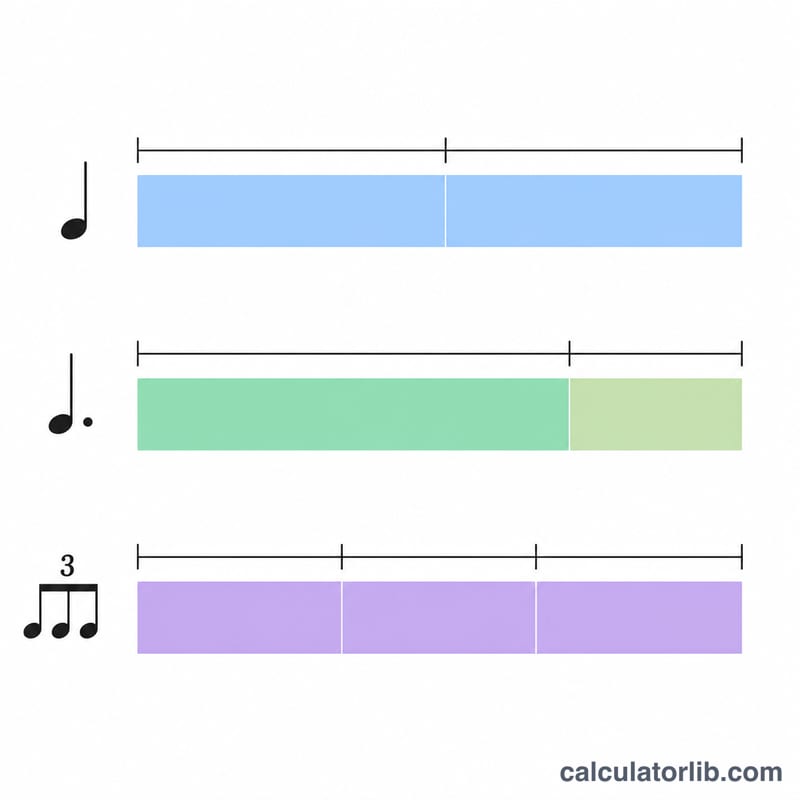
Worked example
At 120 BPM a quarter note is \(60000 / 120 = 500\) ms. An eighth note (note value 0.5) is \(500 \times 0.5 = 250\) ms. Its dotted version is \(250 \times 1.5 = 375\) ms and the triplet is \(250 \times 2/3 \approx 166.67\) ms. The 250 ms delay corresponds to \(1000 / 250 = 4\) Hz.
FAQ
What value should I use for reverb pre-delay? A common choice is a sixteenth or eighth note so the reverb tail starts on the grid.
Why does dotted sound "swung"? Dotted delays are 1.5× the straight time, creating a longer, bouncier echo that pairs well with the off-beat.
Is this accurate for any BPM? Yes — the formula is exact for any constant tempo. For ramping or live tempos, use the average BPM.