
What is the RAID Capacity Calculator?
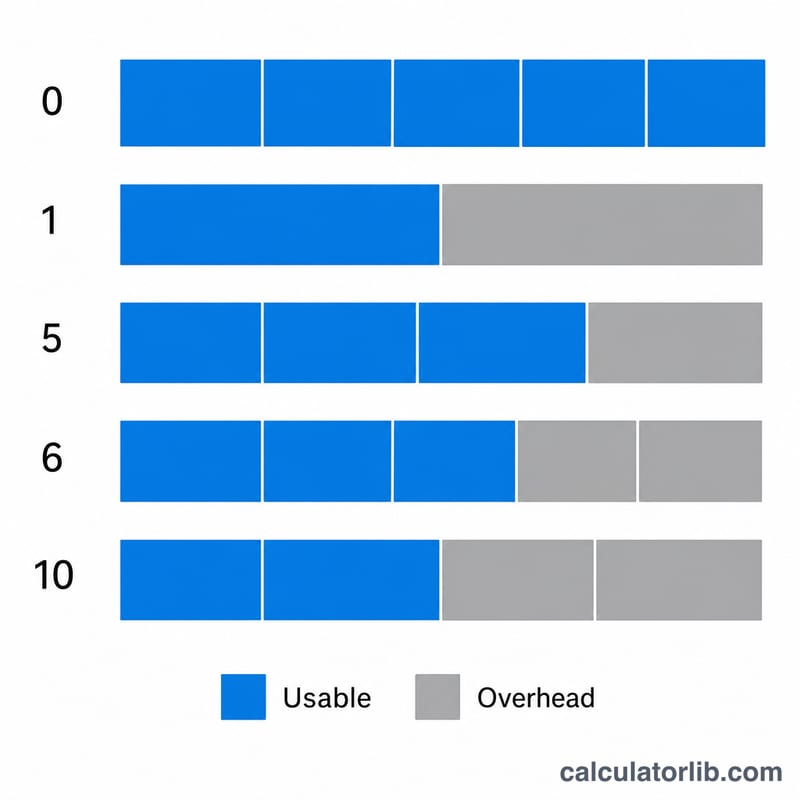
RAID (Redundant Array of Independent Disks) combines multiple physical drives into one logical volume to gain speed, redundancy, or both. Because parity and mirroring consume part of your raw storage, the capacity you can actually use is almost always less than the sum of every disk. This calculator works out the usable capacity for RAID 0, 1, 5, 6 and 10 so you can plan an array before buying drives.
How to use it
Pick a RAID level, enter how many disks are in the array, and type the capacity of a single disk in TB. The calculator assumes all disks are the same size — RAID arrays use the smallest member's capacity for every drive, so mixing sizes wastes the extra space. It returns usable capacity, the raw total, the space lost to redundancy, and your storage efficiency.
The formula explained
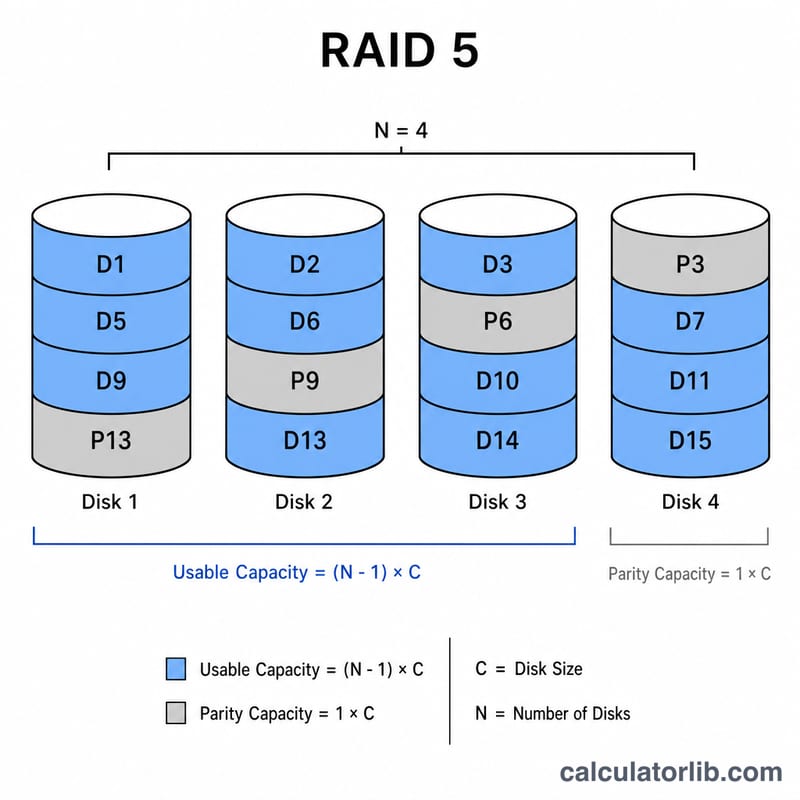
With \(N\) disks each of capacity \(C\): RAID 0 stripes data with no redundancy, so $$\text{usable} = N \times C$$ RAID 1 mirrors, giving just \(C\). RAID 5 uses one disk's worth of parity: $$\text{usable} = (N-1) \times C$$ RAID 6 uses double parity: $$\text{usable} = (N-2) \times C$$ RAID 10 mirrors then stripes, yielding $$\text{usable} = \frac{N}{2} \times C$$ and needing an even number of disks.
Worked example
Suppose you have 4 disks of 4 TB each in RAID 5. $$\text{Usable} = (4-1) \times 4 = 12 \text{ TB}$$ Raw capacity is \(4 \times 4 = 16\) TB, so 4 TB is reserved for parity and efficiency is \(12 \div 16 = 75\%\). The same disks in RAID 6 would give \((4-2) \times 4 = 8\) TB (50% efficiency), while RAID 0 would give the full 16 TB but with no fault tolerance.
FAQ
Does RAID 5 survive a disk failure? Yes, one disk. RAID 6 survives two. RAID 0 survives none.
Why is my usable space smaller than the marketing number? Manufacturers count 1 TB = 1,000,000,000,000 bytes, while operating systems often show TiB (1,099,511,627,776 bytes), making the OS figure ~9% lower. This calculator uses your entered units directly.
Can I mix disk sizes? You can, but every disk is treated as the size of the smallest, so it is best to use identical drives.