
What is Total Harmonic Distortion?
Total Harmonic Distortion (THD) measures how much a periodic signal — a voltage, current, or audio waveform — deviates from a pure sine wave. A perfect sine has energy only at its fundamental frequency. Any non-linearity (amplifiers, power supplies, inverters, transformers) creates extra components at integer multiples of the fundamental, called harmonics. THD expresses the combined size of those harmonics relative to the fundamental as a single percentage. Lower THD means a cleaner signal.
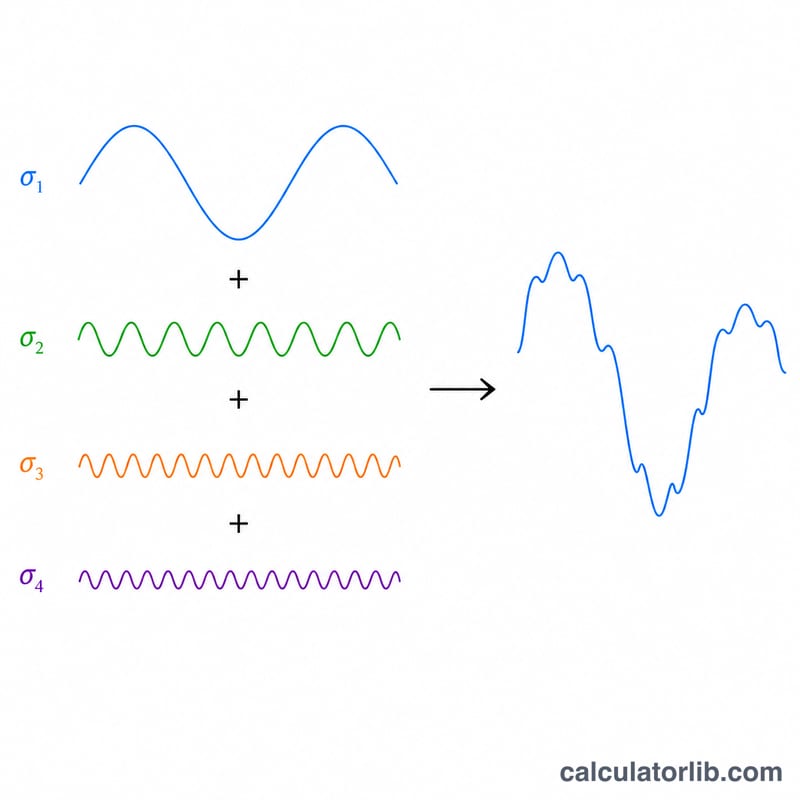
How to use this calculator
Enter the amplitude of the fundamental component (V1) and the amplitudes of each harmonic you have measured (V2 through V7). Amplitudes can be peak values or RMS values — just be consistent, since THD is a ratio and the units cancel. Leave any unused harmonic boxes at zero. The calculator returns THD as a percentage, as a plain ratio, and the RMS magnitude of the combined harmonics.
The formula explained
THD is the square root of the sum of the squares of the harmonic amplitudes, divided by the fundamental amplitude:
$$\text{THD} = \frac{\sqrt{\text{V}_2^{2} + \text{V}_3^{2} + \ldots + \text{V}_n^{2}}}{\text{V}_1} \times 100\%$$
The square-root-of-sum-of-squares term is simply the RMS combination of the harmonics. Dividing by \(\text{V}_1\) normalizes the result so it does not depend on overall signal level.
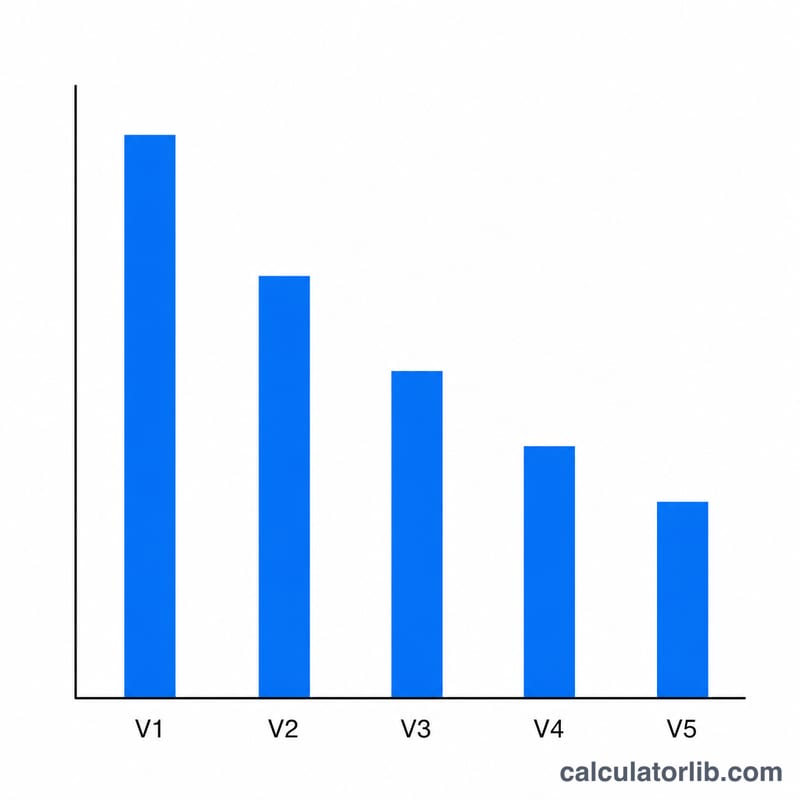
Worked example
Suppose \(\text{V}_1 = 10\), \(\text{V}_2 = 3\), and \(\text{V}_3 = 4\). The harmonic RMS is $$\sqrt{3^2 + 4^2} = \sqrt{25} = 5.$$ Then $$\text{THD} = \frac{5}{10} = 0.5, \text{ or } 50\%.$$ Even though each harmonic alone looks modest, they combine to a significant distortion figure.
FAQ
Should I use peak or RMS amplitudes? Either works, as long as all values use the same convention; the result is a dimensionless ratio.
What THD is considered good? For audio, below 1% is generally inaudible; high-fidelity gear targets under 0.1%. Power systems often limit voltage THD to about 5%.
Why divide by V1 and not the total signal? This is the IEEE/fundamental-referenced definition (THD-F). Some standards divide by the total RMS instead (THD-R); this tool uses THD-F.