
What is Total Head?
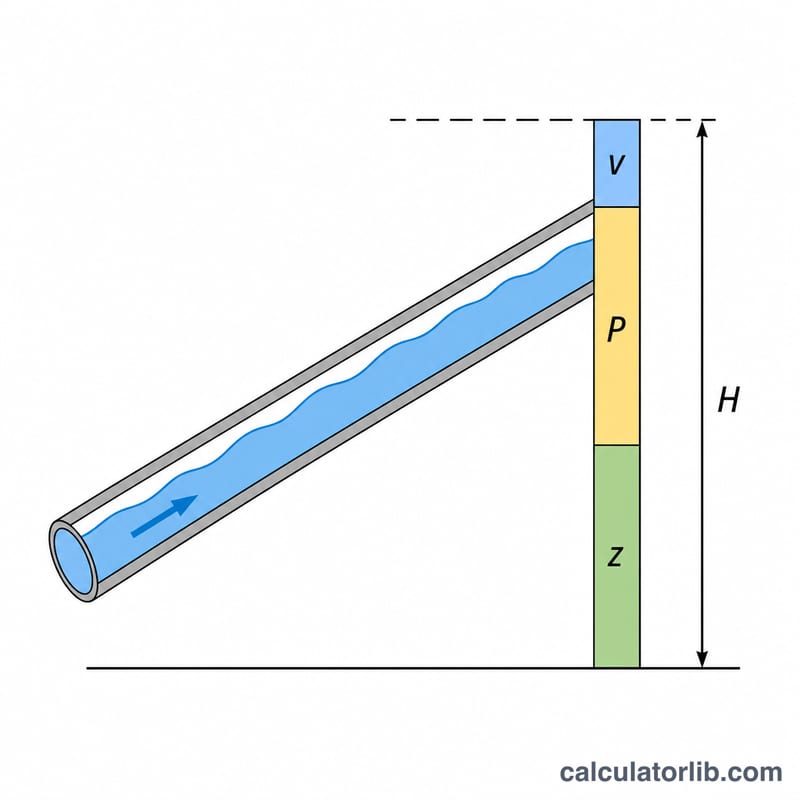
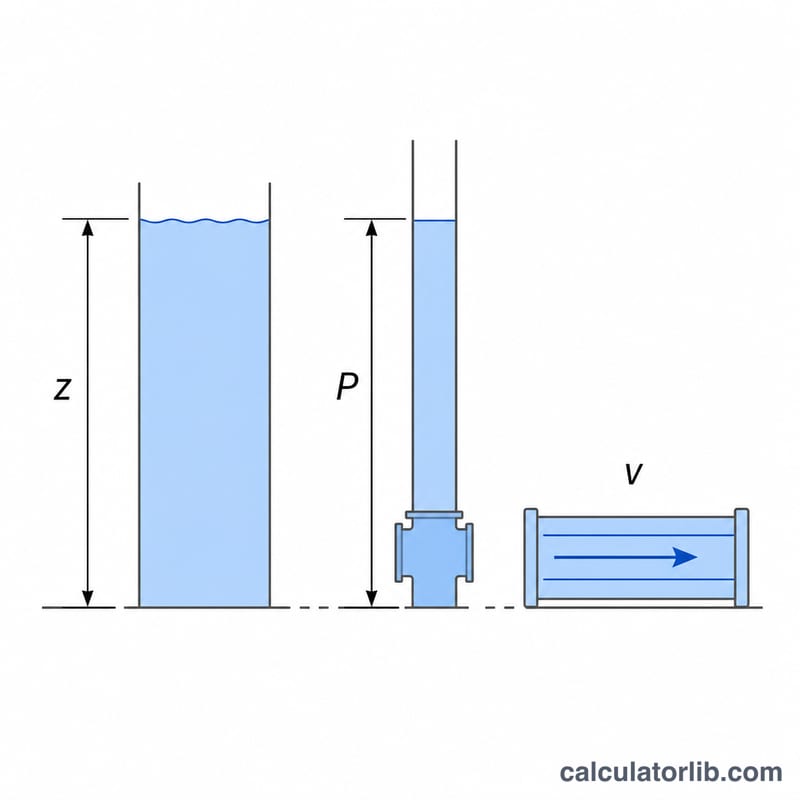
Total head (\(H\)) is the total mechanical energy per unit weight of a flowing fluid, expressed as a height of fluid column in meters. It comes from the Bernoulli equation and combines three forms of energy: elevation (potential), pressure (flow work), and velocity (kinetic). Engineers use total head to size pumps, analyze pipe networks, and verify energy conservation between two points in a flow system.
How to Use the Calculator
Enter the fluid elevation \(z\) above a reference datum, the static pressure \(P\) in pascals, the flow velocity \(v\) in meters per second, the fluid density \(\rho\) (1000 kg/m³ for water), and gravitational acceleration \(g\) (default 9.81 m/s²). The calculator returns the total head along with each individual component so you can see how energy is distributed.
The Formula Explained
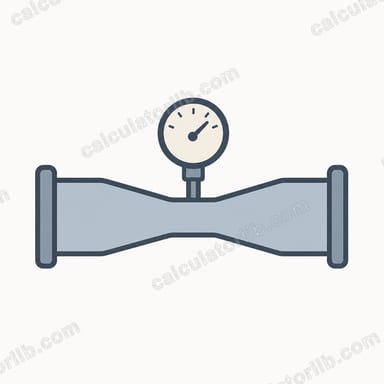
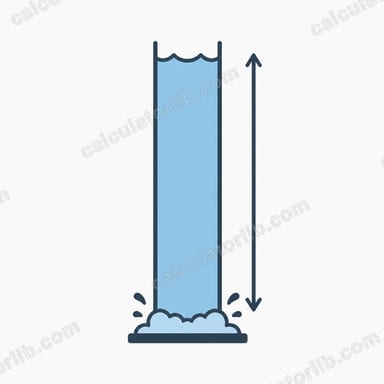
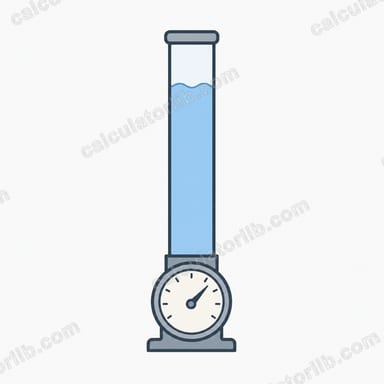
The total head is $$H = z + \frac{P}{\rho g} + \frac{v^{2}}{2g}.$$ The first term is the elevation head, the height itself. The second term, \(\frac{P}{\rho g}\), is the pressure head — the height of fluid that would produce that pressure. The third term, \(\frac{v^{2}}{2g}\), is the velocity head, representing kinetic energy as an equivalent height. All three terms carry the same unit (meters), which is why they can be added directly.
Worked Example
Suppose \(z = 10\ \text{m}\), \(P = 200{,}000\ \text{Pa}\), \(v = 4\ \text{m/s}\), \(\rho = 1000\ \text{kg/m}^3\), \(g = 9.81\ \text{m/s}^2\). Pressure head = $$\frac{200000}{1000 \times 9.81} = 20.387\ \text{m}.$$ Velocity head = $$\frac{4^{2}}{2 \times 9.81} = \frac{16}{19.62} = 0.8155\ \text{m}.$$ Total head = $$10 + 20.387 + 0.8155 = 31.203\ \text{m}.$$
FAQ
Is this gauge or absolute pressure? Use whichever reference you need; for energy comparisons within a system, gauge pressure is common.
What density should I use? Water at room temperature is about 1000 kg/m³. Use the actual fluid density for other liquids or gases.
Can I change gravity? Yes — adjust \(g\) for different planetary conditions or to use 9.80665 m/s² for standard gravity.