
What is the Bernoulli Equation?
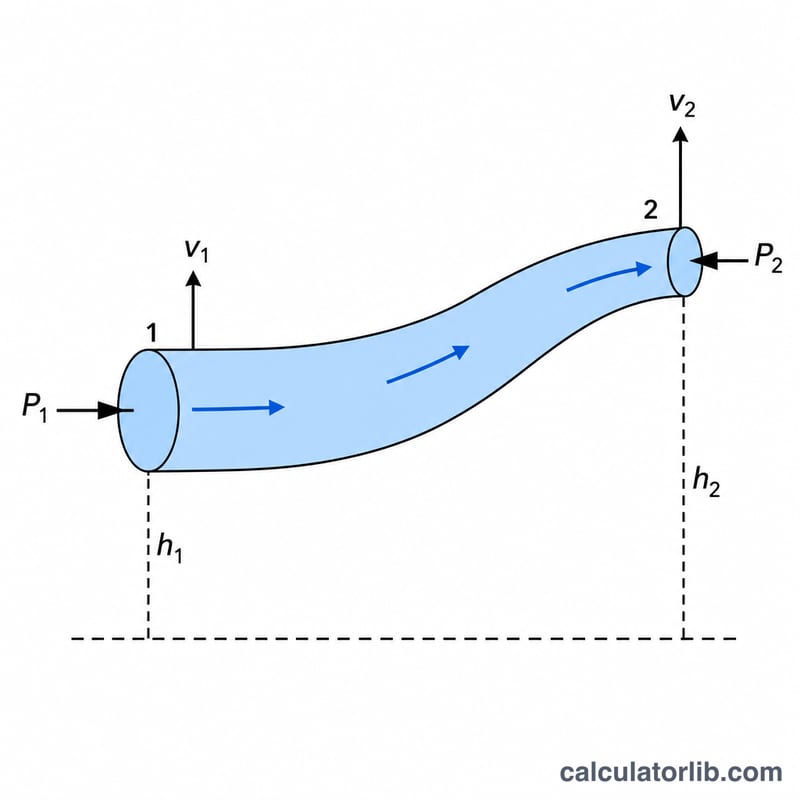
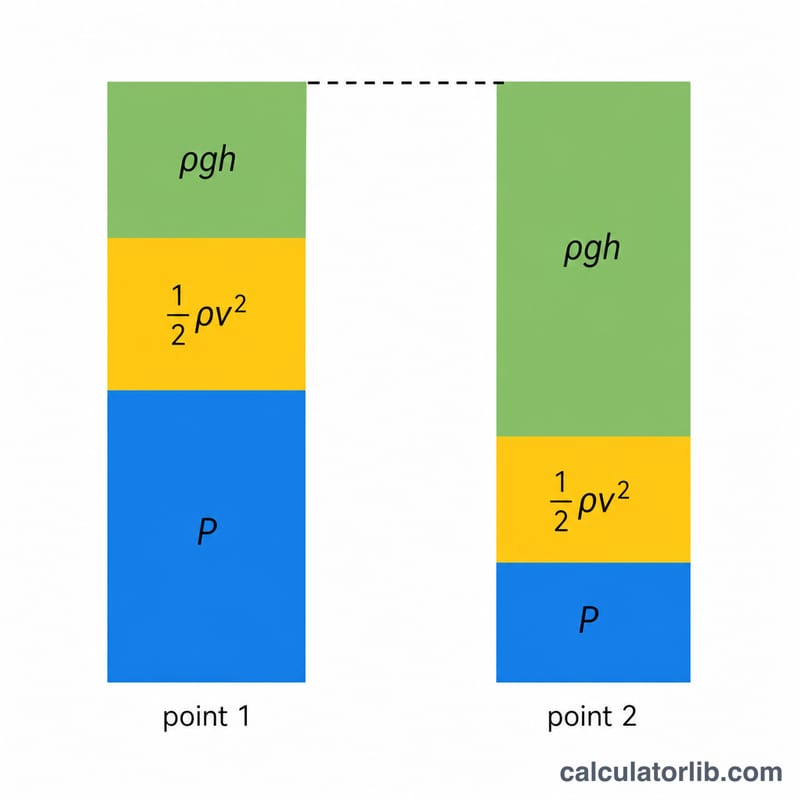
Bernoulli's equation describes the conservation of energy in a moving fluid. For steady, incompressible, frictionless (inviscid) flow along a streamline, the sum of static pressure, dynamic pressure (\(\tfrac{1}{2}\rho v^{2}\)) and hydrostatic pressure (\(\rho g h\)) is constant. This calculator uses that principle to find the static pressure \(P_2\) at a second point when conditions at a first point are known.
How to Use the Calculator
Enter the fluid density \(\rho\) (1000 kg/m³ for water, about 1.225 kg/m³ for air) and gravitational acceleration \(g\) (9.81 m/s²). Provide the pressure, velocity and height at Point 1, then the velocity and height at Point 2. The tool returns \(P_2\) in pascals along with the breakdown of each energy term.
The Formula Explained
Starting from \(P_1 + \tfrac{1}{2}\rho v_1^{2} + \rho g h_1 = P_2 + \tfrac{1}{2}\rho v_2^{2} + \rho g h_2\), we rearrange to isolate \(P_2\):
$$P_2 = P_1 + \tfrac{1}{2}\,\rho\left(v_1^{2} - v_2^{2}\right) + \rho\,g\left(h_1 - h_2\right)$$
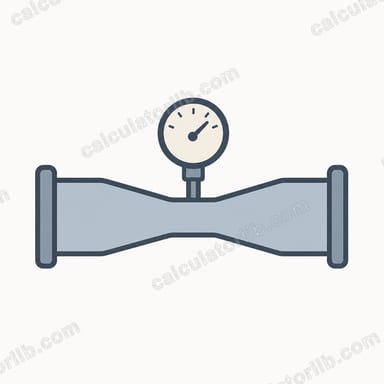
When the fluid speeds up (\(v_2 > v_1\)), the dynamic term grows and the static pressure \(P_2\) falls — the basis of lift, carburetors and Venturi meters.
Worked Example
Water (\(\rho = 1000\) kg/m³) flows at \(v_1 = 2\) m/s with \(P_1 = 101325\) Pa at \(h_1 = 0\). Downstream it accelerates to \(v_2 = 5\) m/s at the same height. Then $$P_2 = 101325 + 0.5\cdot 1000\cdot(4 - 25) + 0 = 101325 - 10500 = 90825\ \text{Pa}.$$ The pressure drops because the kinetic energy increased.
Constants & Reference Values
The Bernoulli equation requires a value for gravitational acceleration and the fluid density. Use the values below as starting points, and always work in consistent SI units (pressure in pascals, density in kg/m³, velocity in m/s, height in metres).
| Quantity | Symbol | Value | Units |
|---|---|---|---|
| Standard gravitational acceleration | \(g\) | 9.81 | m/s² |
| Fresh water (~4 °C) | \(\rho\) | 1000 | kg/m³ |
| Seawater | \(\rho\) | ~1025 | kg/m³ |
| Air (sea level, 15 °C) | \(\rho\) | 1.225 | kg/m³ |
| Light/lubricating oil | \(\rho\) | ~850–900 | kg/m³ |
Incompressibility note: The classic Bernoulli equation assumes constant density. For gases this holds well only at low speeds — typically below a Mach number of about 0.3 (roughly 100 m/s in sea-level air). Above that threshold compressibility effects become significant and a compressible-flow energy balance should be used instead.
Definitions & Glossary
- \(P_1\), \(P_2\) — static pressure at the upstream and downstream points (Pa). This is the pressure a sensor moving with the fluid would read, independent of motion.
- \(v\) — flow velocity of the fluid along a streamline (m/s). \(v_1\) and \(v_2\) are the velocities at the two points.
- \(h\) — elevation head, the vertical height of the point above an arbitrary datum (m).
- \(\rho\) — density, the mass per unit volume of the fluid (kg/m³), assumed constant for incompressible flow.
- \(g\) — gravitational acceleration (m/s²), usually 9.81.
- Static pressure: the thermodynamic pressure of the fluid (Pa), the \(P\) terms in the equation.
- Dynamic pressure: the kinetic-energy term per unit volume, \(\tfrac{1}{2}\rho v^2\) (Pa) — the pressure rise when the flow is brought to rest.
- Hydrostatic pressure: the elevation term per unit volume, \(\rho g h\) (Pa) — pressure due to the weight of fluid column / height difference.
- Streamline: a curve everywhere tangent to the local velocity; Bernoulli's equation applies along a single streamline.
- Inviscid flow: idealised flow with no viscosity, so no energy is lost to friction.
- Steady flow: flow whose properties at any fixed point do not change with time.
More Worked Examples
Example 1 — Elevation change, constant velocity
Water (\(\rho = 1000\,\text{kg/m}^3\)) flows through a uniform pipe so velocity is unchanged (\(v_1 = v_2 = 2\,\text{m/s}\)). The inlet is at \(h_1 = 10\,\text{m}\) with \(P_1 = 150000\,\text{Pa}\); the outlet drops to \(h_2 = 4\,\text{m}\). Find \(P_2\).
- Velocity term: \(\tfrac{1}{2}\rho(v_1^2 - v_2^2) = \tfrac{1}{2}(1000)(2^2 - 2^2) = 0\,\text{Pa}\).
- Elevation term: \(\rho g(h_1 - h_2) = 1000 \times 9.81 \times (10 - 4) = 58860\,\text{Pa}\).
- Add to \(P_1\): \(P_2 = 150000 + 0 + 58860\).
- Result: \(P_2 = \) 208860 Pa.
The pressure rises downstream because the fluid descends 6 m, converting elevation head into pressure. The 58860 Pa gain matches the hydrostatic pressure of a 6 m water column.
Example 2 — Air through a Venturi (velocity increases)
Air (\(\rho = 1.225\,\text{kg/m}^3\)) flows horizontally (\(h_1 = h_2 = 0\)) through a Venturi. At the wide inlet \(v_1 = 20\,\text{m/s}\) and \(P_1 = 101325\,\text{Pa}\); at the throat \(v_2 = 60\,\text{m/s}\). Find \(P_2\).
- Velocity term: \(\tfrac{1}{2}\rho(v_1^2 - v_2^2) = \tfrac{1}{2}(1.225)(20^2 - 60^2) = 0.6125 \times (400 - 3600) = -1960\,\text{Pa}\).
- Elevation term: \(\rho g(h_1 - h_2) = 0\) (horizontal).
- Add to \(P_1\): \(P_2 = 101325 - 1960 + 0\).
- Result: \(P_2 = \) 99365 Pa.
As the air accelerates in the throat its static pressure drops by 1960 Pa — the Venturi effect. That drop equals the increase in dynamic pressure, since for both speeds we have checked that the velocity (Mach ≈ 0.18) stays well below the Mach 0.3 incompressibility limit, so treating the air as constant-density is valid here.
FAQ
Does this work for compressible flow? No. Bernoulli's equation assumes constant density, so it is accurate for liquids and low-speed gas flow (Mach < 0.3).
What about friction and viscosity? The ideal equation ignores losses. For real pipes you must add head-loss terms.
Can it compute velocity instead? This version solves for \(P_2\), but you can rearrange the same equation to find an unknown velocity or height.