
What Is the Rocket Equation?
The Tsiolkovsky rocket equation describes the motion of a vehicle that propels itself by expelling part of its mass at high speed. It links the change in velocity (delta-v, \(\Delta v\)) a rocket can achieve to its propellant exhaust velocity and the ratio of its starting mass to its ending mass. This calculator is universal — it applies to any rocket, anywhere, since it is pure Newtonian physics.
How to Use This Calculator
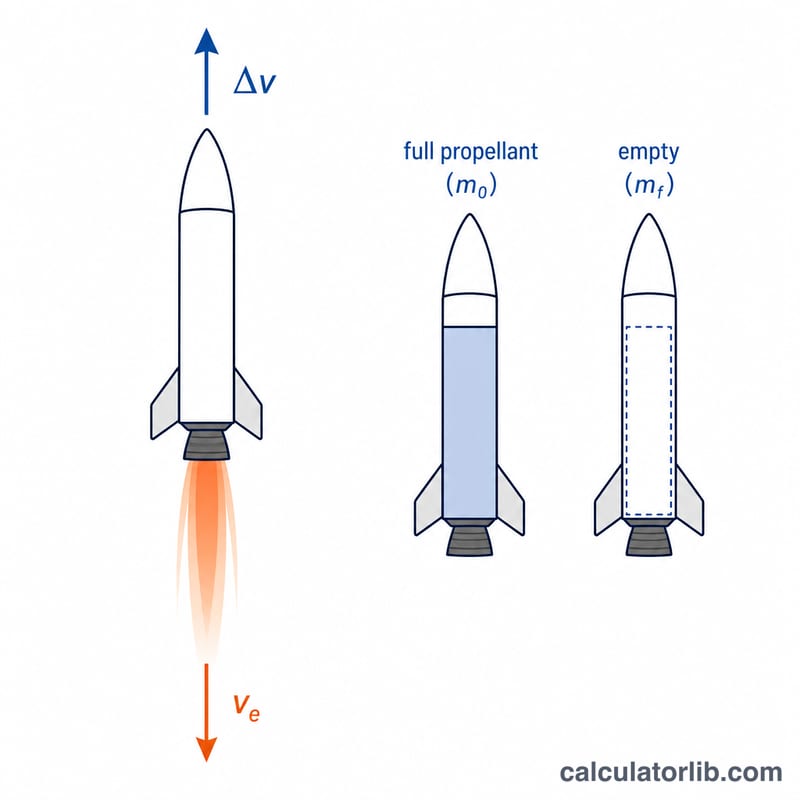
Enter three values: the effective exhaust velocity \(v_e\) (the speed at which propellant leaves the engine, often quoted as specific impulse × 9.81), the initial mass \(m_0\) (the fully fueled rocket), and the final mass \(m_f\) (the rocket after the burn). The tool returns the total achievable \(\Delta v\) in meters per second along with the mass ratio.
The Formula Explained
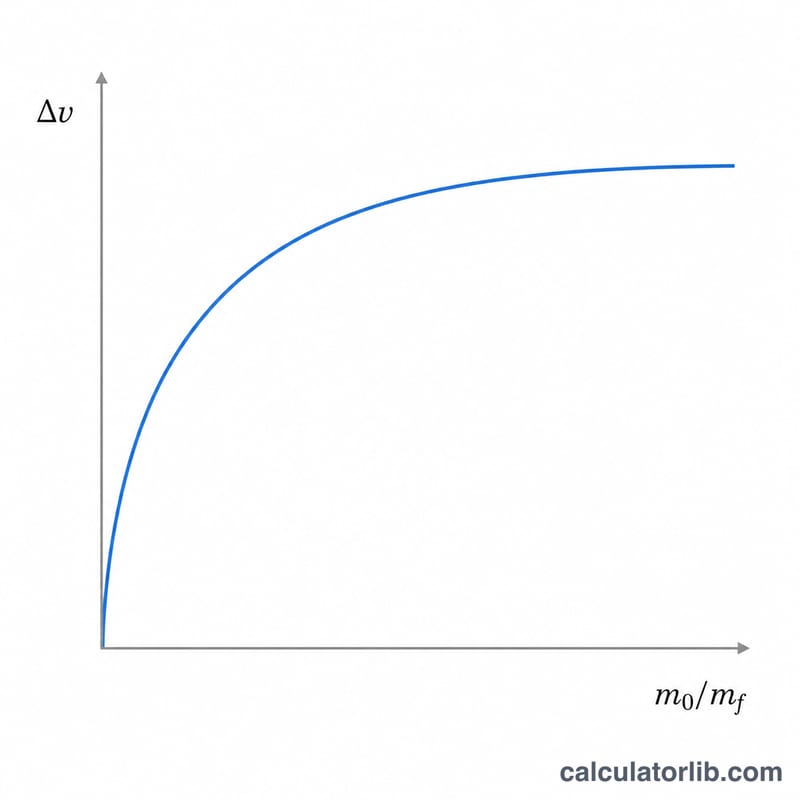
$$\Delta v = v_e \cdot \ln\!\left(\frac{m_0}{m_f}\right)$$ The natural logarithm captures the diminishing returns of carrying more fuel: doubling propellant does not double \(\Delta v\). A higher exhaust velocity (a more efficient engine) raises \(\Delta v\) proportionally, which is why high specific-impulse engines are so valuable for deep-space missions.
Worked Example
Suppose \(v_e = 3{,}000\) m/s, \(m_0 = 50{,}000\) kg and \(m_f = 10{,}000\) kg. The mass ratio is \(50{,}000 / 10{,}000 = 5\). Then $$\Delta v = 3{,}000 \times \ln(5) = 3{,}000 \times 1.6094 \approx 4{,}828 \text{ m/s}.$$ That is enough delta-v for a substantial orbital maneuver.
FAQ
What is effective exhaust velocity? It equals specific impulse (Isp in seconds) multiplied by standard gravity (9.80665 m/s²). An Isp of 300 s gives \(v_e \approx 2{,}942\) m/s.
Does this account for gravity or drag? No. The ideal rocket equation gives the maximum \(\Delta v\) in free space. Real launches lose \(\Delta v\) to gravity and atmospheric drag, so engineers add margin.
Why does fuel give diminishing returns? Because \(\Delta v\) grows with the logarithm of the mass ratio — each additional unit of fuel must also accelerate all the fuel above it, so the payoff shrinks.