
What Is the Mirror Equation Calculator?
This tool solves the spherical mirror equation to find where an image forms and how large it appears. Enter the mirror's focal length (\(f\)) and the object distance (\(d_o\)), and it returns the image distance (\(d_i\)) and the magnification (\(M\)). It works for both concave and convex mirrors using the standard physics sign convention.
How to Use It
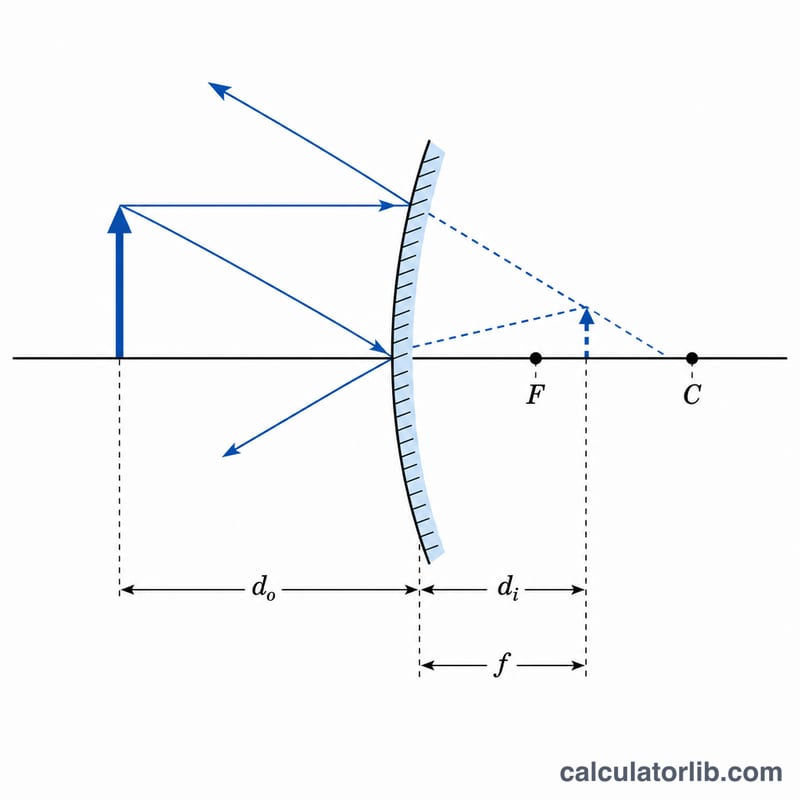
Choose one consistent length unit (centimeters or meters) for both inputs. For a concave (converging) mirror, enter a positive focal length; for a convex (diverging) mirror, enter a negative focal length. The object distance is normally positive when the object sits in front of the mirror. The calculator reports whether the resulting image is real or virtual and upright or inverted.
The Formula Explained
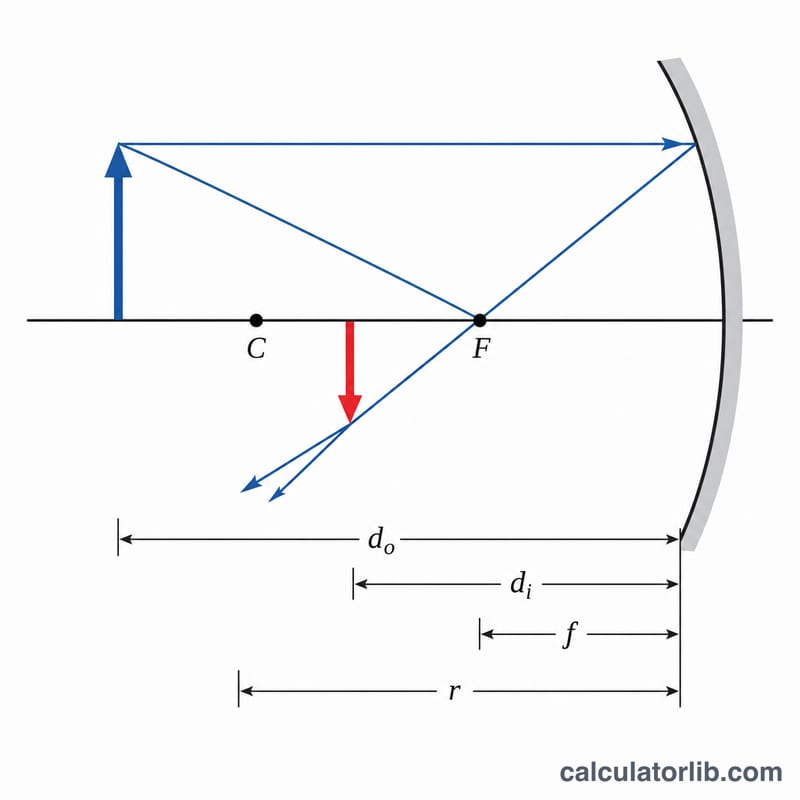
The mirror equation is \(\dfrac{1}{f} = \dfrac{1}{d_o} + \dfrac{1}{d_i}\). Rearranged to solve for image distance: \(\dfrac{1}{d_i} = \dfrac{1}{f} - \dfrac{1}{d_o}\), so $$d_i = \left( \dfrac{1}{f} - \dfrac{1}{d_o} \right)^{-1}$$ Magnification is \(M = -\dfrac{d_i}{d_o}\). A negative \(M\) means an inverted image; \(|M| > 1\) means the image is enlarged. A positive \(d_i\) indicates a real image (formed in front of the mirror), while a negative \(d_i\) indicates a virtual image behind it.
Worked Example
Suppose a concave mirror has \(f = 10\) cm and an object is placed at \(d_o = 30\) cm. Then $$\frac{1}{d_i} = \frac{1}{10} - \frac{1}{30} = 0.1 - 0.0333 = 0.0667,$$ so \(d_i = 15\) cm. Magnification \(M = -\dfrac{15}{30} = -0.5\). The image is real (\(d_i\) positive), inverted (\(M\) negative), and half the size of the object.
FAQ
What does a negative image distance mean? The image is virtual, appearing behind the mirror, and cannot be projected onto a screen.
Why is my magnification negative? A negative \(M\) simply tells you the image is inverted relative to the object; the absolute value gives the size ratio.
Which sign do I use for a convex mirror? Convex (diverging) mirrors have a negative focal length, which always produces an upright, reduced, virtual image.