
What Is the Drake Equation?
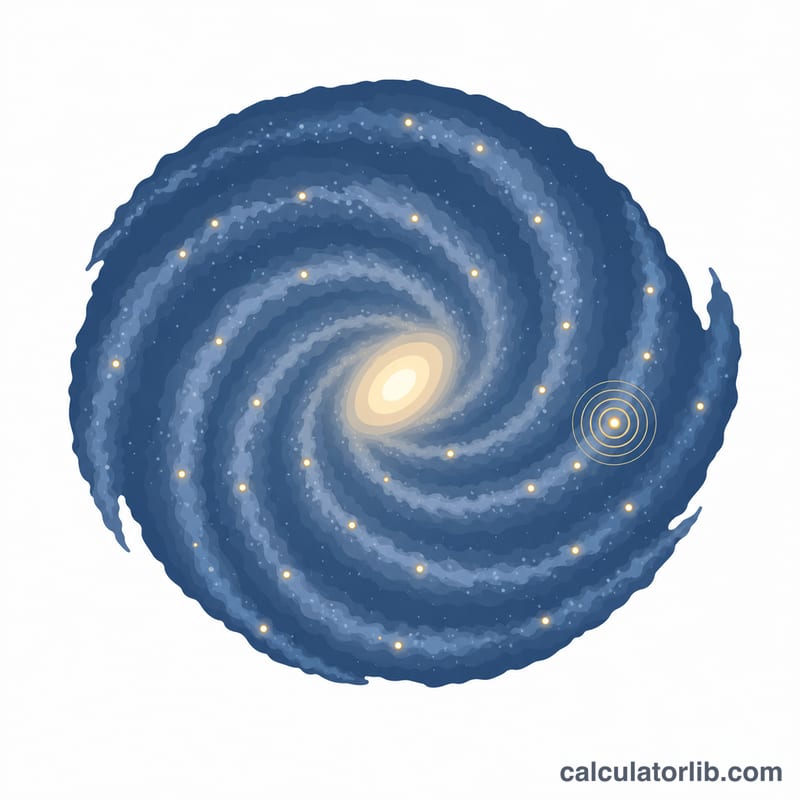
The Drake Equation, formulated by astronomer Frank Drake in 1961, is a probabilistic framework for estimating the number of active, communicating extraterrestrial civilizations (\(N\)) in the Milky Way galaxy. It is not meant to give a precise answer—instead it organizes the unknowns about life beyond Earth into seven discrete factors you can reason about and adjust.
How to Use This Calculator
Enter your best estimate for each of the seven factors. The calculator multiplies them together to produce \(N\). Try the classic textbook values, then experiment: small changes to the more speculative factors (like \(f_i\), the fraction of life that becomes intelligent) can swing the result by orders of magnitude.
The Formula Explained
$$N = \text{R}_\ast \cdot \text{f}_p \cdot \text{n}_e \cdot \text{f}_l \cdot \text{f}_i \cdot \text{f}_c \cdot \text{L}$$
\(R_\ast\) is the average rate of star formation per year; \(f_p\) is the fraction of those stars with planets; \(n_e\) is the average number of potentially life-supporting planets per such star; \(f_l\) is the fraction of those planets where life actually arises; \(f_i\) is the fraction of life-bearing worlds that develop intelligence; \(f_c\) is the fraction of intelligent species that release detectable signals; and \(L\) is the average length of time, in years, that such civilizations remain detectable.

Worked Example
Using a classic set of conservative values: \(R_\ast = 1.5\), \(f_p = 1\), \(n_e = 0.2\), \(f_l = 0.13\), \(f_i = 0.01\), \(f_c = 0.1\), \(L = 10{,}000\). Multiplying: $$1.5 \times 1 \times 0.2 = 0.3; \times 0.13 = 0.039; \times 0.01 = 0.00039; \times 0.1 = 0.000039; \times 10{,}000 = \mathbf{0.39}$$ With these pessimistic assumptions, fewer than one detectable civilization is expected.
FAQ
Is the Drake Equation scientifically accurate? It is a thought tool, not a measurement. Several factors (especially \(f_l\), \(f_i\), \(f_c\), and \(L\)) are highly uncertain, so results vary enormously.
Why do answers range from less than 1 to millions? Because the speculative factors multiply, optimistic and pessimistic estimates differ by many orders of magnitude.
What does \(N\) less than 1 mean? It suggests we might be alone, or that detectable civilizations are very rare in the galaxy at any given time.