
What Is the Rydberg Equation Calculator?
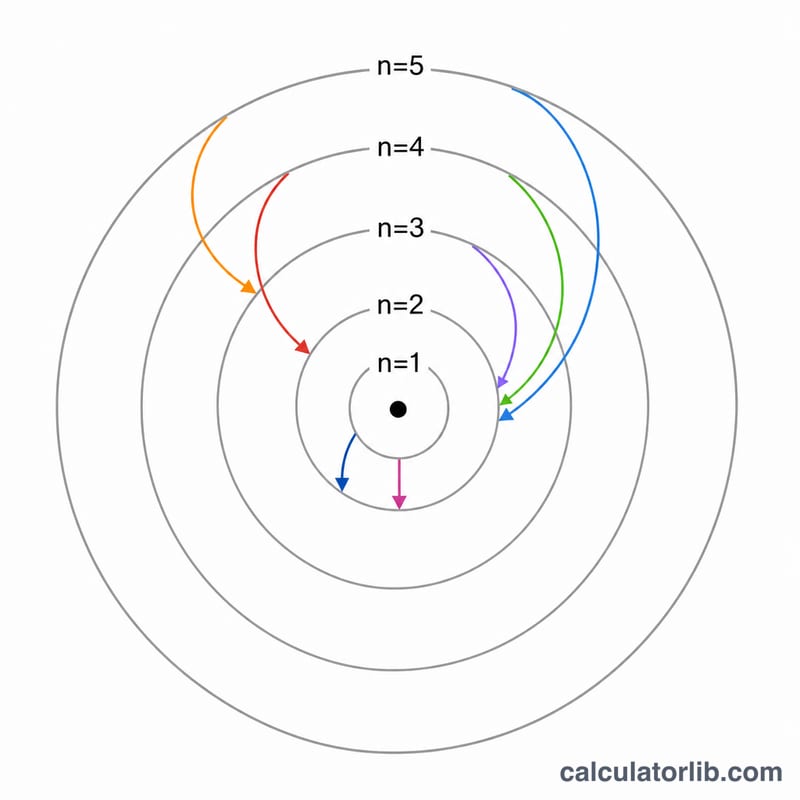
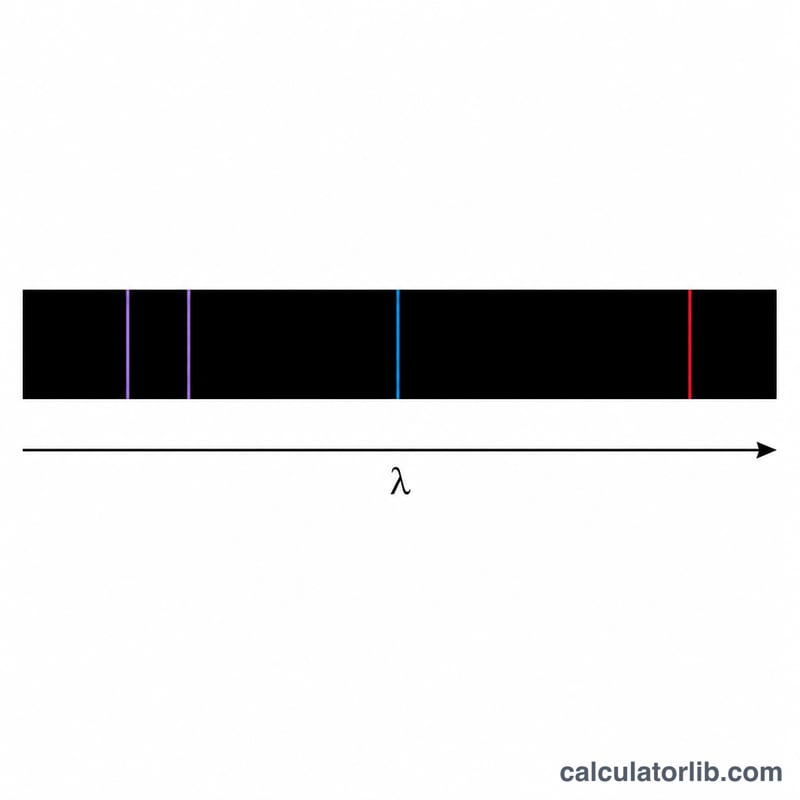
This calculator uses the Rydberg equation to find the wavelength of light emitted or absorbed when an electron in a hydrogen-like atom transitions between two energy levels. It returns the wavelength (in nanometers and meters), the wavenumber (1/λ), and the photon frequency. It is a universal physics tool, applicable to any single-electron system when the appropriate Rydberg constant is used.
How to Use It
Enter the lower principal quantum number n₁ and the higher one n₂ (n₂ must be greater than n₁ for emission/absorption). The default Rydberg constant R = 10,973,731.6 1/m is the value for hydrogen (R∞). You can substitute a different value for other elements or to use the simplified hydrogen constant. The calculator outputs the resulting wavelength and related quantities.
The Formula Explained
The equation is $$\frac{1}{\lambda} = \text{R} \left( \frac{1}{\text{n}_1^{2}} - \frac{1}{\text{n}_2^{2}} \right)$$ The term in parentheses is dimensionless and depends only on the two energy levels. Multiplying by \(R\) gives the wavenumber (reciprocal wavelength). Taking the reciprocal yields the wavelength \(\lambda\), and multiplying the wavenumber by the speed of light \(c = 299{,}792{,}458 \ \text{m/s}\) gives the frequency \(\nu\).
Worked Example
For the Balmer-alpha (H-α) line, \(n_1 = 2\) and \(n_2 = 3\). The bracket is \(\frac{1}{4} - \frac{1}{9} = 0.13889\). With \(R = 1.0973732 \times 10^{7} \ \text{1/m}\), $$\frac{1}{\lambda} = 1{,}524{,}129 \ \text{1/m}, \quad \lambda = 6.5631 \times 10^{-7} \ \text{m} \approx 656.3 \ \text{nm}$$ — the familiar red hydrogen line.
FAQ
What value of R should I use? The Rydberg constant for infinite nuclear mass is \(R_\infty \approx 1.0973731568 \times 10^{7} \ \text{1/m}\). For hydrogen specifically, a slightly smaller reduced-mass value (\(\approx 1.09678 \times 10^{7} \ \text{1/m}\)) gives more accurate spectral lines.
Why must n₂ be larger than n₁? n₁ is the lower energy level and n₂ the higher one; the difference of the inverse squares must be positive to give a physical (positive) wavelength.
Does this work for other elements? The equation works for hydrogen-like (single-electron) ions if you scale \(R\) by \(Z^2\). For multi-electron atoms it is only approximate.