
What Is the Nernst Equation?
The Nernst equation relates the actual electrode or cell potential to its standard potential under non-standard conditions of concentration, pressure, and temperature. It is fundamental to electrochemistry, used in batteries, fuel cells, corrosion analysis, pH electrodes, and biological membrane potentials. This calculator solves for the cell potential E in volts.
How to Use This Calculator
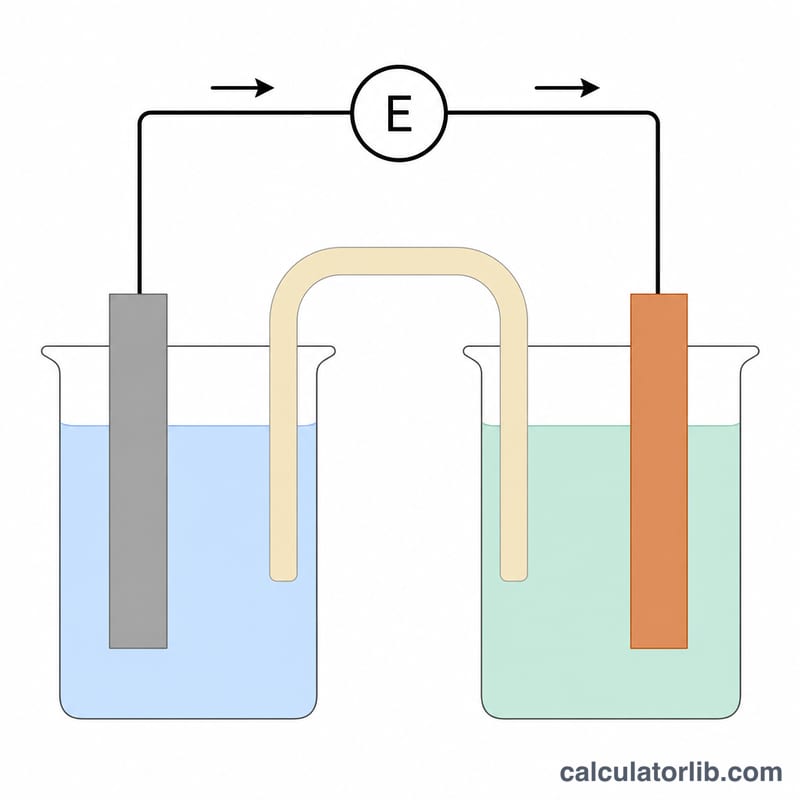
Enter the standard cell potential E° in volts, the number of electrons transferred in the balanced half-reaction (\(n\)), the absolute temperature in kelvin (use 298.15 K for 25 °C), and the reaction quotient \(Q\). The tool computes \(E\) along with the correction term so you can see how far the system deviates from standard conditions.
The Formula Explained
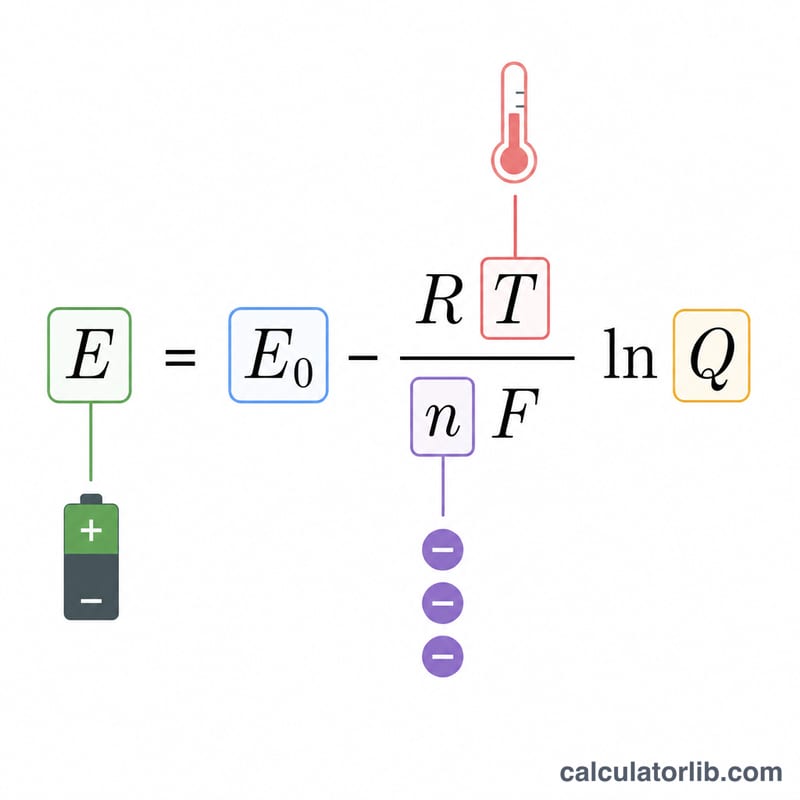
The equation is $$E = E^\circ - \frac{RT}{nF}\ln Q$$ where \(R = 8.314\ \text{J/(mol}\cdot\text{K)}\) is the gas constant, \(T\) is temperature in kelvin, \(n\) is the moles of electrons, and \(F = 96485\ \text{C/mol}\) is the Faraday constant. When \(Q = 1\), \(\ln Q = 0\), so \(E\) equals \(E^\circ\). At 25 °C the prefactor \(RT/F\) equals about 0.02569 V, giving the familiar \(0.0592/n\) V form when using log base 10.
Worked Example
For a Daniell cell with \(E^\circ = 1.10\ \text{V}\), \(n = 2\), \(T = 298.15\ \text{K}\), and \(Q = 10\): the correction term is $$\left(\frac{8.314 \times 298.15}{2 \times 96485}\right) \times \ln(10) = 0.012842 \times 2.302585 \approx 0.02957\ \text{V}.$$ So $$E = 1.10 - 0.02957 \approx 1.0704\ \text{V}.$$
FAQ
What temperature should I use? Use the absolute temperature in kelvin. Room temperature 25 °C is 298.15 K.
What is n? \(n\) is the number of electrons transferred in the balanced overall redox reaction.
Why must Q be positive? The natural logarithm is only defined for positive values; \(Q\) is a ratio of activities and is always greater than zero.