
What is the Van't Hoff equation?
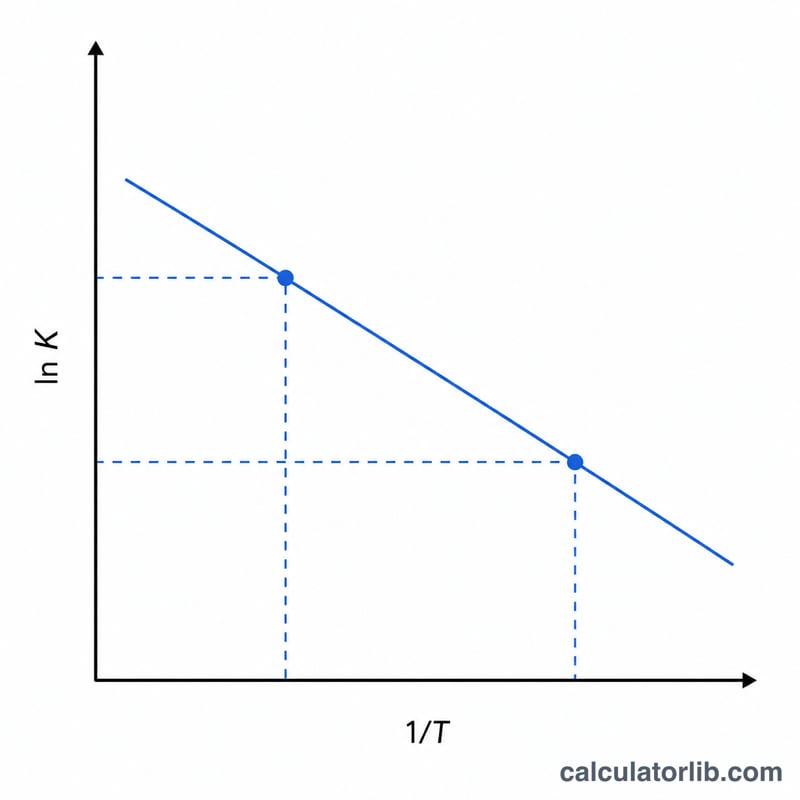
The Van't Hoff equation describes how the equilibrium constant K of a chemical reaction changes with temperature. It links the ratio of equilibrium constants at two temperatures to the standard reaction enthalpy ΔH. This calculator uses the two-point integrated form, assuming ΔH is constant over the temperature range, and reports the new equilibrium constant K2 along with ln(K2/K1) and the K2/K1 ratio.
How to use it
Enter the known equilibrium constant K1 at temperature T1 (in kelvin), the standard enthalpy change ΔH in kJ/mol, and the second temperature T2 (in kelvin). The calculator converts ΔH to joules, applies the gas constant \(R = 8.314\ \text{J/mol}\cdot\text{K}\), and returns K2. A positive ΔH (endothermic reaction) increases K as temperature rises; a negative ΔH (exothermic) decreases K with rising temperature.
The formula explained
The integrated equation is $$\ln\!\left(\frac{K_2}{K_1}\right) = -\frac{\Delta H}{R}\left(\frac{1}{T_2}-\frac{1}{T_1}\right)$$ Solving for K2 gives $$K_2 = K_1\,\exp\!\left[-\frac{\Delta H}{R}\left(\frac{1}{T_2}-\frac{1}{T_1}\right)\right]$$ Temperatures must be in kelvin and ΔH and R must share consistent energy units, so ΔH is converted from kJ/mol to J/mol internally.
Worked example
Suppose K1 = 1 at T1 = 298 K, ΔH = 50 kJ/mol, and T2 = 308 K. Then $$\frac{1}{T_2} - \frac{1}{T_1} = \frac{1}{308} - \frac{1}{298} = -0.00010897\ \text{K}^{-1}$$ $$\frac{\Delta H}{R} = \frac{50000}{8.314} = 6013.95$$ So \(\ln(K_2/K_1) = -(6013.95)(-0.00010897) = 0.65535\), and \(K_2 = 1 \cdot e^{0.65535} \approx 1.9258\). The equilibrium constant nearly doubles for this endothermic reaction over a 10 K rise.
FAQ
Do temperatures need to be in kelvin? Yes. The equation requires absolute temperature; convert from °C by adding 273.15.
What value of R is used? \(R = 8.314\ \text{J/(mol}\cdot\text{K)}\), and ΔH is converted from kJ/mol to J/mol so the units cancel.
Is ΔH assumed constant? Yes. The two-point form assumes ΔH (and ΔS) do not vary appreciably across the temperature interval, which is a good approximation for modest temperature ranges.