
What is molar volume?
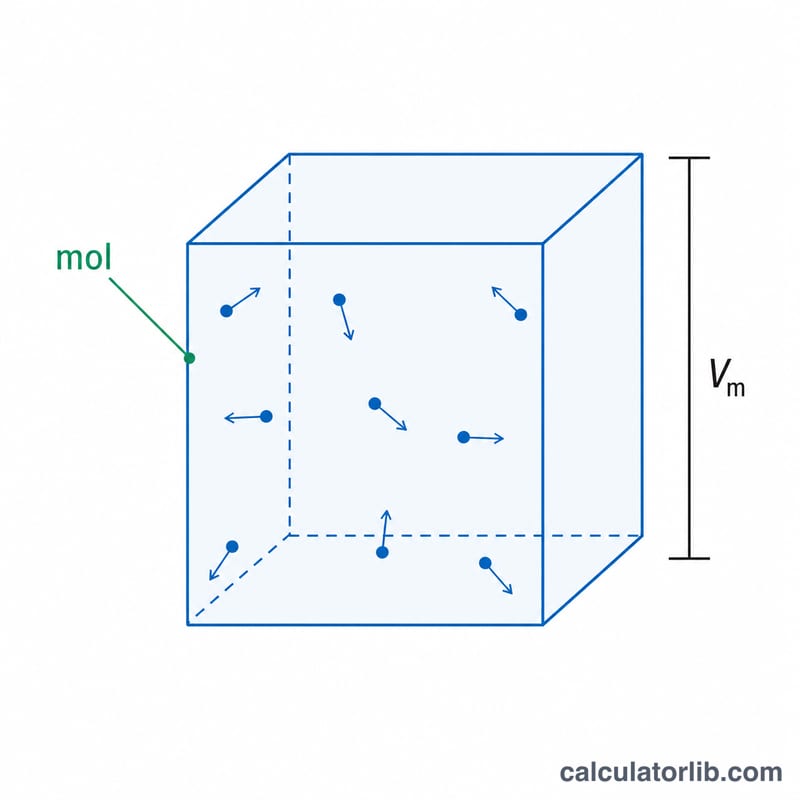
The molar volume of a gas is the volume occupied by exactly one mole of that gas under specified conditions of temperature and pressure. For an ideal gas it follows directly from the ideal gas law, \(PV = nRT\), with \(n\) set to 1 mole. This calculator works for any gas treated as ideal and applies universally — it is not country-specific.
How to use it
Enter the absolute temperature in kelvin (K) and the pressure in kilopascals (kPa). The calculator returns the molar volume in liters per mole (L/mol) and also in cubic meters per mole. Defaults are set to 273.15 K and 101.325 kPa, which is the classic "1 atm" definition of STP and yields the familiar 22.414 L/mol.
The formula explained
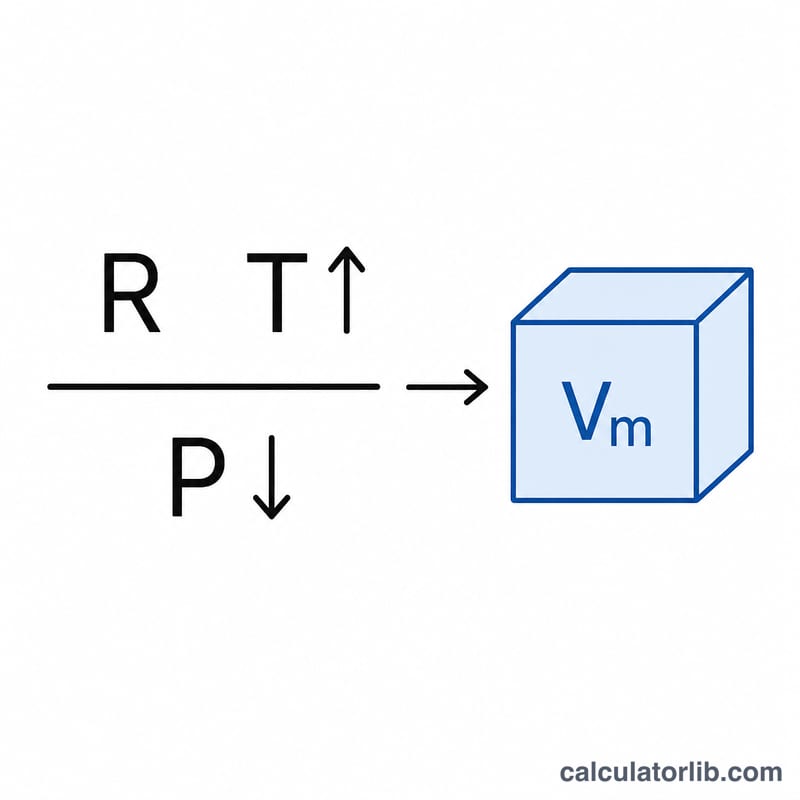
Starting from \(PV = nRT\) and dividing through by \(n\) and \(P\) gives the molar volume $$V_m = \frac{R \cdot \text{Temperature (K)}}{\text{Pressure (kPa)}}$$ To keep units clean we use the gas constant \(R = 8.314462618\ \text{L}\cdot\text{kPa}/(\text{mol}\cdot\text{K})\). With temperature in K and pressure in kPa, the result comes out directly in L/mol. Note that "STP" has more than one definition: IUPAC's modern STP uses 100 kPa (giving \(\approx 22.711\) L/mol), while the older convention uses 1 atm = 101.325 kPa (giving \(\approx 22.414\) L/mol).
Worked example
At \(T = 273.15\) K and \(P = 101.325\) kPa: $$V_m = \frac{8.314462618 \times 273.15}{101.325} = \frac{2271.098\ldots}{101.325} \approx 22.414\ \text{L/mol}$$ This is the value memorized by most chemistry students for a gas at STP.
FAQ
Why is my answer slightly different from 22.4? The exact value depends on which STP definition and gas constant you use. IUPAC's 100 kPa standard gives about 22.711 L/mol, not 22.4.
Does this work for real gases? It assumes ideal-gas behavior, which is accurate for most gases near ambient conditions but deviates at high pressure or low temperature.
What units does temperature need? Kelvin. To convert from Celsius, add 273.15.